
Auxerre Cathedral
Auxerre (united with Sens since 1823)·Roman Catholic·France
Auxerre Cathedral, officially Cathédrale Saint-Étienne d'Auxerre, is a Roman Catholic cathedral located in Auxerre, Burgundy, France. Constructed primarily between the 13th and 16th centuries on the site of an 11th-century Romanesque cathedral, it is renowned for its extensive 13th-century stained glass windows and the 11th-century Carolingian frescoes preserved in its crypt. Since 1823, it has served as the seat of a diocese united with that of Sens Cathedral.
Key Facts
- ›Construction of the Gothic cathedral began around 1215, led by Bishop Robert de Seignelay.
- ›The cathedral is a significant example of the Burgundian Gothic architectural style.
- ›Its crypt houses 11th-century Carolingian frescoes, among the oldest art within the structure.
- ›The cathedral boasts a substantial collection of 13th-century stained glass, known for its rich colors.
- ›The north tower, completed in the ornate Flamboyant Gothic style around 1543, is of comparable height to the towers of Notre-Dame de Paris.
- ›The diocese of Auxerre was suppressed in 1821 and united with the diocese of Sens.

Gothic, Burgundian Gothic, Flamboyant Gothic, Renaissance
- 11th-Century Carolingian Frescoes In the Crypt
- Extensive 13th-Century Stained Glass Windows
- Ambulatory In the Crypt
- North Tower In Flamboyant Gothic Style
- Sculptural Program of the West End Portals
- 16th-Century Rose Windows In the Transepts
- Collection of Misericordes
Robert De Seignelay, Henri De Villeneuve, Germain Michel, Guillaume Cornouvaille, Claude-Nicolas Ledoux, SéBastien Slodtz, Dhumier
About Auxerre Cathedral
Auxerre Cathedral, officially known as Cathédrale Saint-Étienne d'Auxerre, is a significant Roman Catholic cathedral situated in the city of Auxerre in the Burgundy region of France. Dedicated to Saint Stephen, its current Gothic structure was primarily built between the 13th and 16th centuries, rising on the foundations of an earlier Romanesque cathedral completed in 1057. The cathedral is particularly celebrated for its exceptional collection of 11th-century Carolingian frescoes found within its crypt, as well as its expansive and artistically significant stained glass windows.
History and Construction
The origins of Christianity in Auxerre date back to the late 3rd century, with the establishment of its first diocese by Saint Germanus of Auxerre. The Romanesque predecessor to the current cathedral was completed in 1057 and featured an immense crypt with a novel ambulatory, allowing pilgrims access to tombs without disrupting services. The construction of the Gothic cathedral commenced around 1215 under Bishop Robert de Seignelay, who made substantial personal contributions to the project. This new cathedral, along with Dijon Cathedral, became a benchmark for the Burgundian Gothic style. While much of the main structure was completed by 1333, work progressed slowly thereafter. The west front construction began in the late 13th century, the south transept was finished by 1358, and the nave vaults were completed in the early 15th century. The north tower, a prominent feature, was built in the ornate Flamboyant Gothic style and finished around 1543. The cathedral suffered damage during the Wars of Religion in 1567 but was largely repaired by 1576. The ornate Gothic choir screen was replaced in 1764 with an iron grill designed by Claude-Nicolas Ledoux.
Architectural Features and Artistry
Auxerre Cathedral is a prime example of Gothic architecture, with distinct Burgundian Gothic elements. The nave features four-part rib vaults, an evolution from the original plan. The choir, built over the Romanesque crypt, exhibits a three-level elevation with large arcades, a narrow triforium, and upper lancet windows beneath rose windows. The junction between the axial chapel and the ambulatory showcases slender columns that enhance the unity and animation of the church's east end.
The crypt contains some of the oldest art in the cathedral, including frescoes depicting scenes from the Apocalypse, commissioned by Bishop Humbaud, and a later fresco of Christ in Majesty. The cathedral's collection of 13th-century stained glass, particularly in the Chapel of Notre-Dame and the ambulatory, is renowned for its vibrant blues and reds. The nave bays feature 15th-century Renaissance-style windows, while the transept rose windows were completed in the 16th century. The west front portals are notable for their extensive and varied narrative sculptural programs. Inside, the choir features a remarkable collection of sculpted misericordes. The north tower, which contains the belfry, is adorned with decorative niches, gables, and slender spires, and its silhouette is enhanced by prolonging buttresses.
Later Developments and Significance
The diocese of Auxerre, established in the 3rd century, played a significant role in ecclesiastical history, with influential councils held there in the 6th and 7th centuries addressing matters of Christian practice and liturgy. The diocese was suppressed in 1821 and subsequently united with the diocese of Sens Cathedral. The cathedral's grand organ was built in the 19th century and significantly rebuilt and modernized in the late 20th century. The four major bells in the tower, cast in the 19th century, produce a harmony in G major. Auxerre Cathedral stands as a vital center of worship and a testament to centuries of architectural and artistic development in France.
Source: Wikipedia ↗
Frequently Asked Questions
When was Auxerre Cathedral built?
The Gothic cathedral was constructed between the 13th and 16th centuries. Construction began around 1215, with significant portions completed by 1233. The west front and nave vaults were finished in the late 14th and early 15th centuries, respectively, with the north tower completed in 1543.
What is significant about the crypt of Auxerre Cathedral?
The crypt contains 11th-century Carolingian frescoes, which are among the oldest art in the cathedral. It also features an early ambulatory, designed to allow pilgrims to circulate around tombs without disturbing services.
What is notable about the stained glass at Auxerre Cathedral?
Auxerre Cathedral possesses an important collection of 13th-century stained glass, particularly in the Chapel of Notre-Dame and the ambulatory. These windows are recognized for their deep, rich blues and reds. The nave bays feature 15th-century Renaissance-style windows, and the transept rose windows date from the 16th century.
What architectural styles are present at Auxerre Cathedral?
The cathedral primarily exhibits the Gothic architectural style, with specific examples of Burgundian Gothic and Flamboyant Gothic. The north tower, in particular, showcases the richly ornamented Flamboyant Gothic style.
What is the history of the diocese of Auxerre?
The first Christian diocese in Auxerre was established at the end of the 3rd century. The diocese was suppressed in 1821 and has since been united with the diocese of Sens Cathedral.
Related Cathedrals

Bourges Cathedral
Bourges Cathedral, officially the Cathedral of Saint Stephen of Bourges, is a masterpiece of High Gothic architecture in Bourges, France. Constructed between 1195 and 1230, it is renowned for its exceptionally unified and grand interior, impressive sculptural portals, and a significant collection of 13th-century stained glass. Its outstanding architectural qualities led to its designation as a UNESCO World Heritage Site in 1992.
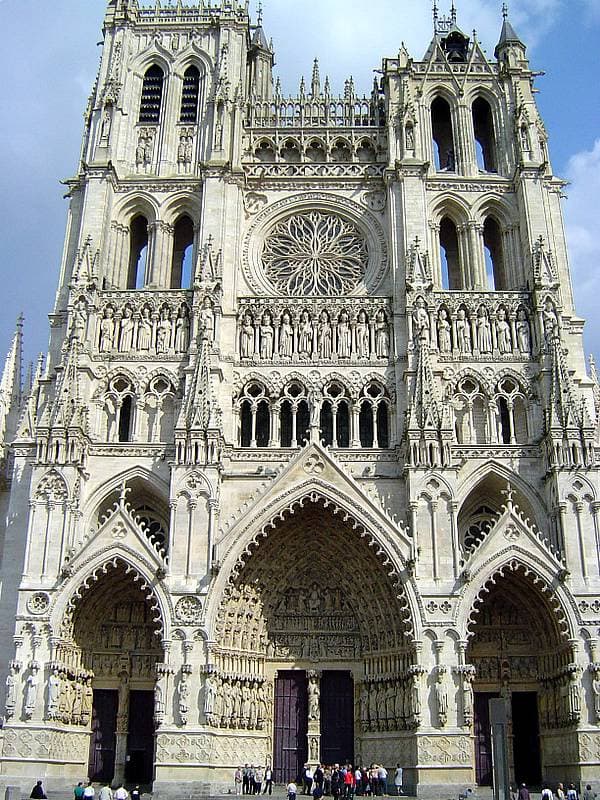
Amiens Cathedral
Amiens Cathedral, officially the Cathedral of Our Lady of Amiens, is a preeminent example of Gothic architecture and a significant religious site in France. It is renowned for its immense scale, being the largest cathedral by volume in France, and for its remarkably unified High Gothic and Rayonnant style, achieved through a swift construction period. The cathedral is also celebrated for its extensive collection of early Gothic sculpture, particularly on its west facade, and holds a UNESCO World Heritage designation.

Angers Cathedral
Angers Cathedral, officially Cathédrale Saint-Maurice d'Angers, is a Catholic cathedral in Angers, France, serving as the seat of the Bishops of Angers. Renowned for its blend of Romanesque and Gothic architectural styles, it also features significant Baroque elements and an exceptional collection of stained-glass windows, some dating back to the late 12th century.