
Bourges Cathedral
Archbishopric of Bourges·Roman Catholic·France
Bourges Cathedral, officially the Cathedral of Saint Stephen of Bourges, is a masterpiece of High Gothic architecture in Bourges, France. Constructed between 1195 and 1230, it is renowned for its exceptionally unified and grand interior, impressive sculptural portals, and a significant collection of 13th-century stained glass. Its outstanding architectural qualities led to its designation as a UNESCO World Heritage Site in 1992.
Key Facts
- ›Construction of the current Gothic cathedral began in 1195 under Archbishop Henri de Sully.
- ›It is characterized by a unified interior space without a transept, featuring double collateral aisles of differing heights.
- ›The cathedral is celebrated for its richly decorated sculptural portals, depicting biblical scenes and lives of saints.
- ›It houses a substantial collection of 13th-century stained glass windows, many of which have been cleaned and protected.
- ›Bourges Cathedral was declared a UNESCO World Heritage Site in 1992.
- ›The Bourges astronomical clock, a technological novelty from 1424, is still functional after repairs.

Unified Interior Space Without A Transept, Double Collateral Aisles of Differing Heights, Sculptural Decoration of Portals, 13th-Century Stained Glass Windows, Bourges Astronomical Clock, Grand Housteau On the West Front, Chapels Built Between Buttresses
About Bourges Cathedral
Bourges Cathedral, officially the Cathedral of Saint Stephen of Bourges (Cathédrale Saint-Étienne de Bourges), stands as a significant example of High Gothic architecture, located in the city of Bourges, France. Dedicated to Saint Stephen, it serves as the seat of the Archbishop of Bourges. The current structure was built predominantly between 1195 and 1230, a period that saw the construction of other iconic Gothic cathedrals like Chartres. Its architectural importance is underscored by its designation as a UNESCO World Heritage Site in 1992, recognizing its exceptional design and historical value.
History and Construction
The site of Bourges Cathedral has a long religious history, with earlier churches dating back to early Christian times and the 6th century. The development of the present Gothic cathedral began under Archbishop Henri de Sully in 1195, with a focus on creating a more ambitious and unified structure than its predecessors. The construction proceeded from the east end (chevet) westward, with major work on the nave completed by around 1235. A notable feature of its construction is the absence of a transept, contributing to a remarkably continuous interior space. The cathedral was complete enough by 1225 to host a council condemning Catharism. Over subsequent centuries, additions and modifications were made, including the construction of chapels in the late Gothic style and the reconstruction of parts of the west front after the collapse of the north tower in 1506.
Architectural Features and Significance
Bourges Cathedral is particularly celebrated for the grand scale and unity of its interior. Unlike many High Gothic cathedrals, it features double collateral aisles that rise in distinct steps, creating a unique visual effect. The sculptural decoration of its five portals on the west front is extensive, depicting scenes from the Last Judgment, the life of Saint Stephen, and Saint Ursinus, the first bishop of Bourges. The cathedral also possesses a remarkable collection of 13th-century stained glass windows, which have undergone cleaning and protective measures in recent times. Another significant feature is the Bourges astronomical clock, installed in 1424, which continues to function. The cathedral's exterior is characterized by its elaborate flying buttresses supporting the upper walls and large windows, and a west front that is grander than many of its contemporaries. The north tower, taller and more elaborately decorated than the unfinished south tower, houses the cathedral's bells.
Source: Wikipedia ↗
Frequently Asked Questions
When was Bourges Cathedral built?
The current Gothic cathedral's construction began in 1195 and was largely completed by 1235, though work on the roof framework and vaults continued until 1259. Subsequent additions and reconstructions occurred over centuries.
What architectural style is Bourges Cathedral?
Bourges Cathedral is primarily built in the High Gothic architectural style. Later additions, such as chapels and parts of the west front, exhibit more ornate late Gothic and Flamboyant Gothic styles.
What makes the interior of Bourges Cathedral unique?
The interior is notable for its immense size and unity, lacking a transept and featuring a continuous, uninterrupted space from the west front to the east end. The elevation of its double collateral aisles in steps also contributes to its distinctive appearance.
Is Bourges Cathedral a UNESCO World Heritage Site?
Yes, Bourges Cathedral was declared a UNESCO World Heritage Site in 1992 due to its quintessential Gothic architecture and its significance in the history of cathedral building.
What is the significance of the sculptural decoration on the portals?
The portals feature extensive sculptural programs, including scenes from the Last Judgment on the central portal, the life of Saint Stephen, and the life of Saint Ursinus. These sculptures offer detailed narrative and theological insights, though some were damaged during historical conflicts.
What is the Bourges astronomical clock?
The Bourges astronomical clock is a complex timepiece installed in the cathedral in 1424. It is a notable technological artifact from the medieval period and remains functional after various repairs and restorations.
Related Cathedrals
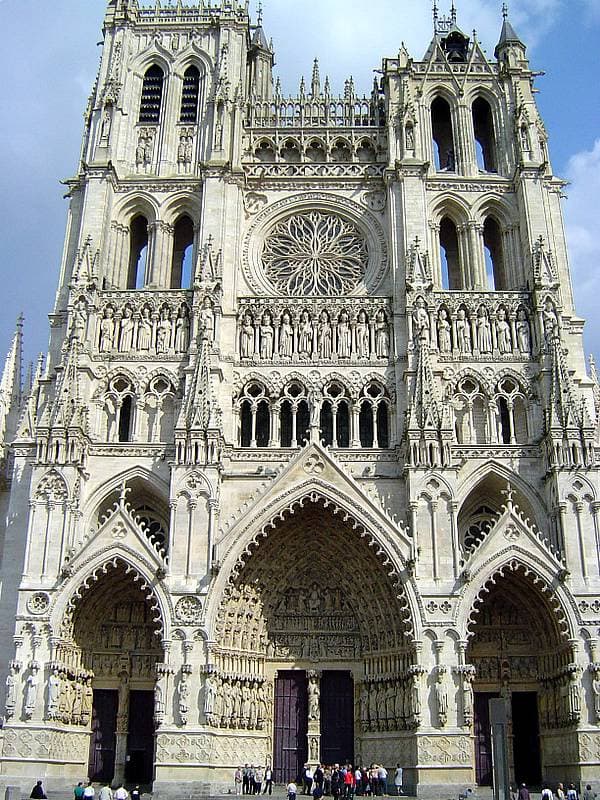
Amiens Cathedral
Amiens Cathedral, officially the Cathedral of Our Lady of Amiens, is a preeminent example of Gothic architecture and a significant religious site in France. It is renowned for its immense scale, being the largest cathedral by volume in France, and for its remarkably unified High Gothic and Rayonnant style, achieved through a swift construction period. The cathedral is also celebrated for its extensive collection of early Gothic sculpture, particularly on its west facade, and holds a UNESCO World Heritage designation.

Auxerre Cathedral
Auxerre Cathedral, officially Cathédrale Saint-Étienne d'Auxerre, is a Roman Catholic cathedral located in Auxerre, Burgundy, France. Constructed primarily between the 13th and 16th centuries on the site of an 11th-century Romanesque cathedral, it is renowned for its extensive 13th-century stained glass windows and the 11th-century Carolingian frescoes preserved in its crypt. Since 1823, it has served as the seat of a diocese united with that of Sens Cathedral.

Bordeaux Cathedral
Bordeaux Cathedral, officially the Primatial Cathedral of St Andrew of Bordeaux, is a Roman Catholic cathedral in Bordeaux, France, serving as the seat of the Archbishop of Bordeaux. It is a significant landmark included in the UNESCO World Heritage Site of the Routes of Santiago de Compostela in France. The cathedral showcases a rich architectural history, evolving from Romanesque to Gothic styles and incorporating Renaissance elements, making it a vital historical and religious site.