
Bordeaux Cathedral
Bordeaux Cathedral, officially the Primatial Cathedral of St Andrew of Bordeaux, is a Roman Catholic cathedral in Bordeaux, France, serving as the seat of the Archbishop of Bordeaux. It is a significant landmark included in the UNESCO World Heritage Site of the Routes of Santiago de Compostela in France. The cathedral showcases a rich architectural history, evolving from Romanesque to Gothic styles and incorporating Renaissance elements, making it a vital historical and religious site.
Key Facts
- ›A church dedicated to Saint Andrew was first mentioned in Bordeaux in 814 AD.
- ›Bordeaux Cathedral was formally consecrated by Pope Urban II in 1096.
- ›The marriage of Eleanor of Aquitaine to Louis VII of France took place here in 1137.
- ›The current Gothic structure was largely developed from the 14th to 15th centuries, with the bell tower completed in 1500.
- ›The cathedral was nationalized and used as a horse feed storage during the French Revolution before being returned to the church in 1798.
- ›In 1998, it was recognized as part of the UNESCO World Heritage Routes of Santiago de Compostela.

Pey-Berland Tower, Royal Portal Sculpture, Gramont Buttress, Marcadé Collection, Misericordes In the Choir, Renaissance Jubé Elements On Organ Tribune
Bertrand Deschamps, Imbert Boachon, Paul Abadie
About Bordeaux Cathedral
Bordeaux Cathedral, officially named the Primatial Cathedral of St Andrew of Bordeaux, is a significant Catholic ecclesiastical building located in the heart of Bordeaux, France. It serves as the principal church of the Archdiocese of Bordeaux and is dedicated to Saint Andrew. Its historical and religious importance is underscored by its inclusion in the UNESCO World Heritage Site of the Routes of Santiago de Compostela in France, designated in 1998.
History and Architecture
The earliest mention of a church dedicated to Saint-André in Bordeaux dates back to 814 AD, during the Carolingian period. This early church was formally consecrated in 1096 by Pope Urban II. Initially, the Romanesque church engaged in a competition for pilgrims with its neighbor, Saint Sevrinus, but Saint-André gradually asserted its prominence, eventually reporting directly to Rome and gaining jurisdiction over several other churches.
A pivotal moment in the cathedral's history occurred in 1137 when the 13-year-old Eleanor of Aquitaine married the future Louis VII of France within its walls. The architectural evolution of the cathedral saw a significant transition from its Romanesque foundations to the French Gothic style beginning in the 13th century. This transformation was a long process, spanning centuries and influenced by the political context of Aquitaine's control by the English, as well as the patronage of Archbishop Bertrand de Goth, who later became Pope Clement V.
The construction of the Gothic cathedral involved numerous phases. The choir was under construction in the early 14th century, with master builder Bertrand Deschamps involved. The Hundred Years' War significantly delayed the construction of the nave, leading to a reduction in its original scale. The separate bell tower, a feature of the Flamboyant Gothic style, was constructed between 1440 and 1500, with its height later modified by storms and reconstruction.
Renaissance decorative elements were introduced in the 16th century, and the structure underwent further modifications and restorations through the 17th, 18th, and 19th centuries. The French Revolution brought considerable damage and desecration, with the cathedral being nationalized and used for secular purposes before its return to the church in 1798. Extensive renovations and reconstructions continued throughout the 19th and 20th centuries, with notable work by architects like Paul Abadie.
Key Features and Significance
Bordeaux Cathedral is characterized by its blend of architectural styles. Key features include the Pey-Berland Tower, a striking example of Flamboyant Gothic architecture, and the Royal Portal, whose 13th-century tympanum sculpture served as a model for Notre Dame de Paris. The Gramont buttress, a massive structure adorned with Renaissance decoration, is another notable exterior element.
Internally, the nave exhibits a complex elevation influenced by the Gothic architecture of western France, featuring rib vaults and lierne vaults. The choir, though narrower and of a different height than the nave, is noted for its consistent Gothic style and its carved misericordes. The cathedral also houses the Marcadé collection, a group of illuminations and other artistic objects donated in 1947.
The cathedral's history is intertwined with major royal events and periods of significant cultural and religious change in France. Its status as a stop on the pilgrimage routes to Santiago de Compostela highlights its long-standing role as a center of religious devotion and a destination for pilgrims.
Source: Wikipedia ↗
Frequently Asked Questions
What is the official name of Bordeaux Cathedral?
The official name of Bordeaux Cathedral is the Primatial Cathedral of St Andrew of Bordeaux (French: Cathédrale-Primatiale Saint-André de Bordeaux).
When was Bordeaux Cathedral first consecrated?
The Romanesque church was formally consecrated by Pope Urban II in 1096. The transformation to the Gothic style occurred over subsequent centuries.
What historical events took place at Bordeaux Cathedral?
Notable events include the marriage of Eleanor of Aquitaine to Louis VII of France in 1137 and the royal wedding of Louis XIII and Anne of Austria in 1615. During the French Revolution, it was nationalized and used as a storage barn.
Is Bordeaux Cathedral a UNESCO World Heritage Site?
Yes, Bordeaux Cathedral is part of the UNESCO World Heritage Site designated as the Routes of Santiago de Compostela in France, recognized in 1998.
What architectural styles can be seen at Bordeaux Cathedral?
The cathedral exhibits a transition from Romanesque foundations to French Gothic architecture. Renaissance decorative elements were also added in the 16th century, and the Pey-Berland tower is in the Flamboyant Gothic style.
Related Cathedrals

Angers Cathedral
Angers Cathedral, officially Cathédrale Saint-Maurice d'Angers, is a Catholic cathedral in Angers, France, serving as the seat of the Bishops of Angers. Renowned for its blend of Romanesque and Gothic architectural styles, it also features significant Baroque elements and an exceptional collection of stained-glass windows, some dating back to the late 12th century.

Amalfi Cathedral
Amalfi Cathedral, officially the Cathedral of Saint Andrew, is a medieval Roman Catholic cathedral located in Amalfi, Italy. It is renowned for its elaborate architecture, a blend of various historical styles, and for housing the relics of the Apostle Saint Andrew. The cathedral has been an important religious center and a significant landmark of the Amalfi Coast for centuries.
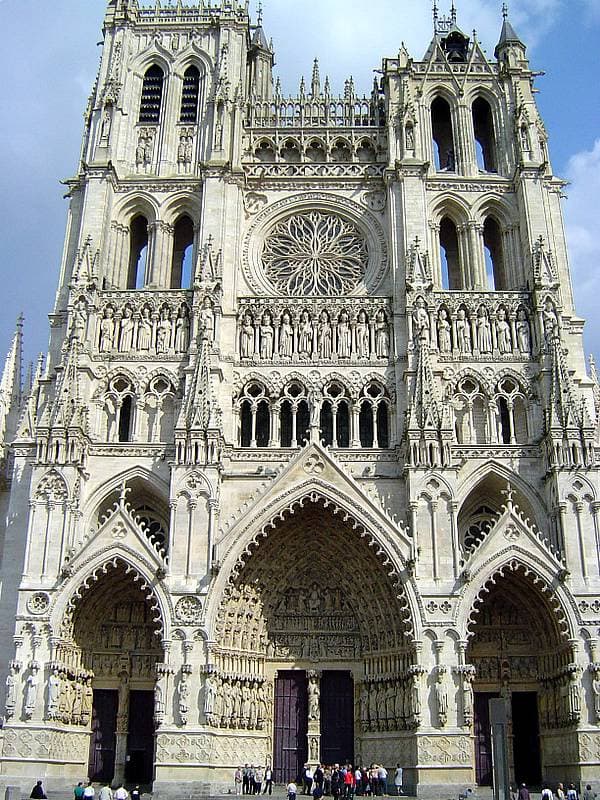
Amiens Cathedral
Amiens Cathedral, officially the Cathedral of Our Lady of Amiens, is a preeminent example of Gothic architecture and a significant religious site in France. It is renowned for its immense scale, being the largest cathedral by volume in France, and for its remarkably unified High Gothic and Rayonnant style, achieved through a swift construction period. The cathedral is also celebrated for its extensive collection of early Gothic sculpture, particularly on its west facade, and holds a UNESCO World Heritage designation.