
Nadapada
Nāropā was an Indian Buddhist Mahasiddha, a highly realized practitioner within the Vajrayana tradition. He is renowned for being a direct disciple of Tilopa and for collating the Six Dharmas, a set of advanced yogic practices crucial for rapid enlightenment. His teachings and lineage are central to the Kagyu school of Tibetan Buddhism.
Key Facts
- ›Nāropā was a Mahasiddha, a realized master in Indian Buddhism.
- ›He was a disciple of Tilopa and associated with Niguma.
- ›He served as a "gatekeeper" of Vikramashila monastery and abbot of Nalanda.
- ›Nāropā is credited with collating the six Dharmas, key Vajrayana practices.
- ›He is considered one of the eighty-four mahasiddhas.
- ›The Naropa University in Colorado is named in his honor.

Important Relationships
- Tilopa
- Niguma
- Marpa Lotsawa
Six Dharmas of Naropa
Nalanda Monastery, Vikramashila Monastery, Phullahari, Pashupatinath Temple
Tilopa
Sanskrit
Ordination
About Nadapada
Nāropā (c. 1016 – 1100 CE)
Nāropā (also known as Nāropāda or Abhayakirti) was a distinguished Indian Buddhist Mahasiddha, a highly realized master within the Vajrayana tradition. His life and teachings are foundational to Tibetan Buddhism, particularly the Kagyu school. He is revered as a direct disciple of the mahasiddha Tilopa and is credited with collating the "Six Dharmas of Naropa," a set of profound yogic practices essential for achieving rapid spiritual realization.
Life and Historical Context
Historical accounts of Nāropā's life are primarily derived from Tibetan hagiographies, which often blend historical events with miraculous narratives. These texts suggest he was born in India, with some sources pinpointing Pataliputra or Bengal, while others indicate a Kashmiri Brahmin background. He initially pursued a secular life, including an arranged marriage, before embarking on a spiritual path. At the age of 28, he entered the renowned Nalanda University, where he excelled in both Sutra and Tantra, becoming known as a brilliant debater and scholar, eventually earning the title "Guardian of the Northern Gate."
His spiritual journey took a pivotal turn upon meeting the mahasiddha Tilopa. Following Tilopa's instructions, Nāropā underwent twelve major and twelve minor hardships, which were understood as veiled teachings on his path to enlightenment. His association with Tilopa and his subsequent rigorous practice led to his full realization of mahāmudrā. He spent twelve years with Tilopa and later resided and taught at Phullahari, where he is believed to have died at the age of 85.
Major Contributions and Legacy
Nāropā's most significant contribution is the codification of the Six Dharmas, a collection of advanced tantric practices that facilitate the attainment of Buddhahood within a single lifetime. These practices, passed down through an unbroken lineage from Tilopa, have been central to the Kagyu tradition and are transmitted to contemporary teachers. He is also recognized for his role as a "gatekeeper" at Vikramashila monastery and as an abbot of Nalanda, demonstrating his standing as a respected monastic leader and scholar.
Nāropā is counted among the eighty-four mahasiddhas, revered figures in Vajrayana Buddhism. His lineage is considered part of the "Golden Garland" of the Kagyu school. His legacy is preserved through his teachings, the practices he compiled, and institutions named in his honor, such as Naropa University in Colorado, USA. While some accounts suggest he was the personal teacher of Marpa Lotsawa, others indicate Marpa received his lineage through intermediary disciples.
Source: Wikipedia ↗
Frequently Asked Questions
When did Nāropā live?
Dates for Nāropā are debated among scholars. Herbert V. Guenther dated him to 1016–1100 CE, while Turrell V. Wylie argued for 956–1040 CE. John Newman supports a death date around 1040 CE, but notes uncertainty regarding his birth year due to differing chronological calculations in Tibetan sources.
Where was Nāropā born?
There are differing accounts regarding Nāropā's birthplace. Some sources identify it with Pataliputra (modern-day Patna) or its surrounding region, Nagara. Other traditions suggest he was born in Bengal or into a Kashmiri Brahmin family.
What is Nāropā famous for?
Nāropā is most famous for collating the Six Dharmas, a set of advanced practices in Vajrayana Buddhism aimed at accelerating the path to Buddhahood. He is also revered as a lineage holder within the Kagyu school and for his devotion to his teacher, Tilopa.
Who were Nāropā's teachers and associates?
Nāropā's primary teacher was Tilopa, from whom he received important lineages. He was also associated with Niguma, who is described as his sister or partner and pupil. He studied at Nalanda and was a gatekeeper at Vikramashila monastery.
What is the meaning of the name Nāropā?
The name Nāropāda, from which Nāropā is derived, combines the nickname "Nāro" meaning "man" or "human being" and "Pāda" meaning "foot" or "step." In Tibetan traditions, he is also identified with Yaśobhadra, "the Great Kashmiri."
What is the historical reliability of Nāropā's biography?
Nāropā's life story is primarily known through Tibetan hagiographies (rnam thar) written centuries after his lifetime. These texts often contain miracle stories and can contradict each other, making it challenging to extract purely historical details. The study of his own writings independent of later interpretations is still developing.
Related Buddhists
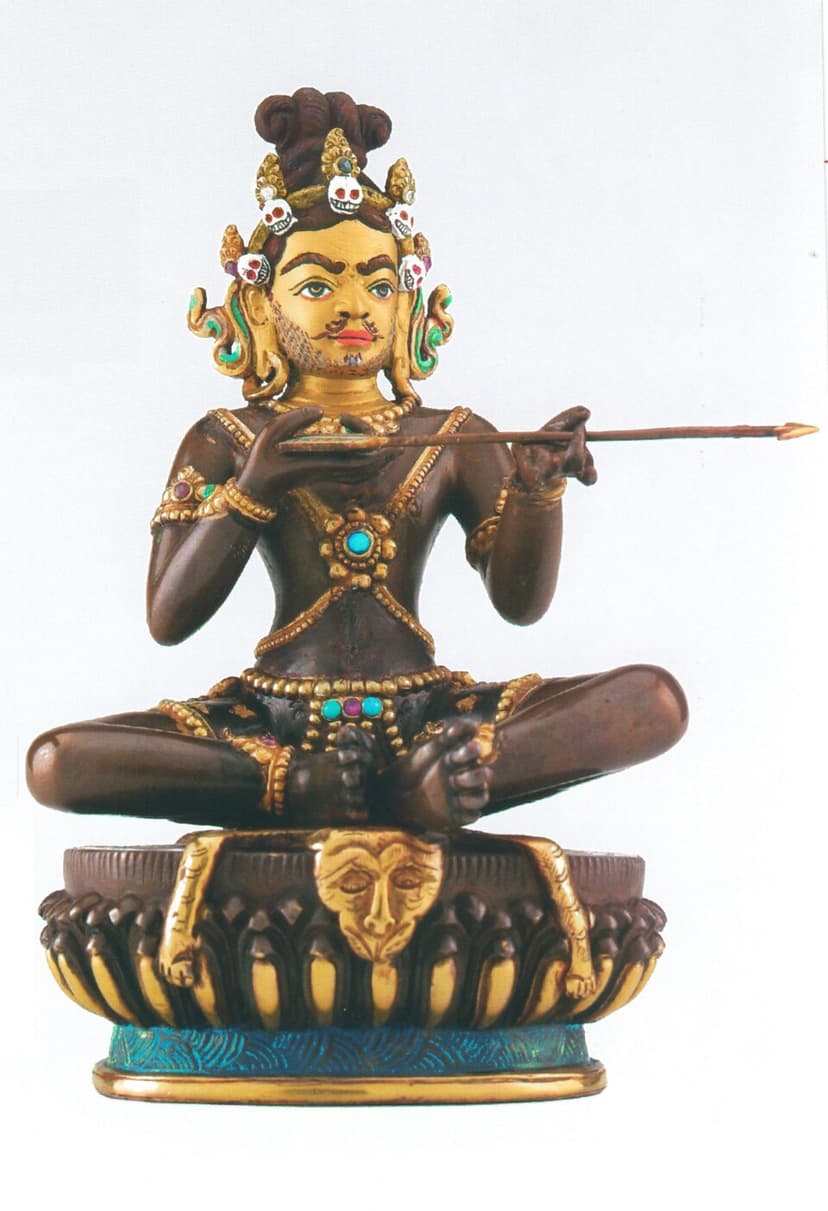
Saraha
Saraha was an 8th-century Indian Buddhist Mahasiddha and poet, considered a founder of Vajrayana Buddhism and the Mahāmudrā tradition. Known as "the one who has shot the arrow," his teachings often used symbolic language, particularly in his doha poetic couplets, caryagiti songs, and vajragiti. He is renowned for his profound realization of Mahamudra, attained through the guidance of two wise female teachers, and his significant literary contributions to Buddhist thought.
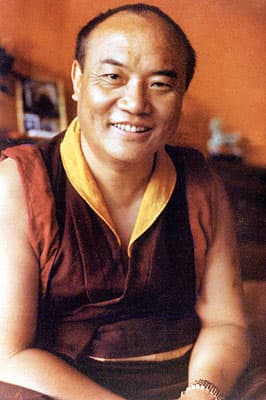
Karmapa
The Karmapa Tulku lineage, established in 1110 CE by the 1st Karmapa, Düsum Khyenpa, is the oldest incarnating lineage of Tibetan Buddhism. The Karmapa, meaning "the one who carries out buddha-activity," is the head of the Karma Kagyu school. The lineage is known for its tulku system, where rebirths are predicted and confirmed, and for the Black Crown, a symbol of spiritual realization.

Padmasambhava
Padmasambhava, also known as Guru Rinpoche, was a semi-legendary Indian tantric Buddhist master who is credited with fully revealing Vajrayana Buddhism in Tibet around the 8th-9th centuries. Revered as an emanation of Shakyamuni Buddha, he played a crucial role in establishing Buddhism in Tibet, including the design of Samye Monastery and the translation of Buddhist scriptures. His life and teachings are central to the Nyingma school and he is widely venerated across the Himalayan regions and beyond.