
Padmasambhava
Padmasambhava, also known as Guru Rinpoche, was a semi-legendary Indian tantric Buddhist master who is credited with fully revealing Vajrayana Buddhism in Tibet around the 8th-9th centuries. Revered as an emanation of Shakyamuni Buddha, he played a crucial role in establishing Buddhism in Tibet, including the design of Samye Monastery and the translation of Buddhist scriptures. His life and teachings are central to the Nyingma school and he is widely venerated across the Himalayan regions and beyond.
Key Facts
- ›Considered a manifestation of Shakyamuni Buddha, foretold by the Buddha himself.
- ›Credited with the full revelation of Vajrayana Buddhism in Tibet around the 8th-9th centuries.
- ›Designed Samye Monastery, the first Buddhist monastery in Tibet, alongside King Trisong Detsen and Khenpo Shantarakshita.
- ›Responsible for initiating the translation of Buddhist teachings and commentaries into Tibetan.
- ›Central figure in the Nyingma school, which traces its Dzogchen lineage to him.
- ›His teachings are transmitted through oral lineages (kama) and hidden treasure texts (termas).

Important Relationships
- King Trisong Detsen
- Khenpo Shantarakshita
- Yeshe Tsogyal
- Mandarava
- King Indrabhuti
- Nubchen Sangye Yeshe
- Nyangral Nyima Özer
- Guru Chöwang
- Orgyen Lingpa
the Garland of Views, A Noble Noose of Methods, the Lotus Garland
Tibet, Nepal, Bhutan, India, Oddiyana, Samye Monastery, Maratika Cave, Pharping, Muktinath, Paro Taktsang, Rewalsar Lake, Bumthang
Shakyamuni Buddha, Garab Dorje, śāNtarakṣIta, Ananda, Amitabha, AmitāYus
Sanskrit, Tibetan
Semi-Legendary Figure, Buddha
About Padmasambhava
Padmasambhava, also known as Guru Rinpoche, is a revered figure in Tibetan Buddhism, widely considered a semi-legendary tantric master from medieval India. Hagiographical sources assert that he was instrumental in fully revealing the Vajrayana tradition in Tibet around the 8th to 9th centuries. He is often regarded as an emanation or Nirmāṇakāya of Shakyamuni Buddha, a role that was purportedly foretold by the Buddha himself.
Historical Context and Contributions
According to early Tibetan accounts, such as the Testament of Ba, Padmasambhava arrived in Tibet during the 8th century. He collaborated with King Trisong Detsen and the Indian abbot Śāntarakṣita to establish Buddhism in the region. A significant achievement attributed to this trio is the design and construction of Samye Monastery, Tibet's first Buddhist monastery. Furthermore, they are responsible for initiating the monumental task of translating all of the Buddha's teachings and their commentaries into the Tibetan language, thereby creating the Tibetan Canon.
While earlier Tibetologists questioned his historical existence, contemporary scholars cautiously accept his historicity. Padmasambhava himself reportedly claimed to be a historical person, and physical marks like footprints in rocks are regarded as supporting evidence. His influence grew significantly from the 12th century onwards, with the proliferation of hagiographies that expanded his profile to include the taming of Tibetan spirits and the concealment of secret texts known as terma.
Teachings and Lineages
In contemporary Tibetan Buddhism, Padmasambhava is venerated as a Buddha. His students are said to include the notable female masters Yeshe Tsogyal and Mandarava. The Nyingma school, one of the oldest traditions of Tibetan Buddhism, considers Padmasambhava a founding figure and traces its Dzogchen lineage back to him.
His teachings are traditionally transmitted through two primary lineages: the oral lineage (kama) and the lineage of hidden treasure texts (termas). These terma texts are believed to be discovered by fortunate individuals, known as tertöns, when the conditions are conducive. Padmasambhava is said to appear to tertöns in visionary encounters, and his form is frequently visualized in guru yoga practices, particularly within the Nyingma school. Padmasambhava is widely venerated by Buddhists across Tibet, Nepal, Bhutan, the Himalayan states of India, and in communities around the world.
Source: Wikipedia ↗
Frequently Asked Questions
Who was Padmasambhava?
Padmasambhava, also known as Guru Rinpoche, was a semi-legendary Indian tantric Buddhist master from the medieval period. He is believed to have played a pivotal role in establishing Vajrayana Buddhism in Tibet during the 8th and 9th centuries.
What is Padmasambhava known for in Tibet?
In Tibet, Padmasambhava is revered for fully revealing Vajrayana Buddhism and for his role in designing Samye Monastery, the first Buddhist monastery in the region. He is also credited with helping to establish the Tibetan Canon of Buddhist texts.
Is Padmasambhava considered a Buddha?
Yes, in modern Tibetan Buddhism, Padmasambhava is considered to be a Buddha, an emanation or Nirmāṇakāya of Shakyamuni Buddha, as foretold by the Buddha himself. He is viewed as a central figure in the transmission of Buddhism to Tibet.
What are Padmasambhava's notable students?
According to traditional hagiographies, Padmasambhava's students included prominent female masters such as Yeshe Tsogyal and Mandarava. Yeshe Tsogyal is widely revered as the 'Mother of Buddhism' in Tibet.
What is the significance of terma texts attributed to Padmasambhava?
Terma, or hidden treasure texts, are believed to have been concealed by Padmasambhava for future discovery by tertöns (treasure finders) when the time is right. Many texts within the Nyingma school are said to originate from Padmasambhava's activities and teachings.
Related Buddhists
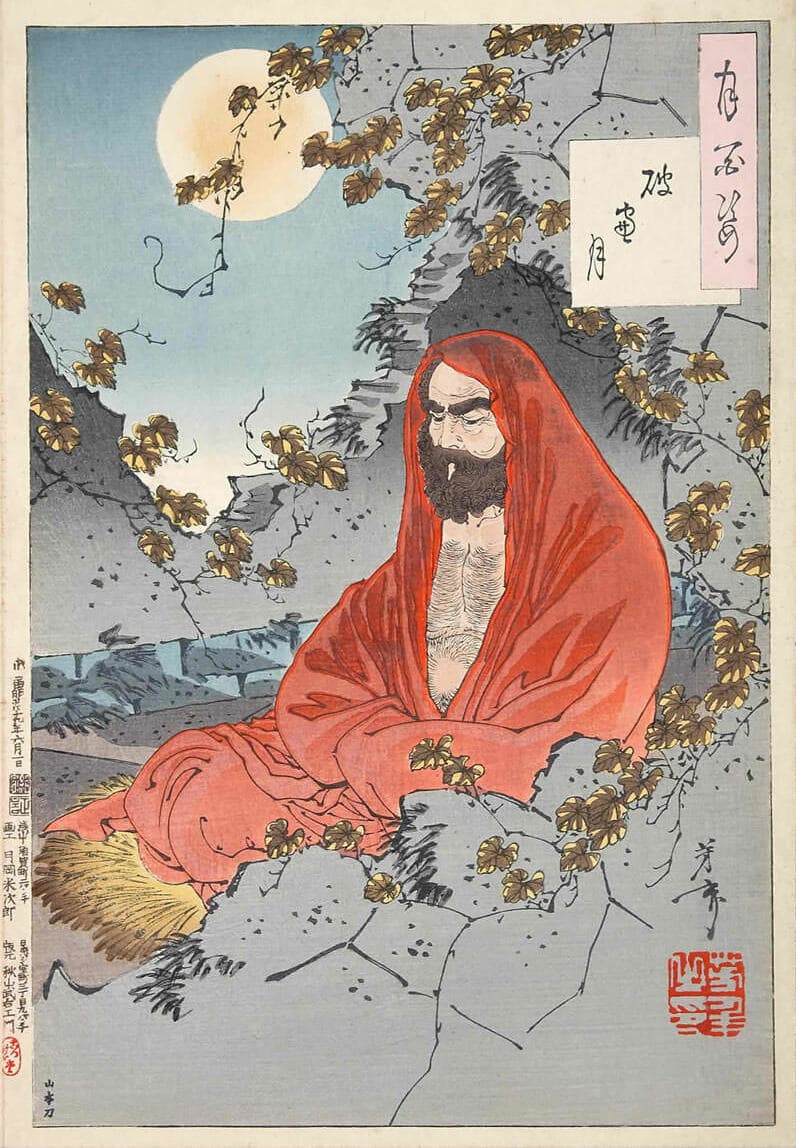
Bodhidharma
Bodhidharma was a semi-legendary Buddhist monk active in the 5th or 6th century CE, traditionally credited as the transmitter of Chan Buddhism to China and its first Chinese patriarch. While biographical details are scarce and often interwoven with legend, he is associated with meditation practices and the Laṅkāvatāra Sūtra. His teachings emphasized direct apprehension of ultimate principles and acceptance of suffering, influencing the development of Zen Buddhism.

Prince Shōtoku
Prince Shōtoku was a semi-legendary regent and politician of Japan's Asuka period, serving under Empress Suiko. He is renowned for modernizing the government and significantly promoting Buddhism in Japan, commissioning temples and authoring Buddhist commentaries. A devotional cult later arose around him, with many Buddhist figures claiming inspiration from his teachings.
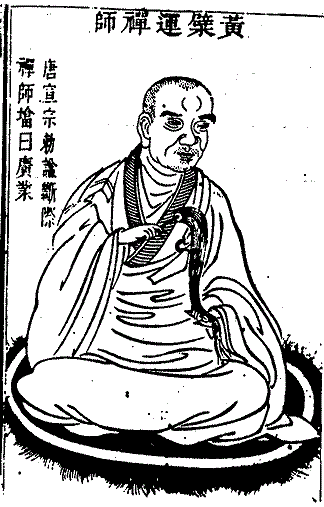
Huangbo Xiyun
Huangbo Xiyun was an influential Chan Buddhist master during the Tang dynasty, known for his teachings on the "One Mind" and the inherent Buddha-nature within all beings. He was a key figure in the Hongzhou school of Chan, a student of Baizhang Huaihai, and the teacher of Linji Yixuan, who founded the Rinzai school of Zen. His teachings emphasized direct experience and the rejection of dualistic thinking, famously encapsulated in the phrase "mind is the Buddha."