
Prince Shōtoku
Prince Shōtoku was a semi-legendary regent and politician of Japan's Asuka period, serving under Empress Suiko. He is renowned for modernizing the government and significantly promoting Buddhism in Japan, commissioning temples and authoring Buddhist commentaries. A devotional cult later arose around him, with many Buddhist figures claiming inspiration from his teachings.
Key Facts
- ›Served as regent under Empress Suiko from 593.
- ›Established the twelve Level Cap and Rank System in 603.
- ›Credited with promulgating the seventeen-article constitution.
- ›Traditionally attributed authorship of the Sangyō Gisho, commentaries on three major sutras.
- ›Commissioned the construction of Shitennō-ji temple after a victory over the Mononobe clan.
- ›His letter to the Emperor of Sui contained the earliest known reference to Japan as the 'land of the rising sun'.

Important Relationships
- Empress Suiko
- Emperor Yōmei
- Princess Hashihito no Anahobe
- Soga clan
- Mononobe clan
- Emperor Yang of Sui
- Bodhidharma
Sangyō Gisho, Hokke Gisho
Settsu Province, Yamato Province, Kansai Region, Shinaga In Kawachi Province
Buddha
Classical Japanese
Regent, Politician, Commentator, Founder
Semi-Legendary Figure, Deified Figure
About Prince Shōtoku
Prince Shōtoku (574–622 CE) was a semi-legendary regent and politician of Japan's Asuka period, who served under Empress Suiko. He is widely recognized for his pivotal role in modernizing the government administration and for his profound influence in promoting Buddhism throughout Japan. Over generations, a devotional cult developed around his figure, seeking his protection for Japan and the Imperial Family, and solidifying his legacy as a key proponent of Buddhist traditions in the nation.
Biography and Accomplishments
According to tradition, Prince Shōtoku was appointed regent in 593 CE. Inspired by Buddhist teachings, he is credited with establishing a centralized government and promulgated the "seventeen-article constitution." In 603, he instituted the Twelve Level Cap and Rank System at the imperial court, a significant reform in governmental structure.
Prince Shōtoku was a devout Buddhist and is traditionally attributed with authoring the Sangyō Gisho, or "Annotated Commentaries on the Three Sutras," which include the Lotus Sutra, the Vimalakirti Sutra, and the Śrīmālādevī Siṃhanāda Sūtra. The Hokke Gisho, the first of these commentaries, is dated to 615 CE, making Prince Shōtoku potentially the first known Japanese writer.
In the late 6th century, he led a national project to promote Buddhism, commissioning the construction of Shitennō-ji temple in Settsu Province (present-day Osaka) following a military victory. His name is also closely associated with Hōryū-ji temple in Yamato Province and numerous other temples in the Kansai region. Despite his deep involvement with Buddhism, he is also said to have held respect for Shinto, visiting shrines alongside temples.
Prince Shōtoku's diplomatic correspondence is also notable. His letter to Emperor Yang of Sui contained the earliest known written reference to the Japanese archipelago as the "land of the rising sun" (hi izuru tokoro). This communication, sent in 607 CE, was part of an exchange that asserted Japan's distinct identity on the international stage.
Legends and Legacy
Legends surround Prince Shōtoku, including claims of his birth in front of a stable door and an encounter with Bodhidharma. His birth name was Prince Umayado, meaning 'prince of the stable door.' He was also known by other names, including Toyosatomimi and Kamitsumiya. He was granted the Sanskrit Dharma name Bhavyaśīla by Bodhidharma, according to legend.
His legacy is further cemented by the continued veneration of his figure, with later religious leaders claiming inspiration from him. Several institutions and educational facilities bear his name, and his portrait has famously appeared on Japanese currency, underscoring his enduring cultural significance.
Source: Wikipedia ↗
Frequently Asked Questions
What is Prince Shōtoku known for?
Prince Shōtoku is primarily known for his role in modernizing Japan's government administration and for his significant efforts in promoting Buddhism throughout the country. He is also credited with establishing important governmental systems and authoring influential Buddhist commentaries.
When did Prince Shōtoku live?
Prince Shōtoku lived from February 7, 574, to April 8, 622. He served as regent during Japan's Asuka period.
What were Prince Shōtoku's major contributions to Buddhism in Japan?
He commissioned the construction of important Buddhist temples like Shitennō-ji and Hōryū-ji, and is traditionally credited with writing commentaries on key sutras, considered the first Japanese texts. His influence led to the establishment of a devotional cult dedicated to his protection and teachings.
What is the significance of Prince Shōtoku's correspondence with the Emperor of Sui?
His correspondence is significant because his letter to the Emperor of Sui contained the earliest known written instance referring to the Japanese archipelago as the 'land of the rising sun'. This marked an important diplomatic and cultural assertion of Japan's identity.
What is the 'seventeen-article constitution' attributed to Prince Shōtoku?
The seventeen-article constitution is a document traditionally credited to Prince Shōtoku, which outlined moral and political principles for the Japanese government. It is considered a foundational text for Japanese governance and ethics.
Related Buddhists
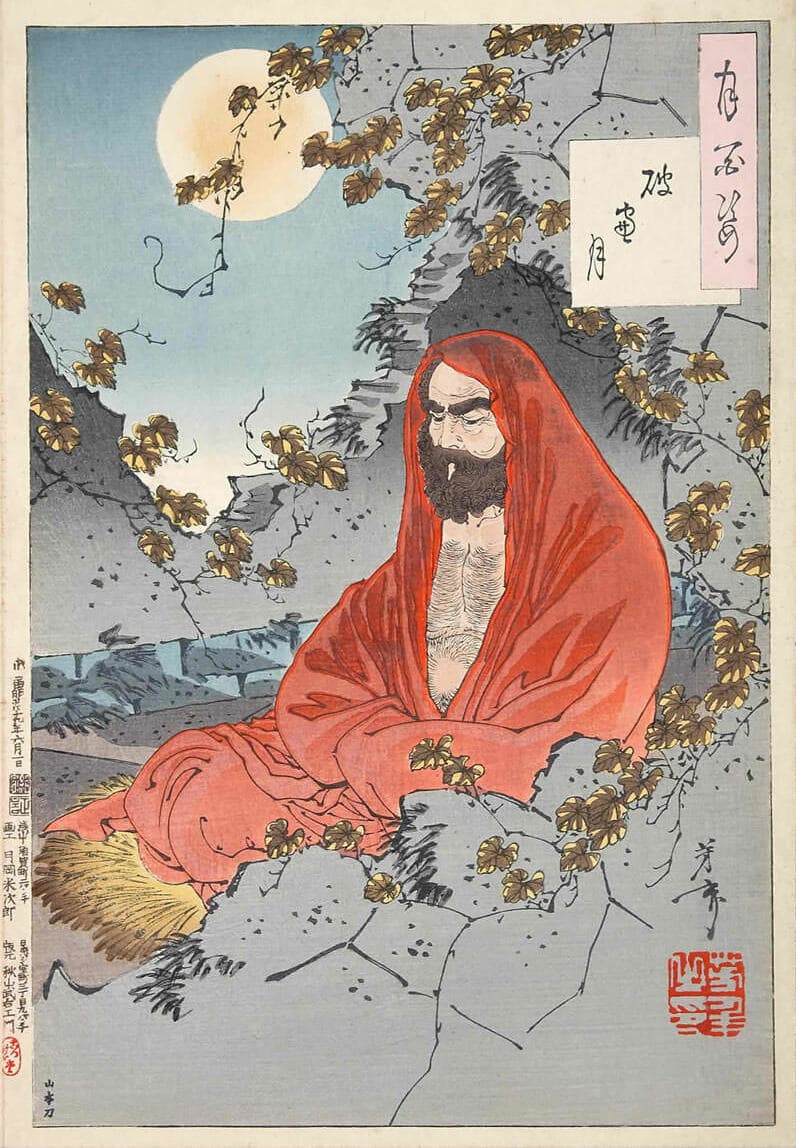
Bodhidharma
Bodhidharma was a semi-legendary Buddhist monk active in the 5th or 6th century CE, traditionally credited as the transmitter of Chan Buddhism to China and its first Chinese patriarch. While biographical details are scarce and often interwoven with legend, he is associated with meditation practices and the Laṅkāvatāra Sūtra. His teachings emphasized direct apprehension of ultimate principles and acceptance of suffering, influencing the development of Zen Buddhism.

Padmasambhava
Padmasambhava, also known as Guru Rinpoche, was a semi-legendary Indian tantric Buddhist master who is credited with fully revealing Vajrayana Buddhism in Tibet around the 8th-9th centuries. Revered as an emanation of Shakyamuni Buddha, he played a crucial role in establishing Buddhism in Tibet, including the design of Samye Monastery and the translation of Buddhist scriptures. His life and teachings are central to the Nyingma school and he is widely venerated across the Himalayan regions and beyond.
Buddhaghosa
Buddhaghosa was a 5th-century Indian Theravādin Buddhist commentator, translator, and philosopher, renowned for his comprehensive synthesis of older Sinhala commentaries. His seminal work, the Visuddhimagga, has been the principal text on meditation and has shaped the orthodox understanding of Theravādin scriptures for centuries. He is widely recognized as the most significant philosopher and commentator of the Theravāda school.