
Bodhidharma
Bodhidharma was a semi-legendary Buddhist monk active in the 5th or 6th century CE, traditionally credited as the transmitter of Chan Buddhism to China and its first Chinese patriarch. While biographical details are scarce and often interwoven with legend, he is associated with meditation practices and the Laṅkāvatāra Sūtra. His teachings emphasized direct apprehension of ultimate principles and acceptance of suffering, influencing the development of Zen Buddhism.
Key Facts
- ›Traditionally considered the first Chinese patriarch of Chan Buddhism.
- ›Associated with the practice of meditation and the Laṅkāvatāra Sūtra.
- ›Teachings emphasized two entrances: direct apprehension of ultimate principle and four practices.
- ›Popularly, though less historically, linked to the founding of Shaolin kung fu.
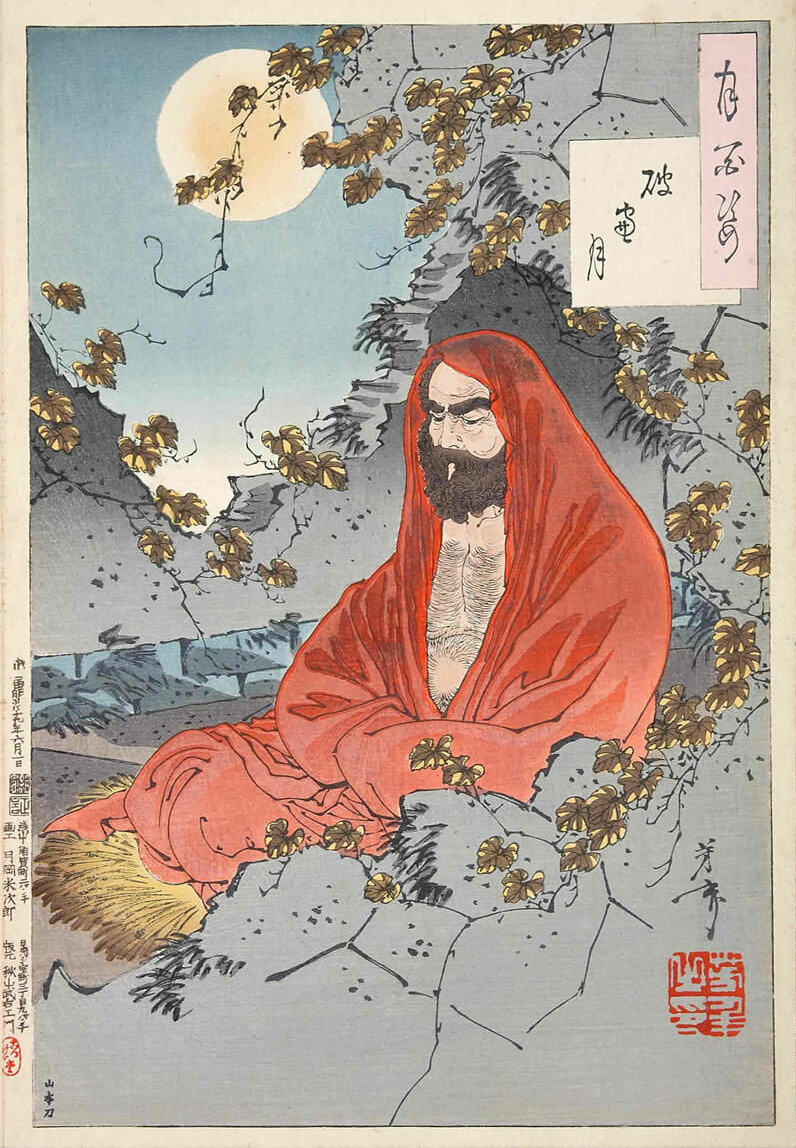
- ›Depicted in art as a non-Chinese, ILL-tempered, bearded figure with a large nose.
- ›His name, Bodhidharma, means 'dharma of awakening' in Sanskrit.
Important Relationships
- Dazu Huike
- Emperor Wu of Liang
- Prajnatara
Two Entrances and Four Practices
Shaolin Monastery, Luoyang, Mount Song
Gautama Buddha, LaṅKāVatāRa SūTra
Sanskrit, Chinese
Monk Vows
About Bodhidharma
Bodhidharma (c. 5th-6th Century CE)
Bodhidharma is a semi-legendary Buddhist monk traditionally credited with transmitting Chan Buddhism to China, where he is revered as its first patriarch. His historical existence is supported by limited contemporary evidence, with later accounts often embellished with legend. He is also popularly, though anachronistically, associated with the founding of Shaolin kung fu.
Life and Historical Context
Bodhidharma is believed to have lived during the 5th or 6th century CE. Contemporary biographical information is scarce, leading to differing accounts of his origins. He is described in principal Chinese sources as either a "Persian Central Asian" or a "South Indian," the third son of a great Indian king. Popular traditions also place his origins in South India or, conversely, consider him a Persian. The exact date of his arrival in China is also debated, with early accounts suggesting the Liu Song dynasty (420–479 CE) and later accounts dating it to the Liang dynasty (502–557 CE). He was primarily active in the territory of the Northern Wei (386–534 CE).
Teachings and Practice
Bodhidharma's teachings and practices are primarily understood through the "Two Entrances and Four Practices," considered the only extant work reliably attributed to him. His philosophy centers on meditation and the Laṅkāvatāra Sūtra. The "two entrances" refer to a direct apprehension of ultimate reality and four practices: accepting suffering as karma, maintaining equanimity, relinquishing craving, and abandoning wrong thoughts. A notable practice associated with Bodhidharma is "wall-gazing," interpreted as a method of "quieting the mind" and a form of seated meditation.
Legacy
Bodhidharma's influence on Chan Buddhism is significant, establishing a lineage that would profoundly shape East Asian Buddhist thought and practice. Legends surrounding him, such as the "nine years of wall-gazing" and the origin of tea, continue to be part of the Chan, Seon, and Zen traditions. While the martial arts connection is a later development, his role as a spiritual transmitter and foundational figure in Chinese Buddhism remains central to his legacy.
Source: Wikipedia ↗
Frequently Asked Questions
Who was Bodhidharma?
Bodhidharma was a semi-legendary Buddhist monk who lived in the 5th or 6th century CE. He is traditionally recognized as the person who brought Chan Buddhism to China and is considered its first Chinese patriarch.
What is Bodhidharma known for teaching?
Bodhidharma's teachings focused on meditation and the Laṅkāvatāra Sūtra. He taught two "entrances" to the Dharma: one of direct apprehension of ultimate principle, and another involving four practices of acceptance and equanimity.
What is the origin of Bodhidharma's name?
Bodhidharma's name means 'dharma of awakening' in Sanskrit. In Chinese, it was often shortened to Dharma, or Ta-mo. The Japanese form, Daruma, is the origin of the well-known daruma dolls.
Where did Bodhidharma come from?
Historical accounts are varied, with principal Chinese sources describing him as coming from the 'Western Regions,' which could refer to Central Asia or the Indian subcontinent. He is described as either 'Persian Central Asian' or a 'South Indian,' the third son of a great Indian king.
What is Bodhidharma's connection to Shaolin kung fu?
Bodhidharma is popularly regarded as the founder of Shaolin kung fu. However, this idea is largely a 20th-century popularization based on the 17th-century Yijin Jing and Daoist associations with his name.
What is 'wall-gazing' in relation to Bodhidharma?
'Wall-gazing' (bìguān) is a practice attributed to Bodhidharma, associated with quieting the mind. While its exact nature remains uncertain, it is often interpreted as a form of meditation, possibly akin to later zazen.
Related Buddhists

Padmasambhava
Padmasambhava, also known as Guru Rinpoche, was a semi-legendary Indian tantric Buddhist master who is credited with fully revealing Vajrayana Buddhism in Tibet around the 8th-9th centuries. Revered as an emanation of Shakyamuni Buddha, he played a crucial role in establishing Buddhism in Tibet, including the design of Samye Monastery and the translation of Buddhist scriptures. His life and teachings are central to the Nyingma school and he is widely venerated across the Himalayan regions and beyond.

Prince Shōtoku
Prince Shōtoku was a semi-legendary regent and politician of Japan's Asuka period, serving under Empress Suiko. He is renowned for modernizing the government and significantly promoting Buddhism in Japan, commissioning temples and authoring Buddhist commentaries. A devotional cult later arose around him, with many Buddhist figures claiming inspiration from his teachings.

Dazu Huike
Dazu Huike was the Second Patriarch of Chan Buddhism, succeeding Bodhidharma. He is credited with developing the "sudden awakening" approach to enlightenment and emphasizing meditation as the primary practice. His teachings, possibly based on the Lankavatara Sutra, stressed the realization of innate Buddha-nature.