
Buddhapālita
Buddhapālita was an influential Indian Mahayana Buddhist commentator active in the 5th-6th centuries CE, primarily known for his commentary on Nagarjuna's Mūlamadhyamakakarikā. His work, the Mūlamadhyama-vṛtti, utilized the reductio ad absurdum method to explain Nagarjuna's philosophy, a methodological approach that later became a defining characteristic of the Prasaṅgika school of Madhyamaka philosophy in Tibetan scholasticism. While little is known about his life, his philosophical method significantly shaped later debates and interpretations within Mahayana Buddhism.
Key Facts
- ›Indian Mahayana Buddhist commentator from the 5th-6th centuries CE.
- ›Authored the influential Mūlamadhyama-Vṛtti, a commentary on Nagarjuna's Mūlamadhyamakakarikā.
- ›His primary philosophical method was the prasaṅgavākya (reductio AD absurdum).
- ›His approach was criticized by Bhāviveka and defended by Candrakīrti.
- ›His method became foundational for the Prasaṅgika school in Tibetan Buddhism.
- ›His surviving commentary is only known through Tibetan translation.
Important Relationships
MūLamadhyama-VṛTti
South India
Nagarjuna, Aryadeva
Sanskrit, Tibetan
About Buddhapālita
Buddhapālita was an influential Indian Mahayana Buddhist commentator and philosopher, active in the 5th to 6th centuries CE. His primary contribution to Buddhist thought was his commentary on Nagarjuna's foundational text, the Mūlamadhyamakakarikā. This work, known as the Mūlamadhyama-vṛtti, is significant for its rigorous application of the prasaṅgavākya, or reductio ad absurdum, method. This philosophical approach involves demonstrating the logical inconsistencies of an opponent's views by revealing their unintended consequences, without the need to establish an independent counter-thesis.
Life and Historical Context
Little is definitively known about the specific details of Buddhapālita's life. Some historical accounts suggest he may have been born in South India. His philosophical approach is understood as a conservative current within Madhyamaka thought, resisting the logico-epistemological innovations being introduced by other contemporary thinkers. Buddhapālita's method is seen as in keeping with the spirit of Nagarjuna's own writings.
Major Contributions
Buddhapālita's sole surviving work is his commentary on Nagarjuna's Mūlamadhyamakakarikā. This extensive commentary, which survives only in Tibetan translation, comprises 27 chapters. It is noted for its close relationship with an even earlier commentary, the Akutobhayā, from which it appears to have drawn about a third of its content. Buddhapālita also occasionally quotes Aryadeva in his work.
Philosophical Debate and Legacy
Buddhapālita's commentarial method drew criticism from his contemporary, Bhāviveka, who argued for the necessity of using independent logical inferences (svatantranumana) in philosophical arguments. A later commentator, Candrakīrti, however, wrote his influential Prasannapadā commentary on the Mūlamadhyamakakarikā based on Buddhapālita's work, defending his method and refuting Bhāviveka's criticisms. This debate led Tibetan scholars, from the 11th century onwards, to categorize Buddhapālita and Candrakīrti as representatives of the Prasaṅgika school, distinct from Bhāviveka's Svātantrika school. However, these specific classifications are not found in Indian Sanskrit sources and were developed later in Tibetan scholasticism.
Source: Wikipedia ↗
Frequently Asked Questions
Who was Buddhapālita?
Buddhapālita was an Indian Mahayana Buddhist commentator who lived and worked during the 5th-6th centuries CE. He is best known for his insightful commentary on Nagarjuna's foundational text, the Mūlamadhyamakakarikā.
What is Buddhapālita's most important work?
Buddhapālita's most significant and surviving work is the Mūlamadhyama-vṛtti. This text is a detailed commentary on Nagarjuna's Mūlamadhyamakakarikā and is crucial for understanding the Madhyamaka philosophical tradition.
What philosophical method did Buddhapālita use?
Buddhapālita primarily employed the prasaṅgavākya, or reductio ad absurdum, method in his philosophical explanations. This involves demonstrating the undesirable consequences of an opponent's thesis without necessarily asserting one's own thesis.
How did Buddhapālita's work influence later Buddhist thought?
Buddhapālita's method of commentary was later defended by Candrakīrti and became a defining characteristic of the Prasaṅgika school of Madhyamaka philosophy, particularly in Tibetan scholasticism. This methodological approach significantly shaped the development of Mahayana philosophical discourse.
What is known about Buddhapālita's life?
Very little is known about Buddhapālita's personal life. Some sources suggest he may have been born in South India, but detailed biographical information is scarce.
Does Buddhapālita's commentary exist in the original Sanskrit?
No, Buddhapālita's Mūlamadhyama-vṛtti does not survive in its original Sanskrit. The only known version is a Tibetan translation, which was completed in the early 9th century.
Related Buddhists
Bodhiruci
Bodhiruci was a Buddhist monk from North India who was active in 6th-century Luoyang, China. He is renowned for his extensive translations of important Mahayana Buddhist texts into Chinese, significantly contributing to the transmission of Buddhist philosophy to East Asia. Bodhiruci is considered the patriarch of the Dashabhumika school, a tradition that formed around his translation of the Ten Stages Sutra and Vasubandhu's commentary.
Christmas Humphreys
Travers Christmas Humphreys was a prominent British jurist and the best-known British convert to Mahayana Buddhism in his time. He founded the influential London Buddhist Society in 1924, which played a significant role in the growth of Buddhism in Britain. Humphreys also authored numerous works on Buddhist philosophy and was a judge at the Old Bailey, known for prosecuting controversial cases.
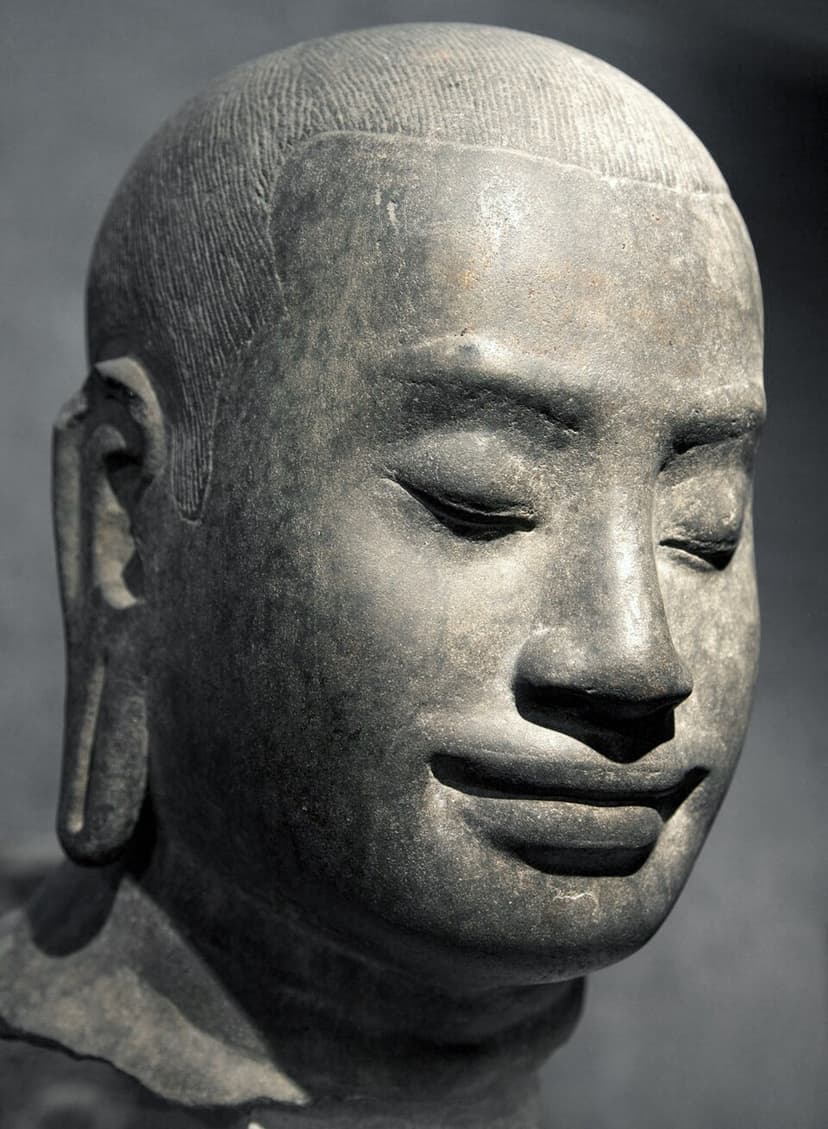
Jayavarman VII
Jayavarman VII was the most powerful monarch of the Khmer Empire, reigning from 1181 to around 1218. As the first Khmer king devoted to Mahayana Buddhism, he initiated a welfare state and commissioned extensive public works, including hospitals and temples, aimed at alleviating human suffering. His reign is marked by monumental construction projects, most notably the Bayon temple and the city of Angkor Thom, and significant military achievements, including the conquest of Champa.