
Christmas Humphreys
Travers Christmas Humphreys was a prominent British jurist and the best-known British convert to Mahayana Buddhism in his time. He founded the influential London Buddhist Society in 1924, which played a significant role in the growth of Buddhism in Britain. Humphreys also authored numerous works on Buddhist philosophy and was a judge at the Old Bailey, known for prosecuting controversial cases.
Key Facts
- ›Founded the London Buddhist Society in 1924, which became a seminal influence on Buddhism in Britain.
- ›Authored numerous books on Mahayana Buddhism and was considered a leading British convert.
- ›Served as a judge at the Old Bailey, prosecuting high-profile cases in the MID-20th century.
- ›His former home in St John's Wood, London, is now a Buddhist temple.
- ›Advocated for the Oxfordian theory of Shakespeare authorship.
- ›Published his autobiography, 'both Sides of the Circle', in 1978.
Important Relationships
- London Buddhist Society
- Theosophical Society
- Inner Temple
- Central Criminal Court
- Meher Baba
- Daisetz Taitaro Suzuki
Both Sides of the Circle, Karma and Rebirth, the Wisdom of Buddhism, Zen: A Way of Life
London, Old Bailey, St John's Wood
J.R. Pain, Charles Henry Allan Bennett, Francis Payne, Annie Besant, George S. Arundale
English
About Christmas Humphreys
Christmas Humphreys (1901–1983)
Travers Christmas Humphreys, QC, was a distinguished British jurist and a prominent figure in the introduction and popularization of Mahayana Buddhism in the United Kingdom. Born in Ealing, Middlesex, he was the son of Travers Humphreys, a noted barrister and judge. Humphreys' early life was marked by a profound reflection on beliefs following the death of his elder brother in World War I, leading him to Buddhism at the age of seventeen.
Legal Career and Public Life
Humphreys pursued a successful legal career, being called to the bar by the Inner Temple in 1924. He served as Junior Treasury Counsel at the Central Criminal Court and later as Senior Treasury Counsel, prosecuting several of the era's most controversial cases, including those involving Timothy Evans, Craig & Bentley, and Ruth Ellis. These cases played a part in the national debate that eventually led to the abolition of capital punishment in the United Kingdom. He also served as a judge at the Old Bailey from 1962 until his retirement in 1976, though he courted controversy with some of his judicial pronouncements later in his career.
Buddhism and Theosophy
In parallel with his legal profession, Humphreys was deeply involved in Buddhist studies and practice. He founded the London Buddhist Lodge in 1924, which evolved into the Buddhist Society, an organization that became central to the growth of Buddhism in Britain and remains one of the oldest Buddhist organizations outside Asia with Western founders. His interest in Eastern thought was influenced by Theosophy, and he corresponded with key figures of the Theosophical Society. Humphreys drafted the Twelve Principles of Buddhism, which received approval from various Buddhist sects and leaders globally. He was also an advocate for the Oxfordian theory of Shakespeare authorship and was involved in arts organizations such as the Ballet Guild and the Tibet Society.
Literary Contributions and Legacy
Humphreys was a prolific author, writing extensively on Mahayana Buddhism, Zen, and related philosophical topics. His notable works include "The Wisdom of Buddhism," "A Popular History of Buddhism," and his autobiography, "Both Sides of the Circle." He also edited works by D. T. Suzuki. In his time, he was recognized as the best-known British convert to Buddhism, and his former home in St John's Wood, London, now serves as a Buddhist temple, testament to his enduring influence on the Buddhist landscape in the UK.
Source: Wikipedia ↗
Frequently Asked Questions
What was Christmas Humphreys' role in the development of Buddhism in the UK?
Christmas Humphreys was instrumental in the growth of Buddhism in Britain. He founded the London Buddhist Society in 1924, which became a central hub for Buddhist practice and study in the UK and remains one of the oldest Buddhist organizations outside of Asia with Western founders.
What was Christmas Humphreys' legal career like?
Humphreys had a distinguished legal career, starting as a defense barrister before being appointed Junior Treasury Counsel and later Senior Treasury Counsel at the Old Bailey. He prosecuted several notable and controversial cases, including those of Timothy Evans, Ruth Ellis, and Klaus Fuchs, which significantly influenced legal discourse in the UK.
What are some of Christmas Humphreys' notable written works?
Humphreys was a prolific author on Buddhist subjects. His published works include 'Karma and Rebirth', 'The Wisdom of Buddhism', and 'Zen: A Way of Life'. He also edited and contributed to several collections of Buddhist texts and poetry.
Did Christmas Humphreys have any involvement with other spiritual or philosophical movements?
Yes, Humphreys was initially drawn to Theosophy and was influenced by its proponents such as Annie Besant. He also met spiritual teacher Meher Baba and was an advocate for the Oxfordian theory of Shakespeare authorship, even renaming the Shakespeare Fellowship to the Shakespeare Authorship Society.
Related Buddhists
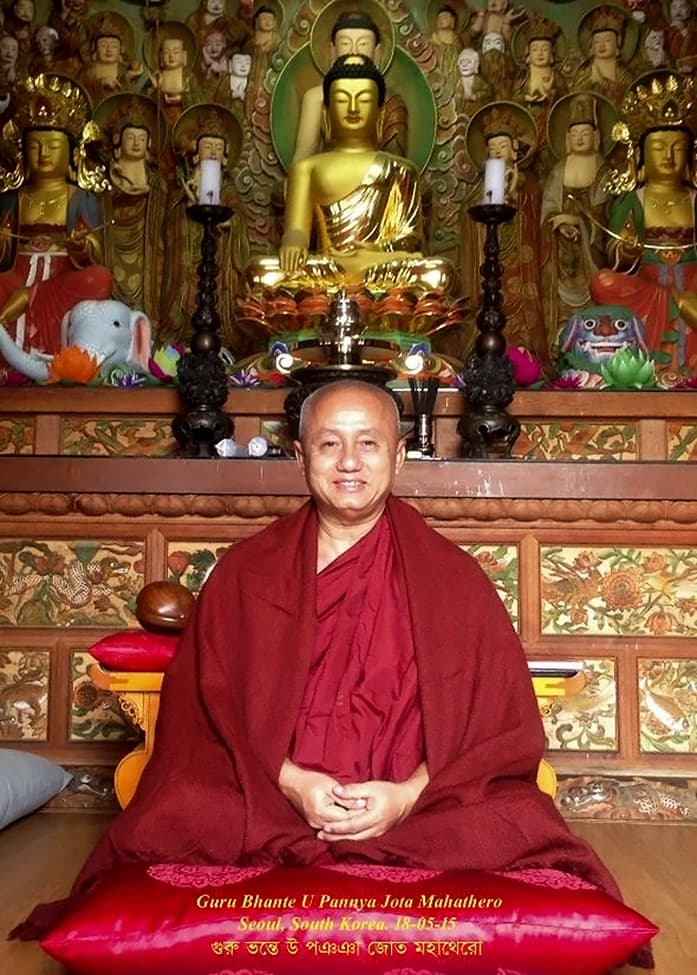
Pannya Jota Mahathera
Ven. U Pannya Jota Mahathera was a Bangladeshi Theravada Buddhist monk and scholar, locally known as Guru Bhante. Before his ordination, he served as a judge and magistrate for the government of Bangladesh. He is recognized for his work as a social reformer, promoting a scientific understanding of Buddhism, and for establishing numerous temples both within and outside of Bangladesh.
Bodhiruci
Bodhiruci was a Buddhist monk from North India who was active in 6th-century Luoyang, China. He is renowned for his extensive translations of important Mahayana Buddhist texts into Chinese, significantly contributing to the transmission of Buddhist philosophy to East Asia. Bodhiruci is considered the patriarch of the Dashabhumika school, a tradition that formed around his translation of the Ten Stages Sutra and Vasubandhu's commentary.
Buddhapālita
Buddhapālita was an influential Indian Mahayana Buddhist commentator active in the 5th-6th centuries CE, primarily known for his commentary on Nagarjuna's Mūlamadhyamakakarikā. His work, the Mūlamadhyama-vṛtti, utilized the reductio ad absurdum method to explain Nagarjuna's philosophy, a methodological approach that later became a defining characteristic of the Prasaṅgika school of Madhyamaka philosophy in Tibetan scholasticism. While little is known about his life, his philosophical method significantly shaped later debates and interpretations within Mahayana Buddhism.