
Bodhiruci
Bodhiruci was a Buddhist monk from North India who was active in 6th-century Luoyang, China. He is renowned for his extensive translations of important Mahayana Buddhist texts into Chinese, significantly contributing to the transmission of Buddhist philosophy to East Asia. Bodhiruci is considered the patriarch of the Dashabhumika school, a tradition that formed around his translation of the Ten Stages Sutra and Vasubandhu's commentary.
Key Facts
- ›A Buddhist monk from North India active in 6th-century China.
- ›Appointed master translator at Yongning Temple by Emperor Xuanwu of the Northern Wei.
- ›Translated significant texts including the ten Stages Sutra and its commentary by Vasubandhu.
- ›Also translated the Sukhāvatīvyūha Sūtra and the Sūtra of the descent to Laṅka.
- ›Considered the patriarch of the Dashabhumika (Dilun) school.
- ›Master of Tanluan, a patriarch of the Pure Land tradition.
Important Relationships
- Emperor Xuanwu of Northern Wei
- Ratnamati
- Daochong
- Tanluan
- Ten Stages Sutra
- Commentary On the Ten Stages Sutra By Vasubandhu
- SukhāVatīVyūHa SūTra
- Stanzas of the Vow To Be Reborn [In the Pure Land] In the SūTra [of the Buddha] Infinite Life
- SūTra of the Descent To LaṅKa
- SūTra of Buddha Names
Luoyang, Yongning Temple
Vasubandhu
Chinese, Sanskrit
Monastic Vows
About Bodhiruci
Bodhiruci was a pivotal Buddhist monk who hailed from North India and established a significant presence in 6th century CE China, particularly in the city of Luoyang. His primary contribution to Chinese Buddhism was through his extensive and skilled translations of key Mahayana scriptures, which facilitated the transmission and study of these texts.
Role in Chinese Buddhism
Appointed as a master translator at the prestigious Yongning temple by Emperor Xuanwu of the Northern Wei dynasty, Bodhiruci played a crucial role in making important Buddhist philosophical and devotional texts accessible to a Chinese audience. He was assisted in his translation efforts by Ratnamati, a monk from central India. By the time of his death, Bodhiruci had translated between 20 and 30 texts, including foundational works that shaped subsequent Buddhist thought in China.
Key Translations and Teachings
Among Bodhiruci's most significant translations are the Ten Stages Sutra (Shidi jing lun) and Vasubandhu's commentary on it. He also translated the Sukhāvatīvyūha Sūtra along with Vasubandhu's commentary, and texts such as the Sūtra of the Descent to Laṅka (Ru lengqie jing) and a Sūtra of Buddha names (Foming jing). These translations were instrumental in the development of distinct Buddhist schools.
Patriarch of the Dashabhumika School
Bodhiruci is recognized as the patriarch of the Dashabhumika school, also known as the Dilun school. This tradition centered its practice and study around the Ten Stages Sutra and Vasubandhu's commentary, which Bodhiruci had so diligently translated. His influence extended through his disciples, notably Daochong, who founded the northern Dilun branch, and Tanluan, a highly influential figure in the development of the Pure Land tradition.
Source: Wikipedia ↗
Frequently Asked Questions
What is Bodhiruci known for?
Bodhiruci is primarily known for his extensive work as a translator of important Buddhist scriptures from Sanskrit into Chinese. He also holds significance as the patriarch of the Dashabhumika school, which was founded based on his translations.
Which Buddhist texts did Bodhiruci translate?
Bodhiruci translated numerous significant texts, including the Ten Stages Sutra and Vasubandhu's commentary on it, the Sukhāvatīvyūha Sūtra with Vasubandhu's commentary, the Sūtra of the descent to Laṅka, and a Sūtra of Buddha names.
What Buddhist school is Bodhiruci associated with?
Bodhiruci is regarded as the patriarch of the Dashabhumika school, also known as the Dilun school in Chinese. This school's primary focus was the study of the Ten Stages Sutra and Vasubandhu's commentary, which Bodhiruci translated.
Who were Bodhiruci's notable students?
Bodhiruci had influential disciples, including Daochong, who founded a northern branch of the Dilun school, and Tanluan, who became one of the patriarchs of the Pure Land tradition.
Where and when was Bodhiruci active?
Bodhiruci was active in the area of Luoyang, China, during the 6th century CE. He was a monk from North India.
Related Buddhists
Buddhapālita
Buddhapālita was an influential Indian Mahayana Buddhist commentator active in the 5th-6th centuries CE, primarily known for his commentary on Nagarjuna's Mūlamadhyamakakarikā. His work, the Mūlamadhyama-vṛtti, utilized the reductio ad absurdum method to explain Nagarjuna's philosophy, a methodological approach that later became a defining characteristic of the Prasaṅgika school of Madhyamaka philosophy in Tibetan scholasticism. While little is known about his life, his philosophical method significantly shaped later debates and interpretations within Mahayana Buddhism.
Christmas Humphreys
Travers Christmas Humphreys was a prominent British jurist and the best-known British convert to Mahayana Buddhism in his time. He founded the influential London Buddhist Society in 1924, which played a significant role in the growth of Buddhism in Britain. Humphreys also authored numerous works on Buddhist philosophy and was a judge at the Old Bailey, known for prosecuting controversial cases.
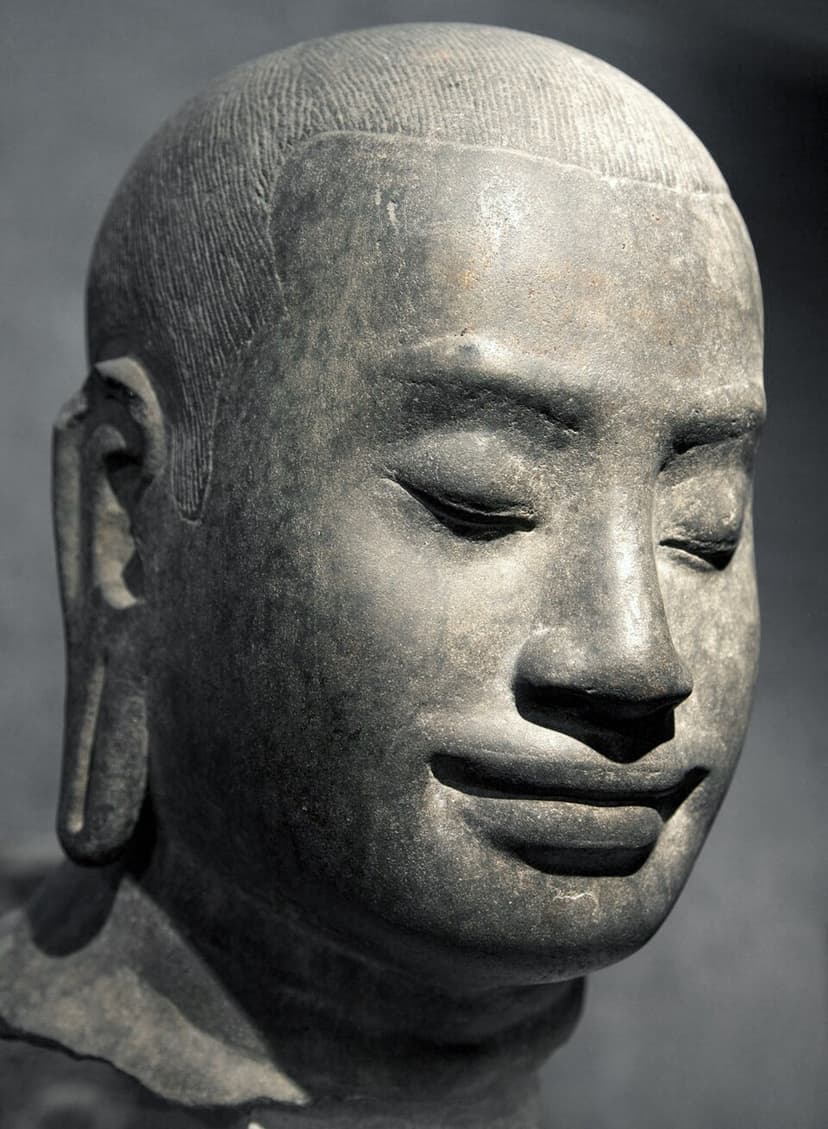
Jayavarman VII
Jayavarman VII was the most powerful monarch of the Khmer Empire, reigning from 1181 to around 1218. As the first Khmer king devoted to Mahayana Buddhism, he initiated a welfare state and commissioned extensive public works, including hospitals and temples, aimed at alleviating human suffering. His reign is marked by monumental construction projects, most notably the Bayon temple and the city of Angkor Thom, and significant military achievements, including the conquest of Champa.