
Pannya Jota Mahathera
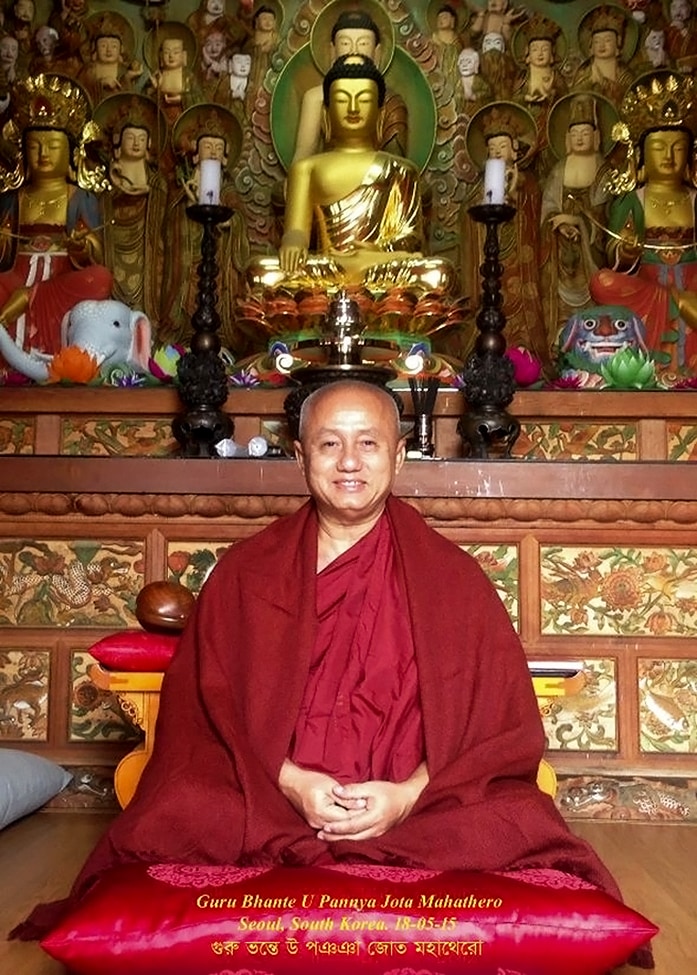
Ven. U Pannya Jota Mahathera was a Bangladeshi Theravada Buddhist monk and scholar, locally known as Guru Bhante. Before his ordination, he served as a judge and magistrate for the government of Bangladesh. He is recognized for his work as a social reformer, promoting a scientific understanding of Buddhism, and for establishing numerous temples both within and outside of Bangladesh.
Key Facts
- ›Born into the Royal Bohmong family in Bandarban, East Pakistan (now Bangladesh).
- ›Served as a judge and magistrate for the Bangladesh government for approximately eight years.
- ›Became a Buddhist monk in 1990, changing his name to U Pannya Jota Mahathera.
- ›Authored several successful books on Buddhist topics for Bangladeshi readers.
- ›Founded and built numerous Buddhist temples, including the notable Buddha Dhatu Jadi (Bandarban Golden Temple).
- ›Participated in international Buddhist conferences, including the World Buddhist Summit and UN Day of Vesak.
Important Relationships
- Hla Thowai Prue (father)
- Aung Mra Ching (mother)
- Kyaw Zaw Than (grandfather)
- Ching Mrong Bihara (ordination site)
Books On Buddhist Topics
Bandarban, Bangladesh, Yangoon, Myanmar, Maung Daw, Arakan State, Myanmar, Buddha Gaya, India
S.N. Goenka
Bhikkhu
About Pannya Jota Mahathera
Who was Ven. U Pannya Jota Mahathera?
Ven. U Pannya Jota Mahathera, also known locally as Guru Bhante, was a significant figure in Bangladeshi Theravada Buddhism. Born in 1955 into the Royal Bohmong family in Bandarban, East Pakistan, he led a multifaceted life before and after his ordination. His journey included a career as a judge and magistrate for the government of Bangladesh for approximately eight years before he embraced monastic life in 1990.
Life and Contributions
As a Buddhist monk, U Pannya Jota Mahathera dedicated himself to the practice and propagation of Dhamma. He traveled extensively, teaching laypeople and engaging in meditation practices learned from masters in India and Burma, including S.N. Goenka. He was particularly noted as a social reformer who advocated for a scientific understanding of Buddhism, challenging non-scientific beliefs prevalent in Bangladesh. His scholarly pursuits led him to publish several well-received books on Buddhist subjects.
Establishment of Temples and International Engagement
A major aspect of his legacy is the establishment of numerous Buddhist temples both within Bangladesh and abroad. Notable among these are the Buddha Dhatu Jadi (Bandarban Golden Temple) and Rama Zadi in Bangladesh. He also played a role in international Buddhist discourse, attending conferences such as the World Buddhist Summit and UN Day of Vesak, thereby fostering connections with Buddhist communities worldwide. U Pannya Jota Mahathera passed away in 2020.
Source: Wikipedia ↗
Frequently Asked Questions
Who was Ven. U Pannya Jota Mahathera?
Ven. U Pannya Jota Mahathera was a prominent Bangladeshi Theravada Buddhist monk, scholar, and social reformer. He was born into royalty and previously served as a judge before dedicating his life to monasticism.
What was his role before becoming a monk?
Before his ordination in 1990, U Pannya Jota Mahathera served the government of Bangladesh as a judge and magistrate for about eight years. This period of his life was marked by his legal career.
What is he known for in his life as a monk?
As a monk, U Pannya Jota Mahathera was known for his in-depth practice and teaching of Buddhism, emphasizing its potential for peace. He worked as a social reformer to promote scientific understanding of Buddhist principles and denied non-scientific beliefs. He also authored books and established many temples.
What notable temples did he establish?
U Pannya Jota Mahathera established numerous temples both in and outside Bangladesh. Among the most famous is the Buddha Dhatu Jadi, also known as the Bandarban Golden Temple, which houses the second-largest Buddhist statue in Bangladesh.
Did he travel internationally?
Yes, Ven. U Pannya Jota Mahathera visited various countries to deepen his understanding of meditation and meet teachers. He also attended international Buddhist conferences, including events in Myanmar, Thailand, Vietnam, and South Korea.
Related Buddhists
Kanshi Ram
Kanshi Ram was an influential Indian politician and social reformer, renowned for his work in mobilizing and uplifting the Bahujans, comprising India's lower castes and untouchable groups. He founded key organizations like the Dalit Shoshit Samaj Sangharsh Samiti (DS-4), BAMCEF, and the Bahujan Samaj Party (BSP), creating a political platform for marginalized communities. His efforts significantly impacted India's political landscape, particularly in Uttar Pradesh.
Christmas Humphreys
Travers Christmas Humphreys was a prominent British jurist and the best-known British convert to Mahayana Buddhism in his time. He founded the influential London Buddhist Society in 1924, which played a significant role in the growth of Buddhism in Britain. Humphreys also authored numerous works on Buddhist philosophy and was a judge at the Old Bailey, known for prosecuting controversial cases.

Shibani Kashyap
Shibani Kashyap is an Indian singer who rose to prominence in Hindi cinema, known for her unique Sufi-western blend of music. She gained national fame with her debut pop album and has since released several albums and sung songs for numerous films and television serials. Kashyap is also recognized for her involvement in reality singing shows and social causes.