
Ajahn Sumedho
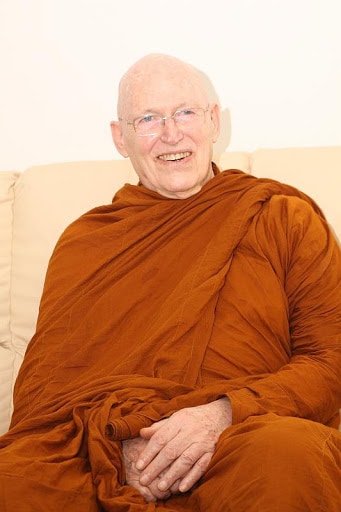
Ajahn Sumedho is an American Buddhist monk, ordained in 1967 and a central figure in establishing monasteries in Thailand and England. As a senior Western representative of the Thai Forest Tradition, he is recognized for his pivotal role in transmitting Buddhist teachings to the West through his direct, practical, and awareness-focused teachings.
Key Facts
- ›Born Robert Karr Jackman in Seattle, Washington, on July 27, 1934.
- ›Served as a U.S. Navy medic during the Korean War.
- ›Earned BA in Far Eastern studies and MA in South Asian studies from UC Berkeley.
- ›Helped establish Wat Pa Nanachat in Thailand and Cittaviveka and Amaravati monasteries in England.
- ›Regarded as Ajahn Chah's most influential Western disciple.
- ›Known for practical, direct teachings emphasizing intuitive awareness and seeing things as they are.
Important Relationships
the Way It Is, the Sound of Silence, Mindfulness – the Path To the Deathless, Gratitude, Intuitive Awareness, It’S Like This, Now Is the Knowing, Sila and Religious Convention; Patience, Teachings From the Forest, the Four Noble Truths
Wat Pa Nanachat, Cittaviveka Forest Monastery, Amaravati Buddhist Monastery, Wat Nong Pah Pong
Ajahn Chah, Edward Salim Michael
English
Bhikkhu, Samanera
About Ajahn Sumedho
Ajahn Sumedho, born Robert Karr Jackman on July 27, 1934, is a highly respected American Buddhist monk and a significant figure in the transmission of Theravāda Buddhism to the West. As one of the most senior Western representatives of the Thai Forest Tradition, he is renowned for his instrumental role in establishing monastic communities and for his direct, practical teachings.
Life and Historical Context
Born in Seattle, Washington, Sumedho served as a medic in the U.S. Navy during the Korean War. He pursued higher education, earning a BA in Far Eastern studies and an MA in South Asian studies from the University of California, Berkeley. After a period with the Peace Corps in Borneo, a chance encounter with a Buddhist monk in Singapore led him to Thailand. He became a novice in 1966 and was ordained as a bhikkhu (monk) in 1967.
Sumedho trained under the esteemed Thai monk Ajahn Chah at Wat Nong Pah Pong from 1967 to 1977, becoming his most influential Western disciple. In 1975, he co-founded Wat Pa Nanachat, an international monastery in Thailand for non-Thai students. In 1977, he was encouraged to establish a branch monastery in England, which led to the founding of Cittaviveka Forest Monastery. He later became the abbot of Amaravati Buddhist Monastery, established in 1984, and played a key role in building the global network of monasteries in Ajahn Chah's lineage. Ajahn Sumedho retired in 2010 but returned to Amaravati in 2020, where he currently resides.
Teachings and Practice
Ajahn Sumedho's teachings are characterized by their simplicity, directness, and focus on practical application. He emphasizes cultivating immediate intuitive awareness and integrating this awareness into everyday life, often advising his students to "see things the way that they actually are." He is known for his engaging, witty, and kind communication style, often using humor and personal anecdotes to illustrate points about meditation and experiencing life. A specific meditation technique he teaches is referred to as "the sound of silence," which is detailed in his book "The Way It Is."
Notable Works
Ajahn Sumedho has authored several books and publications, including "The Way It Is," "The Sound of Silence," "Mindfulness – The Path to the Deathless," and "Teachings from the Forest." His talks and teachings have been widely disseminated through recordings and publications worldwide.
Source: Wikipedia ↗
Frequently Asked Questions
Who is Ajahn Sumedho?
Ajahn Sumedho, born Robert Karr Jackman, is an American Buddhist monk and a prominent figure in the Thai Forest Tradition. He is highly regarded for his role in establishing Buddhist monasteries in the West and transmitting the Buddha's teachings globally.
When and where was Ajahn Sumedho born?
Ajahn Sumedho was born on July 27, 1934, in Seattle, Washington, in the United States.
What is Ajahn Sumedho's significance in Buddhism?
He is considered a seminal figure in bringing Theravada Buddhism to the West, instrumental in founding important monasteries like Wat Pa Nanachat, Cittaviveka, and Amaravati. He is also known as one of Ajahn Chah's most influential Western disciples.
What are Ajahn Sumedho's teachings focused on?
His teachings are direct and practical, emphasizing immediate intuitive awareness and its integration into daily life. He focuses on the practical application of Buddhist principles, encouraging practitioners to 'see things the way that they actually are'.
What meditation technique is associated with Ajahn Sumedho?
Ajahn Sumedho teaches and uses a meditation technique he calls 'the sound of silence,' which is discussed in his book 'The Way It Is.' He was influenced by Edward Salim Michael's work on inner vigilance.
What role did Ajahn Sumedho play in establishing monasteries?
He was instrumental in establishing Wat Pa Nanachat in Thailand for non-Thai students and later co-founded Cittaviveka Forest Monastery and Amaravati Buddhist Monastery in England, serving as abbot of the latter until his retirement.
Related Buddhists
Ajahn Viradhammo
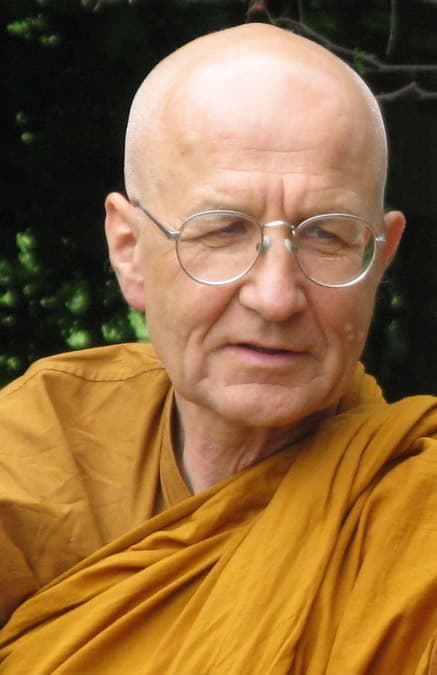
Ajahn Viradhammo, born Vitauts Akers, is a Canadian monk within the Theravada Buddhist tradition, specifically the Thai Forest tradition. He is recognized as the most senior Thai Forest monk in Canada and currently serves as the Abbot of Tisarana Buddhist Monastery in Perth, Ontario. Ordained by Ajahn Chah, he played a significant role in establishing monasteries in the UK, New Zealand, and Canada.
Alan Watts
Alan Watts was a British and American writer, speaker, and philosophical entertainer, renowned for interpreting and popularizing Eastern philosophies like Buddhism, Taoism, and Hinduism for Western audiences. He gained a significant following through his radio broadcasts and writings, most notably "The Way of Zen," which introduced the Beat Generation and counterculture to Buddhist thought. Watts's work explored human consciousness, the interconnectedness of nature, and sought to bridge the gap between Eastern and Western thought, leaving a lasting influence on philosophical and cultural discourse.
Issan Dorsey
Issan Dorsey, born Tommy Dorsey Jr., was a Sōtō Zen monk and teacher who served as the abbot of Hartford Street Zen Center in San Francisco. He is recognized for his compassionate work establishing the Maitri Hospice, the first Buddhist hospice in the United States, which cared for individuals dying of AIDS. Many of his students and colleagues viewed him as an embodiment of a bodhisattva.