
Alan Watts
United States·Zen Buddhism (popularizer)·Male·20th century
Alan Watts was a British and American writer, speaker, and philosophical entertainer, renowned for interpreting and popularizing Eastern philosophies like Buddhism, Taoism, and Hinduism for Western audiences. He gained a significant following through his radio broadcasts and writings, most notably "The Way of Zen," which introduced the Beat Generation and counterculture to Buddhist thought. Watts's work explored human consciousness, the interconnectedness of nature, and sought to bridge the gap between Eastern and Western thought, leaving a lasting influence on philosophical and cultural discourse.
Key Facts
- ›Born in Kent, England, on January 6, 1915.
- ›Became interested in Buddhism at age 16 and was secretary of the London Buddhist Lodge.
- ›Authored over 25 books and numerous articles on religion and philosophy.
- ›His book "the Way of Zen" (1957) was a bestseller and introduced many Westerners to Buddhism.
- ›Known for his popular radio broadcasts, particularly from KPFA in Berkeley, California.
- ›Died in California on November 16, 1973, at the age of 58.
Important Relationships
- Eleanor Everett (wife)
- Ruth Fuller Everett (mother-in-law)
- Sokei-an Sasaki (Zen master/mentor)
- Saburo Hasegawa (colleague)
- Elsa Gidlow (friend, dedicatee of autobiography)
- Jean Burden (lover, influence)
- the Spirit of Zen
- Myth & Ritual In Christianity
- Behold the Spirit: A Study In the Necessity of Mystical Religion
- the Way of Zen
- Nature, Man and Woman
- the New Alchemy
- Psychotherapy East and West
- the Joyous Cosmology
- the Book: On the Taboo Against Knowing Who You Are
- Tao: the Watercourse Way
Chislehurst, Kent, England, London, England, New York, United States, San Francisco, California, Berkeley, California, Druid Heights, California
Buddhism, Taoism, Hinduism, Alfred Korzybski, Norbert Wiener, Carl Jung, D. T. Suzuki
English
Ordained Episcopalian Priest
About Alan Watts
Alan Wilson Watts (January 6, 1915 – November 16, 1973) was a British-American writer, speaker, and self-styled "philosophical entertainer" who became a leading interpreter and popularizer of Eastern philosophies for a Western audience. He is best known for introducing Buddhist, Taoist, and Hindu thought to the Beat Generation and the emerging counterculture through his prolific writings and engaging lectures.
Early Life and Spiritual Awakening
Born in Chislehurst, Kent, England, Watts displayed an early fascination with spirituality and the mysterious Far East. Influenced by his mother's religious family and Far Eastern art, he developed a deep interest in Eastern philosophies. He chose Buddhism over Anglican Christianity and became secretary of the London Buddhist Lodge at the age of 16. Despite a scholarship opportunity to Oxford, his academic path was unconventional, and he later pursued studies at Seabury-Western Theological Seminary, where he was ordained an Episcopalian priest in 1945, seeking to blend Christian worship with Asian philosophy.
Philosophical Contributions and Popularization
Watts resigned from the priesthood in 1950 and moved to California, joining the faculty of the American Academy of Asian Studies. He began a long-running weekly radio program at KPFA in Berkeley, which garnered a large following and was instrumental in disseminating his ideas. His seminal work, "The Way of Zen" (1957), became a bestseller and a foundational text for many interested in Buddhism. Watts's writings explored themes such as the nature of consciousness, the interconnectedness of the universe, and the critique of the "skin-encapsulated ego," drawing parallels between Eastern wisdom and modern science, psychology, and cybernetics.
Later Years and Legacy
Throughout his career, Watts lectured extensively at universities and to the public, influencing the American intelligentsia of the 1950s to 1970s. He also explored the use of psychedelic drugs for mystical insight and became increasingly concerned with ecological issues. In his later years, he continued to write and broadcast, focusing on topics such as child-rearing, the arts, cuisine, and the relationship between humanity and nature. Watts died in 1973 at the age of 58 in Druid Heights, California. His lectures and writings remain widely popular, continuing to reach new audiences through public radio and the internet, solidifying his legacy as a key figure in the cross-cultural transmission of Eastern philosophical traditions.
Source: Wikipedia ↗
Frequently Asked Questions
What was Alan Watts's primary role in the Buddhist community?
Alan Watts was not a traditional Buddhist monk or ordained teacher. Instead, he acted as a "philosophical entertainer" and popularizer, interpreting and explaining Buddhist philosophy, particularly Zen, to a Western audience through his books and lectures.
What were Alan Watts's most influential books?
Among his most influential works are "The Way of Zen" (1957), which introduced the Beat Generation and counterculture to Buddhist concepts, and "Nature, Man and Woman" (1958), which he considered his best work. Other notable books include "Psychotherapy East and West" (1961) and "The Book: On the Taboo Against Knowing Who You Are."
How did Alan Watts become interested in Eastern philosophies?
Watts became interested in Eastern philosophies, particularly Buddhism, from a young age, influenced by his mother's religious family and his fascination with Far Eastern art and culture. He actively sought out Buddhist teachings and writings in libraries and through contacts like the London Buddhist Lodge.
What was Alan Watts's connection to Zen Buddhism?
Watts had a profound interest in Zen (Ch'an) Buddhism, which he saw as a synthesis of Taoism, Confucianism, and Buddhism. He studied its principles extensively and introduced its concepts to the West through his writings and lectures, though he did not undergo formal Zen training.
What was Alan Watts's view on psychotherapy and Eastern philosophy?
In "Psychotherapy East and West," Watts argued that Western psychotherapy could achieve a similar liberation as Eastern spiritual practices if it discarded dualistic thinking. He saw potential for Eastern philosophy to inform and enhance Western psychological approaches.
Related Buddhists

14th Dalai Lama
The 14th Dalai Lama, born Lhamo Thondup, is the current spiritual leader of Tibetan Buddhism and the former temporal leader of Tibet. He is widely regarded as an emanation of Avalokiteśvara, the Bodhisattva of Compassion, and has led the Tibetan government in exile since 1959. Known for his advocacy for peace and interfaith dialogue, he was awarded the Nobel Peace Prize in 1989.

Allen Ginsberg
Allen Ginsberg was a prominent American poet and writer, best known as a central figure of the Beat Generation. He was a vocal critic of militarism, materialism, and sexual repression, and he explored themes of Eastern religions, drugs, and counterculture in his work. His most famous poem, "Howl," led to an influential obscenity trial that defended freedom of speech.
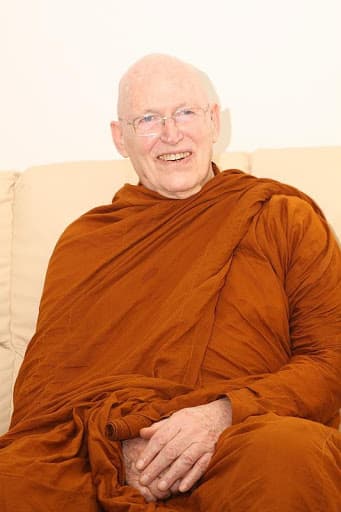
Ajahn Sumedho
Ajahn Sumedho is an American Buddhist monk, ordained in 1967 and a central figure in establishing monasteries in Thailand and England. As a senior Western representative of the Thai Forest Tradition, he is recognized for his pivotal role in transmitting Buddhist teachings to the West through his direct, practical, and awareness-focused teachings.