
Vĩnh Tràng Temple
Vĩnh Tràng Temple is a prominent Buddhist temple located near Mỹ Tho in Vietnam's Mekong Delta, recognized as one of the region's most well-known religious sites. Established in the mid-19th century and undergoing significant renovations, it serves as a major destination for both tourists and pilgrims, and currently functions as the office for the provincial Buddhist Association.
Key Facts
- ›Vĩnh Tràng Temple was initiated in the MID-19th century by district chief BùI Công Đạt and completed in 1850.
- ›The temple suffered damage during French colonial conflicts between 1859 and 1862 and was subsequently reconstructed.
- ›Significant renovations occurred in the late 19th and early 20th centuries under abbots Thích Chánh Hậu and Thích Minh Đàn.
- ›The main Tam quan gateway, built in 1933, features a blend of European and Asian architectural styles.
- ›The temple houses numerous statues of Buddhas, bodhisattvas, arahants, and venerated abbots.
- ›It currently serves as the administrative office for the provincial Buddhist Association of Tiền Giang Province.
Important Relationships
- Bùi Công Đạt
- Thích Từ Lâm
- Thích Huệ Đăng
- Thích Thiện Đề
- Thích Trà Chánh
- Thích Minh Phước
- Thích Chánh Hậu
- Thích Minh Đàn
- Nguyễn Phi Hoanh
- Buddhist Association of Tiền Giang Province
- Tam Quan Gateway
- Statues of Buddhas, Bodhisattvas, and Arahants
- Garden With Fruit Trees
- Stupa of ThíCh CháNh HậU
Completion of Construction In 1850, Damage During French Colonial Conflicts, Reconstruction Efforts, Major Rebuilding After Tropical Storm In 1904
European, Asian, Traditional Vietnamese
About Vĩnh Tràng Temple
Vĩnh Tràng Temple is a significant Buddhist temple located near Mỹ Tho in the Mekong Delta region of southern Vietnam. It is widely recognized as one of the most well-known temples in the area and holds importance as a cultural and religious landmark.
History and Development
The temple's origins trace back to the middle of the 19th century, with its erection organized by the district chief Bùi Công Đạt. He enlisted the monk Thích Từ Lâm to preside over the temple. Following Bùi Công Đạt's death, Thích Huệ Đăng oversaw the remainder of the construction, and Vĩnh Tràng Temple was completed in 1850. The temple endured significant damage between 1859 and 1862 during conflicts between French colonial forces and the Nguyễn dynasty. Thích Thiện Đề, the successor to Thích Huệ Đăng, led the subsequent reconstruction efforts. The temple later fell into disuse after his death.
A period of resurgence began in 1890 when Thích Trà Chánh became the abbot. In 1895, Thích Chánh Hậu initiated a comprehensive renovation. A major tropical storm in 1904 necessitated further rebuilding in 1907. Thích Chánh Hậu served as abbot for 33 years until his death in 1923. His successor, Thích Minh Đàn, organized additional renovations, including work on the main triple gate, ceremonial hall, and patriarch hall.
Architecture and Features
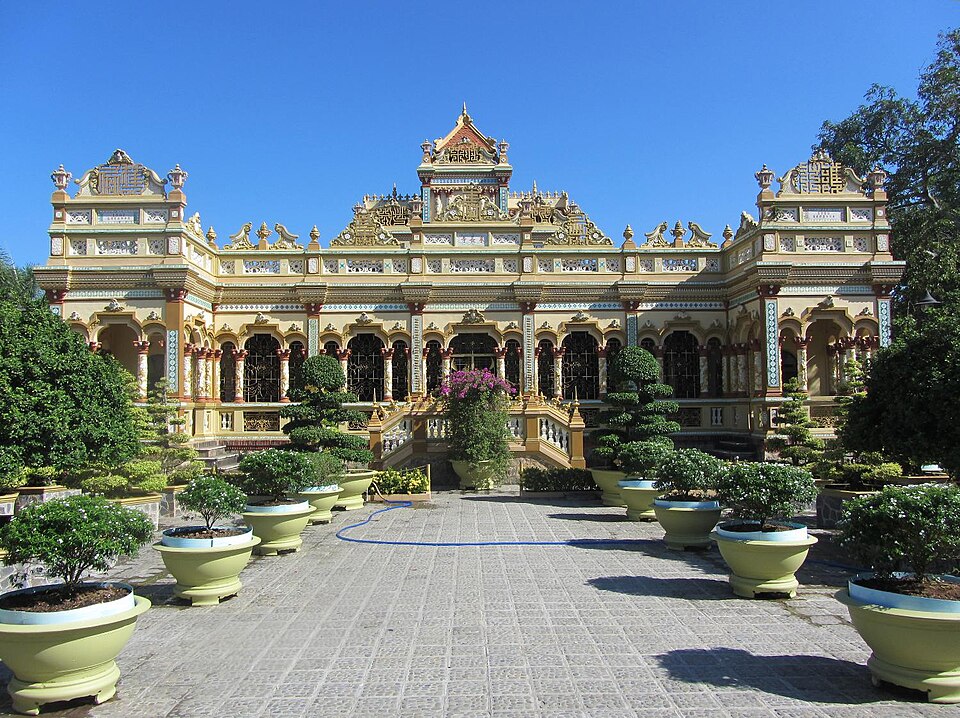
The main Tam quan gateway, constructed in 1933 with craftsmen from Huế, is a notable architectural element. It features a central steel gate flanked by concrete gates styled like a historical fortress, with an upper level and an additional gate. Statues of Thích Chánh Hậu and Thích Minh Đàn, created by Nguyễn Phi Hoanh, are positioned on either side. The temple's facade exhibits a distinctive blend of European and Asian architectural influences.
Inside the main hall, visitors can find numerous statues depicting various Buddhas, including Amitabha Buddha and Gautama Buddha, alongside arahants and bodhisattvas. Statues of Thích Chánh Hậu and Thích Minh Đàn are also present. The oldest statues in the temple are bronze figures of Amitabha, Avalokiteshvara, and Đại Thế Chí bodhisattva; however, the original Avalokiteshvara statue has been lost and replaced with a wooden version. A life-sized statue of the Ngọc Hoàng is also housed within the temple.
The temple grounds are adorned with a garden featuring many pot plants. Beneath the shade of a tree lies the stupa of Thích Chánh Hậu, where his ashes are interred. The statues of 18 arahants, carved from wood by southern craftsmen in 1907, are also notable features.
Current Significance
Today, Vĩnh Tràng Temple serves as the office for the board of the provincial Buddhist Association of Tiền Giang Province. It is a significant provincial destination, attracting a large number of tourists and Buddhist pilgrims.
Source: Wikipedia ↗
Frequently Asked Questions
When was Vĩnh Tràng Temple founded?
The temple's establishment was initiated in the middle of the 19th century and it was completed in 1850.
What significant events have affected Vĩnh Tràng Temple?
Vĩnh Tràng Temple was seriously damaged during the French colonial battles between 1859 and 1862 and was later ravaged by a tropical storm in 1904, necessitating major rebuilding.
What are the notable architectural features of Vĩnh Tràng Temple?
The main Tam quan gateway, built in 1933, is a notable feature, blending European and Asian architectural styles, with steel and concrete gates. The front of the temple also exhibits this mixed architectural design.
What kind of statues can be found at Vĩnh Tràng Temple?
The temple contains multiple statues of various Buddhas, including Amitabha Buddha and Gautama Buddha, as well as arahants, bodhisattvas, and venerated abbots like Thích Chánh Hậu and Thích Minh Đàn. The oldest statues are bronze figures of Amitabha, Avalokiteshvara, and Đại Thế Chí.
What is the current role of Vĩnh Tràng Temple?
Vĩnh Tràng Temple currently serves as the office for the board of the provincial Buddhist Association of Tiền Giang Province and is a significant destination for tourists and pilgrims.
Related Buddhist Temples

Long Sơn Temple
Long Sơn Temple, also known as Đăng Long Tự, is a significant Buddhist temple located in Nha Trang, Vietnam, and is considered one of the city's main religious sites. Established in 1886, it has undergone several reconstructions and expansions, most notably after being destroyed by a cyclone in 1900 and damaged during the Vietnam War. The temple is renowned for its large white concrete statue of Gautama Buddha, which is visible from afar and serves as a prominent landmark and vantage point over the city.
Quan m Pagoda
The Quan m Temple, also known as the Ôn Lăng Assembly Hall, is a significant Chinese-style Buddhist temple located in Ho Chi Minh City, Vietnam. Founded in the 19th century by Hokkien immigrants, it is a popular center for both Vietnamese and Chinese Buddhists, venerating Guanyin, Amitabha Buddha, and incorporating elements of Taoism and folk worship.

Tây An Temple
Tây An Temple is a significant Buddhist temple located near Châu Đốc in An Giang Province, Vietnam. Built in 1847, it is renowned for its historical importance, unique architecture blending Indian and local styles, and its role as a pilgrimage site, particularly during traditional festivals.