
Tây An Temple
Tây An Temple is a significant Buddhist temple located near Châu Đốc in An Giang Province, Vietnam. Built in 1847, it is renowned for its historical importance, unique architecture blending Indian and local styles, and its role as a pilgrimage site, particularly during traditional festivals.
Key Facts
- ›Founded in 1847 by Governor Doãn Uẩn of an Giang.
- ›Features architecture that fuses Indian styles with local Vietnamese motifs.
- ›Houses approximately 200 19th-century wooden statues of Buddhas, bodhisattvas, and other figures.
- ›Includes a notable stupa dedicated to Master Đoàn Minh Huyên, a prominent monk.
- ›Attracts large numbers of pilgrims, especially during traditional Buddhist festivals.
- ›Located near Sam Mountain, five kilometers from Châu ĐốC.

Important Relationships
- Doãn Uẩn
- Đoàn Minh Huyên
- Thích Nhất Thừa
- Thích Bửu Thọ
- Statue of Bodhisattva Avalokiteshvara
- Elephant Statues
- Approximately 200 19th-Century Wooden Statues of Buddhas, Bodhisattvas, Etc.
- Stupa of TâY An Master, đOàN Minh HuyêN
- Three-Storey Tower
- Renovation of Main Hall and Patriarch Hall By ThíCh NhấT ThừA
- Fundraising and Refurbishment By ThíCh BửU Thọ, Including Erection of A Three-Storey Tower
Indian Styles, Local Motifs
About Tây An Temple
Tây An Temple is a significant Buddhist religious site located in southern Vietnam, near the town of Châu Đốc within An Giang Province's Mekong Delta region. Established in 1847 by Governor Doãn Uẩn, the temple holds historical and architectural importance, drawing visitors and pilgrims alike.
History and Construction
The temple's construction was initiated in 1847 by Doãn Uẩn, the Governor of An Giang. Situated near Sam Mountain, it was noted in the official chronicles of the Nguyễn dynasty as a structure with a commanding view over the surrounding town and province. Over its more than a century and a half of existence, Tây An Temple has undergone numerous renovations. Key among these were the 1861 refurbishment of the main and patriarch halls by Thích Nhất Thừa, and a significant 1958 undertaking by Thích Bửu Thọ, which involved refurnishing the main hall, the temple's front, and the construction of a three-storey tower.
Architecture and Artistry
The architectural design of Tây An Temple is a notable blend, fusing Indian stylistic elements with indigenous local motifs. At the entrance, near the triple gate, stands a statue of the bodhisattva Avalokiteshvara. The front pavement is adorned with two elephant statues: one black with two tusks and another white with six tusks. The main hall houses an extensive collection of approximately 200 statues, primarily made of wood. These figures represent Buddhas, bodhisattvas, arahants, atulas, and devas, and all date back to the 19th century, having been meticulously crafted by artisans from An Giang and the neighboring Đồng Tháp Province.
Spiritual Significance and Pilgrimage
The rear section of the temple features various stupas dedicated to deceased monks. Among these, the stupa of Tây An Master, Đoàn Minh Huyên (1807–1856), is particularly prominent. Master Huyên was a revered figure known for his extensive travels across the Mekong Delta, disseminating Buddhist teachings from 1849 onwards, and spent his final years at Tây An Temple. The temple hosts traditional Buddhist festivals annually, including observances on the full moon of the first lunar month, the full moon of the tenth lunar month, and the twelfth of the eighth lunar month, which marks the death anniversary of Tây An Master. During these festivals, and for the first four lunar months of the year, Tây An Temple attracts a substantial number of pilgrims from various regions.
Source: Wikipedia ↗
Frequently Asked Questions
When was Tây An Temple built?
Tây An Temple was built in 1847. It was established by the Governor of An Giang, Doãn Uẩn, during the Nguyễn dynasty.
What architectural styles can be found at Tây An Temple?
The temple's architecture is a notable fusion of Indian styles blended with local Vietnamese motifs. This creates a unique aesthetic that reflects cultural exchange.
What kinds of statues are housed in Tây An Temple?
Inside the main hall, there are around 200 statues made of wood, dating back to the 19th century. These depict Buddhas, bodhisattvas, arahants, atulas, and devas, and were crafted by local artisans.
Is Tây An Temple a pilgrimage site?
Yes, Tây An Temple is a significant pilgrimage site. It attracts a large number of pilgrims throughout the year, particularly during traditional Buddhist festivals.
What are some of the notable features of Tây An Temple?
Notable features include a statue of the bodhisattva Avalokiteshvara near the triple gate, two elephant statues at the front pavement, and a stupa dedicated to Tây An Master, Đoàn Minh Huyên.
Related Buddhist Temples

Long Sơn Temple
Long Sơn Temple, also known as Đăng Long Tự, is a significant Buddhist temple located in Nha Trang, Vietnam, and is considered one of the city's main religious sites. Established in 1886, it has undergone several reconstructions and expansions, most notably after being destroyed by a cyclone in 1900 and damaged during the Vietnam War. The temple is renowned for its large white concrete statue of Gautama Buddha, which is visible from afar and serves as a prominent landmark and vantage point over the city.
Quan m Pagoda
The Quan m Temple, also known as the Ôn Lăng Assembly Hall, is a significant Chinese-style Buddhist temple located in Ho Chi Minh City, Vietnam. Founded in the 19th century by Hokkien immigrants, it is a popular center for both Vietnamese and Chinese Buddhists, venerating Guanyin, Amitabha Buddha, and incorporating elements of Taoism and folk worship.
Vĩnh Tràng Temple
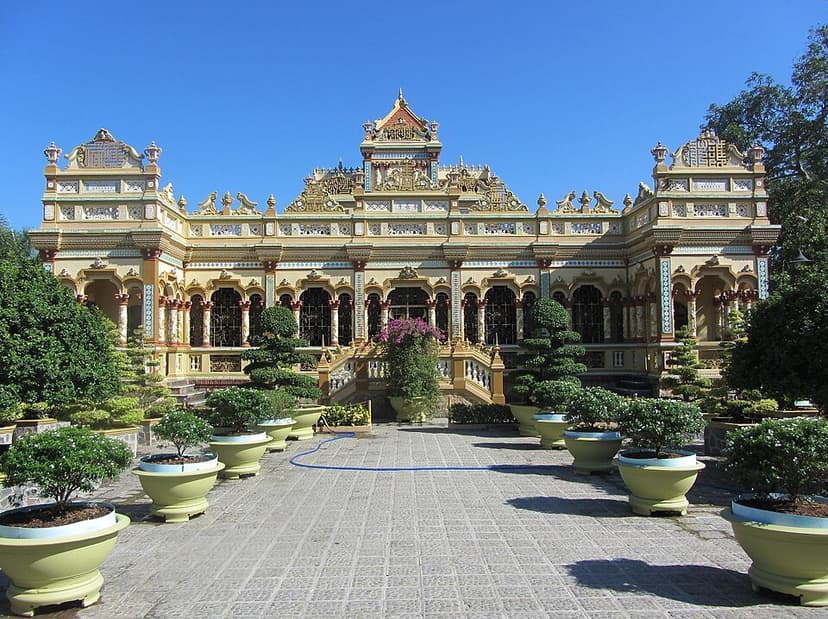
Vĩnh Tràng Temple is a prominent Buddhist temple located near Mỹ Tho in Vietnam's Mekong Delta, recognized as one of the region's most well-known religious sites. Established in the mid-19th century and undergoing significant renovations, it serves as a major destination for both tourists and pilgrims, and currently functions as the office for the provincial Buddhist Association.