
Quan m Pagoda
The Quan m Temple, also known as the Ôn Lăng Assembly Hall, is a significant Chinese-style Buddhist temple located in Ho Chi Minh City, Vietnam. Founded in the 19th century by Hokkien immigrants, it is a popular center for both Vietnamese and Chinese Buddhists, venerating Guanyin, Amitabha Buddha, and incorporating elements of Taoism and folk worship.
Key Facts
- ›Founded in the late 19th century by Hokkien immigrants to Vietnam.
- ›Dedicated primarily to Guanyin (Quan M), the Chinese goddess of mercy.
- ›Incorporates worship of Amitabha Buddha, Taoist deities, and the sea goddess Mazu.
- ›Features distinct courtyards and altars dedicated to various deities and Buddhist figures.
- ›Inscriptions are predominantly in Chinese, with some Vietnamese labels added.
- ›Serves as a popular pilgrimage and worship site for both Vietnamese and Chinese Buddhists.
Important Relationships
- Amitabha Buddha
- Jade Emperor
- Mazu
- Avalokiteshvara Bodhisattva
- Mahasthamaprapta Bodhisattva
- Manjusri Bodhisattva
- Samantabhadra Bodhisattva
- Maitreya
- Monkey (Journey to the West)
Large Statue of Guanyin, Altar To Mazu, Altar To the Jade Emperor, Relief Panels With Taoist and Buddhist Motifs, Artificial Pond and Pavilion In the Garden
Chinese-Style Buddhist
About Quan m Pagoda
Quan Âm Temple
The Quan Âm Temple, also known as the Ôn Lăng Assembly Hall, is a significant Chinese-style Buddhist temple located on Lão Tử Street in the Chợ Lớn ward of Ho Chi Minh City, Vietnam. Founded in the late 19th century by Hokkien immigrants, the temple stands as a vibrant center for religious practice and cultural expression, attracting both Vietnamese and Chinese Buddhists.
Religious Significance and Syncretism
The temple's primary dedication is to Guanyin (Quan Âm in Vietnamese), the revered Chinese goddess of mercy and the Chinese manifestation of the bodhisattva Avalokiteshvara. Reflecting the syncretic nature of popular Chinese religious traditions, the Quan Âm Temple also incorporates the worship of Amitabha Buddha within a Pure Land Buddhist framework. Furthermore, it includes elements of Taoism and the folk worship of Mazu, the Fujianese sea goddess, who is honored in her role as the "Queen of Heaven" (Thien Hau).
Architectural Layout and Iconography
The pagoda complex is situated on Lão Tử Street, with an associated garden and artificial pond located across from the main temple building. The temple itself features a distinct layout, beginning with a small front courtyard leading to an antechamber dedicated to the Jade Emperor. The main chamber is devoted to Mazu, and a large rear courtyard is dominated by an impressive statue of Guanyin. The temple's iconography is rich and detailed, with numerous relief panels and statues adorning its various sections. These depict scenes and figures from Buddhist cosmology, Taoist mythology, and Chinese folklore, including representations of the Three Stars (Phước Lộc Thọ), various bodhisattvas, and characters from the classic novel Journey to the West.
Source: Wikipedia ↗
Frequently Asked Questions
When was the Quan Âm Temple founded?
The Quan Âm Temple was founded in the late 19th century. It was built by Hokkien immigrants who had settled in the city.
What deities are venerated at Quan Âm Temple?
The temple is primarily dedicated to Guanyin, also known as Quan Âm. It also features altars for Amitabha Buddha, the Jade Emperor, and Mazu, the Chinese sea goddess.
What are the key architectural features of Quan Âm Temple?
The temple complex includes a gatehouse, courtyards, an antechamber with an altar to the Jade Emperor, a main chamber with an altar to Mazu, and a rear courtyard dominated by a large statue of Guanyin. There is also an associated garden with an artificial pond and pavilion across the street.
What is the significance of the Mazu altar?
The main altar inside the pagoda is dedicated to Mazu, also known as Thien Hau or 'Empress of Heaven'. She is a syncretized figure with both the Virgin Mary and Guanyin in her role as a beloved mother and celestial empress.
Are there any notable statues or reliefs within the temple complex?
Yes, the temple features numerous statues and relief panels. These include a large Guanyin statue in the rear courtyard, depictions of Amitabha Buddha presiding over the Pure Land, Taoist Immortals, and figures from the classic novel Journey to the West, such as Monkey.
Related Buddhist Temples

Long Sơn Temple
Long Sơn Temple, also known as Đăng Long Tự, is a significant Buddhist temple located in Nha Trang, Vietnam, and is considered one of the city's main religious sites. Established in 1886, it has undergone several reconstructions and expansions, most notably after being destroyed by a cyclone in 1900 and damaged during the Vietnam War. The temple is renowned for its large white concrete statue of Gautama Buddha, which is visible from afar and serves as a prominent landmark and vantage point over the city.

Tây An Temple
Tây An Temple is a significant Buddhist temple located near Châu Đốc in An Giang Province, Vietnam. Built in 1847, it is renowned for its historical importance, unique architecture blending Indian and local styles, and its role as a pilgrimage site, particularly during traditional festivals.
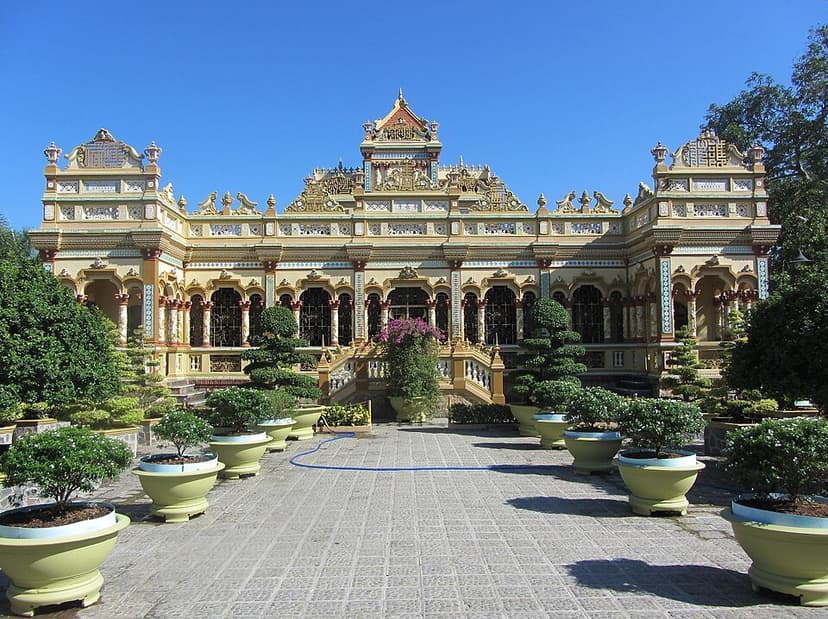
Vĩnh Tràng Temple
Vĩnh Tràng Temple is a prominent Buddhist temple located near Mỹ Tho in Vietnam's Mekong Delta, recognized as one of the region's most well-known religious sites. Established in the mid-19th century and undergoing significant renovations, it serves as a major destination for both tourists and pilgrims, and currently functions as the office for the provincial Buddhist Association.