
Long Sơn Temple
Long Sơn Temple, also known as Đăng Long Tự, is a significant Buddhist temple located in Nha Trang, Vietnam, and is considered one of the city's main religious sites. Established in 1886, it has undergone several reconstructions and expansions, most notably after being destroyed by a cyclone in 1900 and damaged during the Vietnam War. The temple is renowned for its large white concrete statue of Gautama Buddha, which is visible from afar and serves as a prominent landmark and vantage point over the city.
Key Facts
- ›Long Sơn Temple was founded in 1886 under the abbotship of Thích Ngộ Chí.
- ›The temple was moved to its current location at the foot of TrạI Thủy mountain after being destroyed by a cyclone in 1900.
- ›It served as the headquarters for the Buddhist Association in Khánh Hòa Province starting in 1936.
- ›The temple was heavily damaged during the Vietnam War in 1968 but was subsequently restored.
- ›A large white concrete statue of Gautama Buddha, 24 meters tall, was erected on the site in 1965 and is a major focal point.
- ›The temple's architecture features dragon mosaics made from glass and ceramic tiles, and its main ceremonial hall displays modern interpretations of classical motifs.

Important Relationships
- Thích Ngộ Chí
- Thích Tôn Thất Quyền
- Võ Đình Thụy
- Thích Thiện Bình
- Võ Đình Diệp
- Thích Đức Minh
- Kim Điền
- Hai Duc Temple
Large White Concrete Statue of Gautama Buddha, Dragon Mosaics On Entrance and Roofs, Garden, Statues of Seven Arahants, Pair of Dragons In Front of the Main Statue
- Founded In 1886
- Destroyed By Cyclone and Moved In 1900
- Became Headquarters of Buddhist Association In KháNh HòA Province In 1936
- Renovated and Expanded In 1940
- Heavily Damaged During Vietnam War In 1968
- Restoration Efforts Interrupted By the Fall of Saigon In 1975
Modern Interpretations of Classical Motifs
About Long Sơn Temple
Long Sơn Temple, historically known as Đăng Long Tự, stands as a prominent Buddhist religious site in the city of Nha Trang, located along the South Central Coast of Vietnam. It is recognized as one of the city's primary attractions, alongside Hai Duc Temple. The temple's establishment dates back to 1886, initiated under the guidance of Abbot Thích Ngộ Chí, who had previously been involved in anti-French resistance efforts.
History and Development
The temple's early years saw it erected on a different hill. However, a significant cyclone in 1900 led to its destruction, necessitating its relocation to the current site at the foot of Trại Thủy mountain. This new location in the Phương Sơn ward is situated approximately 400 meters west of the railway station. In 1936, Long Sơn Temple was designated as the headquarters for the Buddhist Association of Khánh Hòa Province. Further renovations and expansions were undertaken in 1940, under the leadership of Thích Tôn Thất Quyền and lay Buddhist Võ Đình Thụy.
The temple's history is also marked by periods of damage and reconstruction. During the Vietnam War, in 1968, it suffered considerable damage, particularly to its roof. Following the war, in 1971, Thích Thiện Bình organized a capital works program for restoration. This restoration was approximately 60% complete, following the architectural plans of Võ Đình Diệp, when it was interrupted by the Fall of Saigon.
Notable Features and Significance
A key highlight of Long Sơn Temple is the imposing white concrete statue of Gautama Buddha, situated on the crest of the hill. This statue, which measures 24 meters from ground to top and 21 meters from its base, was cast in 1964 and installed the following year under the direction of Thích Đức Minh. The sculpture itself, created by Kim Điền, features a 14-meter Buddha figure atop a 7-meter lotus blossom. The area around the statue is further enhanced by statues of seven arahants and a pair of 7.20-meter long dragons. The statue is a visible landmark, discernible from the national highway or by train as one approaches the city.
Architecturally, the temple's entrances and roofs are adorned with vibrant dragon mosaics, constructed from glass and ceramic tiles. The main ceremonial hall showcases modern interpretations of classical motifs. Notably, the nasal hairs of the dragons are intricately wrapped around the pillars flanking the main altar. Access to the main statue involves climbing 152 stone steps, and from this elevated position, visitors can enjoy panoramic views of Nha Trang city. The temple grounds also include a garden area.
Source: Wikipedia ↗
Frequently Asked Questions
When was Long Sơn Temple founded?
Long Sơn Temple was founded in 1886. It was established under the abbotship of Thích Ngộ Chí, who was a participant in anti-French resistance forces before joining the sangha.
Why was the temple moved from its original location?
The original temple was destroyed by a large cyclone in 1900. Following this event, it had to be relocated to its current site at the foot of Trại Thủy mountain.
What is the most notable feature of Long Sơn Temple?
The most notable feature is the large white concrete statue of Gautama Buddha, which stands 24 meters tall and is visible from a distance as one enters Nha Trang. It was cast in 1964 and installed the following year.
Has the temple been damaged in conflicts?
Yes, Long Sơn Temple was heavily damaged in 1968 during the Vietnam War, particularly its tiled roof. Restoration efforts were undertaken in 1971 but were interrupted by the Fall of Saigon.
What are some architectural highlights of the temple?
The entrance and roofs are decorated with intricate dragon mosaics crafted from glass and ceramic tiles. The main ceremonial hall is adorned with modern interpretations of classical motifs, and dragons are featured wrapping around pillars near the main altar.
Related Buddhist Temples
Quan m Pagoda
The Quan m Temple, also known as the Ôn Lăng Assembly Hall, is a significant Chinese-style Buddhist temple located in Ho Chi Minh City, Vietnam. Founded in the 19th century by Hokkien immigrants, it is a popular center for both Vietnamese and Chinese Buddhists, venerating Guanyin, Amitabha Buddha, and incorporating elements of Taoism and folk worship.

Tây An Temple
Tây An Temple is a significant Buddhist temple located near Châu Đốc in An Giang Province, Vietnam. Built in 1847, it is renowned for its historical importance, unique architecture blending Indian and local styles, and its role as a pilgrimage site, particularly during traditional festivals.
Vĩnh Tràng Temple
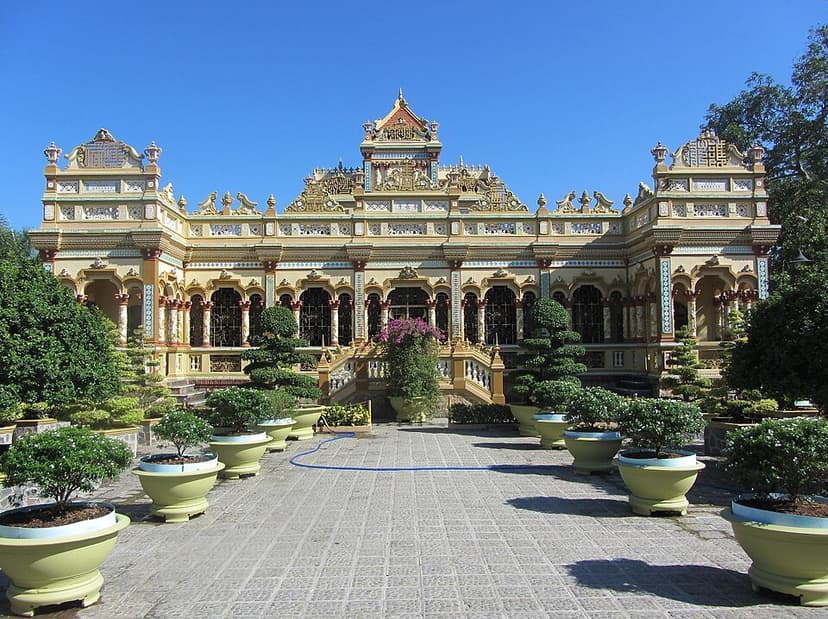
Vĩnh Tràng Temple is a prominent Buddhist temple located near Mỹ Tho in Vietnam's Mekong Delta, recognized as one of the region's most well-known religious sites. Established in the mid-19th century and undergoing significant renovations, it serves as a major destination for both tourists and pilgrims, and currently functions as the office for the provincial Buddhist Association.