
Gautama Buddha
Siddhartha Gautama, widely known as the Buddha, was a religious teacher who founded Buddhism in the eastern Indo-Gangetic Plains during the 6th or 5th century BCE. After renouncing his royal life, he achieved enlightenment and taught a Middle Way emphasizing ethical conduct, mindfulness, and meditation. His core teachings, including the Four Noble Truths and the Noble Eightfold Path, formed the basis of a tradition that spread widely.
Key Facts
- ›Founded Buddhism in the eastern Indo-Gangetic Plains during the 6th or 5th century BCE.
- ›Born to royal parents of the Shakya clan in Lumbini.
- ›Attained enlightenment (nirvana) at Bodh Gaya.
- ›Taught a Middle Way between sensual indulgence and severe asceticism.
- ›Core teachings include the four Noble Truths and the Noble Eightfold Path.
- ›His teachings were compiled into the Vinaya Piṭaka and Sūtra Piṭaka.
Important Relationships
- Shakya clan
- Bimbisara
- Ajatashatru
- Mahavira
- Ājīvika
- Cārvāka
- Jainism
- Ajñana
- Alara Kalama
- Uddaka Rāmaputta
Vinaya PiṭAka, SūTra PiṭAka
Lumbini, Bodh Gaya, Kushinagar, Indo-Gangetic Plains
Middle Indo-Aryan Dialects
Renounced Home Life
About Gautama Buddha
Siddhartha Gautama: The Founder of Buddhism
Siddhartha Gautama, most commonly known as the Buddha, meaning 'the awakened one,' was a pivotal religious teacher and wandering ascetic who lived in the eastern Indo-Gangetic Plains during the 6th or 5th century BCE. His life and teachings form the foundation of Buddhism, a major world religion.
Life and Historical Context
According to traditional Buddhist accounts, Siddhartha Gautama was born into a royal family of the Shakya clan in Lumbini, in what is now Nepal. He renounced his privileged life to become a wandering ascetic, seeking an end to suffering. After years of mendicancy and intense meditation, he attained enlightenment (nirvana) at Bodh Gaya, located in present-day Bihar, India. Following his awakening, the Buddha traveled through the lower Indo-Gangetic Plain, disseminating his teachings and establishing a monastic order known as the sangha.
Scholars generally agree that the Buddha lived, taught, and founded a monastic order during the Mahajanapada period, likely during the reign of Bimbisara of Magadha. However, the exact dates of his birth and death are uncertain, with various chronologies proposed, placing his life between the 6th and 4th centuries BCE. His life coincided with a period of significant intellectual and religious ferment in ancient India, marked by the flourishing of various śramaṇa schools of thought and influential thinkers.
Core Teachings and Contributions
The Buddha taught a Middle Way, eschewing both sensual indulgence and severe asceticism, as the path to liberation from ignorance, craving, rebirth, and suffering. His central doctrines are encapsulated in the Four Noble Truths and the Noble Eightfold Path, which outline ethical training, mindfulness, and meditative practices for the cultivation of the mind and compassion. Key concepts in his teachings include the five skandhas (aggregates of existence) and dependent origination, which explain the arising and ceasing of phenomena due to their interdependence, lacking inherent self-existence.
His teachings were initially transmitted orally and later compiled into canonical texts. The earliest compilations include the Vinaya Piṭaka, detailing monastic discipline, and the Sūtra Piṭaka, a collection of discourses attributed to him. Later traditions developed further texts, including systematic treatises, biographies, and stories of his past lives (Jataka tales).
Legacy and Significance
The Buddha's teachings spread beyond the Indian subcontinent, evolving into diverse traditions such as Theravāda, Mahāyāna, and Vajrayāna. While Buddhism's prominence in India declined after the 8th century CE, it flourished significantly in Southeast and East Asia, becoming a transformative spiritual and cultural force.
He is revered as the Tathāgata ('one who has thus gone' or 'thus come'), Bhagavato ('the Blessed One'), and Araham ('Worthy of homage'), among many other epithets that highlight his perfected qualities as a teacher and liberator.
Source: Wikipedia ↗
Frequently Asked Questions
What does the title 'Buddha' mean?
The title 'Buddha' means 'Awakened One' or 'Enlightened One.' It is not a personal name but a title given to those who have attained bodhi, or enlightenment, awakening from the 'deep sleep of ignorance.'
Where was Siddhartha Gautama born and where did he die?
According to Buddhist legends, Siddhartha Gautama was born in Lumbini, in what is now Nepal. Buddhist tradition holds that he died in Kushinagar, in modern-day Uttar Pradesh, India, reaching parinirvana.
What are the central teachings of the Buddha?
The Buddha's core teachings are summarized in the Four Noble Truths and the Noble Eightfold Path. These emphasize ethical training, kindness toward others, and meditative practices such as mindfulness and sense restraint.
What is the significance of the term 'Tathāgata'?
Tathāgata is a term the Buddha commonly used when referring to himself and other Buddhas. While its exact meaning is unknown, it is often interpreted as 'one who has thus gone' or 'one who has thus come,' signifying a being beyond all transient phenomena.
What historical evidence exists for the Buddha?
No written records from the Buddha's lifetime have been found. However, inscriptions from the middle of the 3rd century BCE, such as those of Ashoka, mention the Buddha and Buddhism, with Ashoka's Lumbini pillar inscription commemorating the Buddha's birthplace.
Related Buddhists
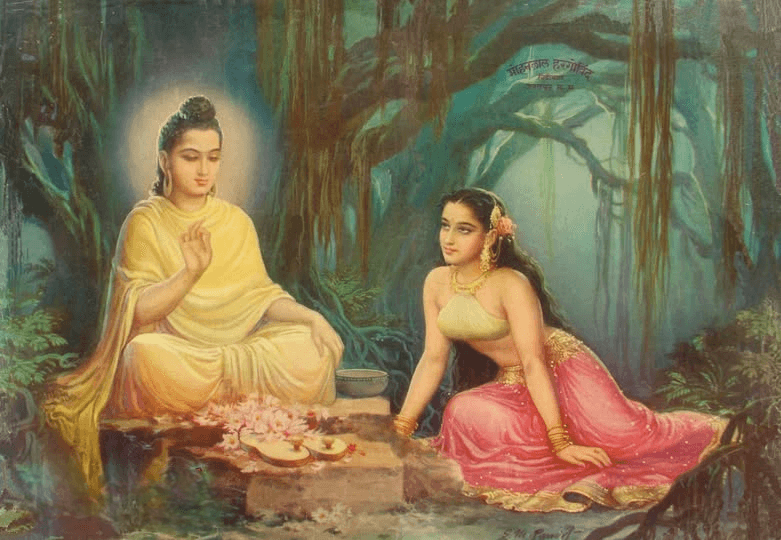
Amrapali
Amrapali, also known as Ambapālī, was a renowned nagarvadhu (royal courtesan) and rajnartaki (court dancer) in the Republic of Vaishali around 500 BCE. Celebrated for her extraordinary beauty and talent, she later embraced Buddhism and became an arahant. Her life is documented in ancient Pali texts and Buddhist traditions, notably in connection with her donation of a mango grove to the Buddha and his order.
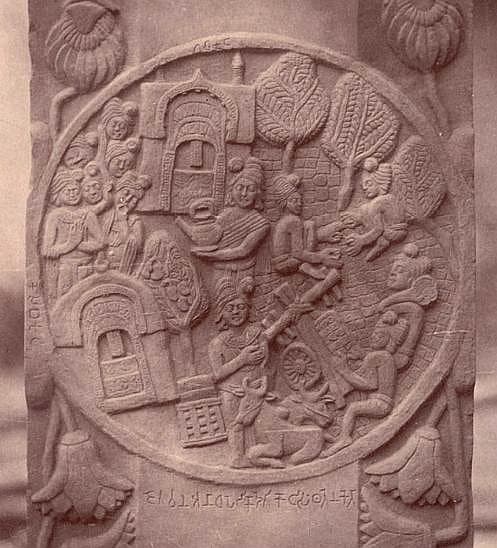
Anathapindika
Anathapindika, born Sudatta, was a prominent wealthy merchant and philanthropist in ancient Savatthi during the time of Gautama Buddha. He is renowned as the chief male patron of the Buddha and is celebrated for his exceptional generosity, earning him the name "one who gives alms to the unprotected." His most significant contribution was founding the Jetavana Monastery, a vital center for Buddhist practice.

Ajātasattu
Ajātasattu was a powerful king of the Haryanka dynasty in ancient Magadha, reigning from approximately 492 to 460 BCE. He is known for his military conquests, including the subjugation of the Vajjika League and the city of Vaishali, and for initiating the fortification of Pataliputra. A contemporary of both Mahavira and Gautama Buddha, Ajātasattu held significant religious importance in both Jain and Buddhist traditions, eventually becoming a devout follower of the Buddha.