
Amrapali
Amrapali, also known as Ambapālī, was a renowned nagarvadhu (royal courtesan) and rajnartaki (court dancer) in the Republic of Vaishali around 500 BCE. Celebrated for her extraordinary beauty and talent, she later embraced Buddhism and became an arahant. Her life is documented in ancient Pali texts and Buddhist traditions, notably in connection with her donation of a mango grove to the Buddha and his order.
Key Facts
- ›Amrapali was a celebrated nagarvadhu and rajnartaki in ancient Vaishali.
- ›She was believed to be spontaneously born at the foot of a mango tree.
- ›Amrapali's wealth and fame significantly contributed to the glory of Vaishali.
- ›She developed a relationship with King Bimbisara of Magadha and bore him a son.
- ›Amrapali later renounced her position, converted to Buddhism, and became an arahant.
- ›Her mango grove, Ambapali vana, was donated to the Buddha and his order, where he preached sermons.
Important Relationships
- Gautama Buddha
- Bimbisara
- Ajatashatru
- Vimala Kondanna
Ambapalika Sutra
Vaishali, Ambapali Vana
Gautama Buddha
Pali
Buddhist Vows
Courtesan, Dancer, Spiritual Figure
Historical Figure, Enlightened Being
About Amrapali
Āmrapālī
Āmrapālī, also known by variations such as Ambapālika and Ambapali, was a celebrated courtesan and court dancer of the Republic of Vaishali in ancient India, flourishing around the 5th century BCE. Her life story is documented in old Pali texts and Buddhist traditions, highlighting her eventual embrace of Buddhism and attainment of spiritual enlightenment.
Life and Spiritual Journey
Born around 600-500 BCE, Amrapali's name is etymologically linked to mango trees, and legends suggest she was born under one. She rose to prominence in Vaishali, a city known for its cultural vibrancy and the custom of appointing a nagarvadhu. Amrapali was renowned not only for her extraordinary beauty and charm but also for her talents in various art forms, including music and dance, which brought her considerable fame and wealth. Her status as a courtesan meant she was dedicated to the pleasure of many, though she retained the right to choose her lovers.
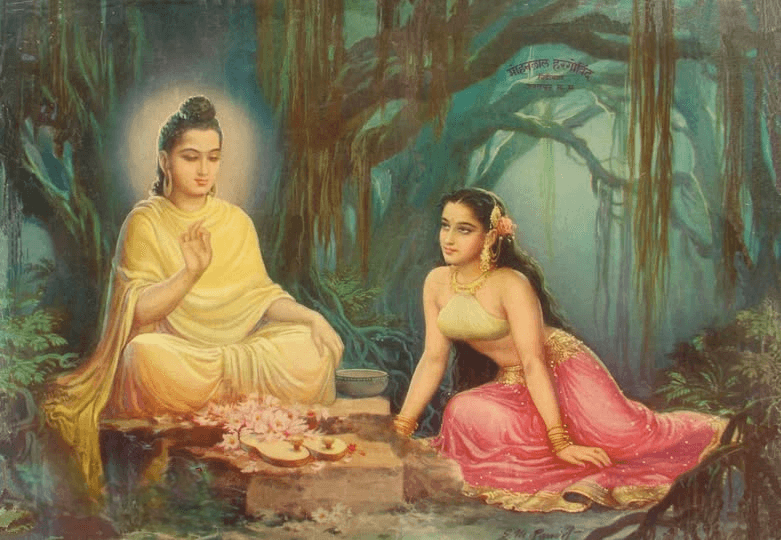
Stories recount her encounters with powerful rulers, including King Bimbisara of Magadha, with whom she is said to have had a son. Later, during an invasion by Ajatashatru, Amrapali's beauty reportedly moved him, leading to her preservation while Vaishali was devastated. Her most significant interaction, however, was with the Buddha. Amrapali was deeply moved by his teachings and invited him and his order for a meal. Following this encounter, she made a momentous decision to donate her property, including her well-known mango grove named Ambapali vana, to the Buddhist Sangha. This grove became a significant site for the Buddha's sermons.
Spiritual Attainment and Legacy
After dedicating her wealth and property to the Buddhist order, Amrapali renounced her life as a courtesan and court dancer and embraced the Buddhist path. She dedicated her remaining life to serving the poor and destitute. Buddhist traditions recognize her as an arahant, a fully enlightened being who has achieved nirvana. Her story is often cited as an example of the Buddha's unbiased regard towards women and his acceptance of individuals from all walks of life into the spiritual fold. While some historical accounts are preserved in Pali texts, her early life and relationships, such as the one with Bimbisara, are also found in Mahayana traditions and Gilgit Manuscripts, showcasing a complex cultural memory.
Amrapali's life has been adapted into numerous films, television series, and novels, cementing her place as a significant figure in both historical and cultural narratives.
Source: Wikipedia ↗
Frequently Asked Questions
Who was Amrapali?
Amrapali was a famous courtesan and court dancer in the Republic of Vaishali around 500 BCE. She was renowned for her exceptional beauty and artistic talents.
What is Amrapali known for in Buddhist traditions?
In Buddhist traditions, Amrapali is celebrated for embracing the Buddha's teachings and achieving the status of an arahant. She is also known for donating her mango grove, Ambapali vana, to the Buddha and his order, which became a significant site for sermons.
What was Amrapali's relationship with King Bimbisara?
According to some accounts, Amrapali had a relationship with King Bimbisara of Magadha, with whom she had a son named Vimala Kondanna. This alliance is mainly preserved in oral traditions and some Chinese Buddhist texts.
Did Amrapali have any connection to Ajatashatru?
Yes, Ajatashatru, Bimbisara's son, was reportedly moved by Amrapali's beauty. When she was imprisoned during a conflict, he burned Vaishali, but spared Amrapali. This event led her to renounce her affections for him.
How did Amrapali become an arahant?
Amrapali was deeply moved by a sermon given by the Buddha. She subsequently renounced her life as a courtesan, accepted Buddhist teachings, and dedicated herself to serving the poor and the Buddhist order, eventually attaining enlightenment as an arahant.
Related Buddhists

Gagan Malik
Gagan Malik is an Indian actor and Buddhist activist, widely recognized for his portrayal of Siddhartha Gautama (The Buddha) in the Sri Lankan film "Sri Siddhartha Gautama." He received the Best Actor Award at the World Buddhist Film Festival for this role, which significantly impacted his life and led him to embrace Buddhism and initiate humanitarian projects. Malik is also known for his acting roles as Lord Rama and his involvement in various television shows and films.

Lisa
Lalisa Manobal, known mononymously as Lisa, is a globally recognized Thai rapper, singer, and dancer. She achieved international fame as a member of the K-pop group Blackpink and later launched a successful solo career. Lisa is also an influential figure in fashion, serving as a global ambassador for luxury brands, and has expanded into acting and entrepreneurship.
Gautama Buddha
Siddhartha Gautama, widely known as the Buddha, was a religious teacher who founded Buddhism in the eastern Indo-Gangetic Plains during the 6th or 5th century BCE. After renouncing his royal life, he achieved enlightenment and taught a Middle Way emphasizing ethical conduct, mindfulness, and meditation. His core teachings, including the Four Noble Truths and the Noble Eightfold Path, formed the basis of a tradition that spread widely.