
Kalyani Ordination Hall
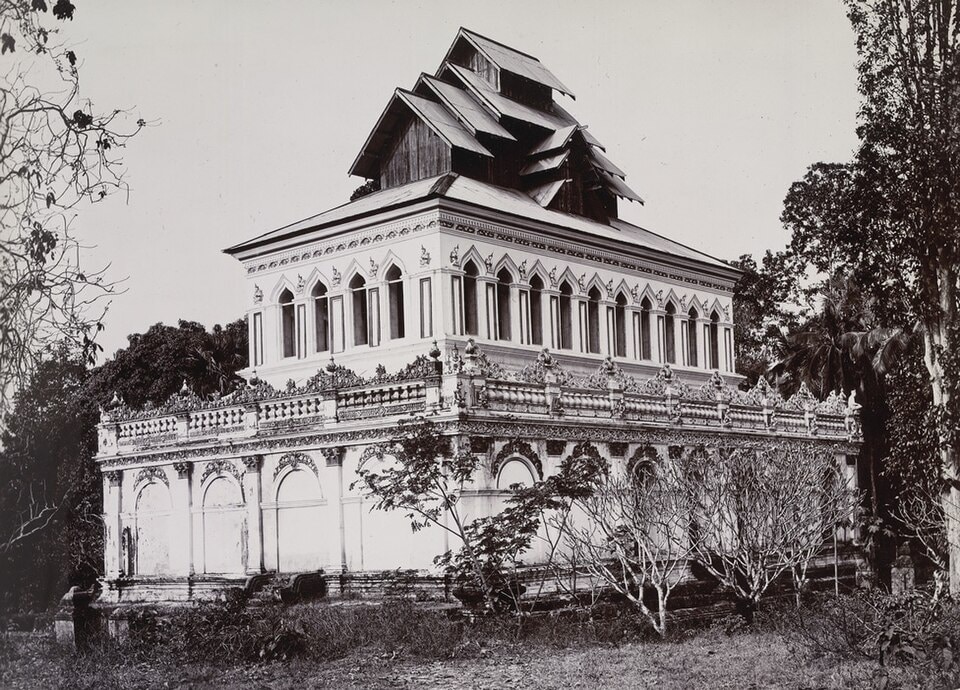
The Kalyani Ordination Hall is a significant Buddhist site in Bago, Myanmar, renowned for housing the Kalyani Inscriptions. These inscriptions, dating back to 1480, are crucial historical records of Theravada Buddhism. The hall itself, originally built in 1476 by King Dhammazedi to purify the Sangha, has been destroyed and reconstructed multiple times, with its current form dating from 1954.
Key Facts
- ›Established by King Dhammazedi of the Hanthawaddy kingdom in 1476.
- ›Built to purify the kingdom's Sangha through re-ordination of monks.
- ›Houses the Kalyani Inscriptions, sandstone pillars inscribed in Pali and Mon from 1480.
- ›The inscriptions are vital historical records of Theravada Buddhism.
- ›Has been destroyed multiple times, including by Portuguese explorers in 1599 and King Alaungpaya in 1757.
- ›The current structure was reconstructed in 1954 following an earthquake in 1930.
Important Relationships
- King Dhammazedi
- Hanthawaddy kingdom
- Kelaniya Raja Maha Vihara (Sri Lanka)
Kalyani Inscriptions
Re-Ordination of Monks To Purify the Sangha, Burning By Portuguese Explorers, Destruction By King Alaungpaya, Destruction By Earthquake, Reconstruction
About Kalyani Ordination Hall
The Kalyani Ordination Hall, known in Pali as Kalyāṇī Sīmā, is a significant Buddhist ordination hall situated in Bago, Myanmar. Its importance stems from its role as a major pilgrimage site and, crucially, as the repository of the Kalyani Inscriptions. These inscriptions, consisting of ten sandstone pillars carved in Pali and Mon, were erected in 1480 and provide invaluable historical documentation of Theravada Buddhism and the religious landscape of that era.
History and Construction
The history of the Kalyani Ordination Hall is deeply intertwined with the religious reforms of King Dhammazedi of the Hanthawaddy kingdom. In 1476, the king initiated a project to purify the kingdom's Sangha, which had been affected by internal schisms. To achieve this, he dispatched senior monks and their disciples to Sri Lanka for re-ordination at the Kelaniya Raja Maha Vihara. Upon their return, King Dhammazedi commissioned the construction of the Kalyani Ordination Hall, drawing its name from the Sri Lankan river, Kelani. This initial construction inspired the establishment of numerous similarly named ordination halls throughout the Hanthawaddy Kingdom, with nine large and 107 small ones documented.
The structure has faced considerable destruction over the centuries. It was burned by Portuguese explorers in 1599 and later destroyed by King Alaungpaya during his invasion of Bago in 1757. The hall has also succumbed to natural disasters, including fires and earthquakes, with a particularly devastating earthquake in 1930 leveling the entire structure. The present-day Kalyani Ordination Hall is a reconstruction completed in 1954.
Source: Wikipedia ↗
Frequently Asked Questions
When was the Kalyani Ordination Hall first built?
The Kalyani Ordination Hall was first built in 1476 by King Dhammazedi of the Hanthawaddy kingdom. Its construction was part of a larger effort to purify the Buddhist Sangha within the kingdom.
What are the Kalyani Inscriptions?
The Kalyani Inscriptions are a set of 10 sandstone pillars found at the ordination hall, inscribed in Pali and Mon in 1480. They are considered important historical records of Theravada Buddhism and the era in which they were created.
Has the Kalyani Ordination Hall always been standing?
No, the ordination hall has been destroyed multiple times throughout its history. It was burned by Portuguese explorers in 1599, destroyed by King Alaungpaya in 1757, and leveled by an earthquake in 1930.
What is the significance of the Kalyani Ordination Hall?
It is a major pilgrimage site that houses important historical inscriptions related to Theravada Buddhism. Its founding by King Dhammazedi also signifies a key moment in the religious history of the Hanthawaddy kingdom.
When was the current Kalyani Ordination Hall constructed?
The extant ordination hall was reconstructed in 1954. This followed the complete destruction of the previous structure by an earthquake in 1930.
Related Buddhist Temples

Upali Ordination Hall
The Upali Ordination Hall is a significant Buddhist ordination hall located in Myanmar, renowned for its exceptionally well-preserved interior frescoes from the Konbaung Dynasty. Originally built during the reign of King Anawrahta and consecrated by monks from Ceylon, its interior was later adorned with detailed murals depicting Buddhas, Jataka tales, and monastic discipline.
Htupayon Pagoda
The Htupayon Pagoda is a significant Buddhist stupa located in Sagaing, Myanmar, originally founded in 1444 by King Narapati I. It has a long history of enduring earthquakes and undergoing multiple major reconstructions, with the current structure completed in 2016, making it a testament to resilience and ongoing devotion.

Le-myet-hna Temple
Le-myet-hna Temple, meaning 'four-sided temple' in Burmese, is a significant Buddhist structure located in Mrauk U. Built by King Min Saw Mon in 1430 AD, it is distinguished by its unique architecture featuring four cardinal entrances and eight seated Buddhas surrounding a central column.