
Htupayon Pagoda
The Htupayon Pagoda is a significant Buddhist stupa located in Sagaing, Myanmar, originally founded in 1444 by King Narapati I. It has a long history of enduring earthquakes and undergoing multiple major reconstructions, with the current structure completed in 2016, making it a testament to resilience and ongoing devotion.
Key Facts
- ›Founded in 1444 by King Narapati I of Ava.
- ›Located near the Yadanabon Bridge in Sagaing, Myanmar.
- ›Has been impacted by numerous earthquakes throughout its history, notably in 1839 and 2012.
- ›Undergone at least three major reconstructions, with the most recent completed in 2016.
- ›The current height of the pagoda is 61.5 meters (202 ft).
- ›Its relic chamber was modeled after the Thuparamaya pagoda in Anuradhapura, Sri Lanka.
Important Relationships
- King Narapati I of Ava
- Thuparamaya pagoda
- Relic Chamber Modeled After Thuparamaya Pagoda In Anuradhapura, Sri Lanka
- Original Height of 49 Meters
- Current Height of 61.5 Meters
- Founded In 1444 By King Narapati I.
- Ceremony Commemorating Initial Construction Held In Late 1445 Or Early 1446.
- Relic Chamber Filled and Dedicated In 1447/48.
- Hti Raised In 1454/55.
- Severely Damaged By the 1839 Ava Earthquake.
- Sustained 15 Major Cracks From the November 11, 2012 Earthquake.
- Reconsecrated On March 16, 2016.
About Htupayon Pagoda
The Htupayon Pagoda is a prominent Buddhist stupa situated in Sagaing, Myanmar. Its foundation dates back to 1444, established by King Narapati I of Ava, making it a structure with a deep historical and religious significance. The pagoda is notable for its resilience, having endured numerous earthquakes throughout its existence due to its location on the Sagaing Fault.
History and Reconstructions
Construction of the Htupayon Pagoda commenced on October 23, 1444, during a period of Chinese invasions. The initial phase was completed around late 1445 or early 1446, marked by a ceremony attended by foreign diplomats and royals. The relic chamber was filled and dedicated in 1447/48, with the crowning umbrella installed in 1454/55. Historical inscriptions suggest its original height was 49 meters (161 ft).
The pagoda's history is marked by significant damage from earthquakes in various years, including 1501/02, 1512/13, 1590/91, 1648/49, 1781/82, 1839, and 2012. The 1839 Ava earthquake severely damaged the structure, leaving only the base intact. The 2012 earthquake caused 15 major cracks, raising concerns about its stability.
At least three major reconstructions have been undertaken. The first occurred in 1605/06. A second reconstruction project began in 1851/52 following the 1839 earthquake but was interrupted by political events. The most recent and significant reconstruction was completed in 2016, following the 2012 earthquake. This project, led by Ven. Sitagu Sayadaw, rebuilt the pagoda with an enlarged profile, a wider base, and increased height, reaching 61.5 meters (202 ft). The relic chamber was designed to emulate the Thuparamaya pagoda in Anuradhapura, Sri Lanka. The newly reconstructed pagoda was consecrated on March 16, 2016.
Significance
The Htupayon Pagoda is a testament to the enduring spirit of Buddhist faith and architectural preservation in Myanmar. Its repeated reconstructions highlight the importance placed on its upkeep and its role as a spiritual center. Its historical association with royalty and its survival through natural disasters underscore its deep-rooted place in the nation's heritage.
Source: Wikipedia ↗
Frequently Asked Questions
When was the Htupayon Pagoda founded?
The Htupayon Pagoda was founded in 1444 by King Narapati I of Ava. Construction began on October 23, 1444.
What is the current height of the Htupayon Pagoda?
The current height of the Htupayon Pagoda is 61.5 meters (202 ft). This is after its most recent reconstruction.
Has the Htupayon Pagoda been damaged by earthquakes?
Yes, the Htupayon Pagoda is located on the Sagaing Fault and has experienced repeated earthquakes throughout its history. Significant damage occurred from the 1839 Ava earthquake and the 2012 earthquake.
How many major reconstructions has the Htupayon Pagoda undergone?
The pagoda has undergone at least three major reconstructions. The first was in 1605/06, the second was initiated in 1851/52 in response to the 1839 earthquake, and the third was completed in 2016 following the 2012 earthquake.
What is notable about the relic chamber of the Htupayon Pagoda?
The relic chamber of the Htupayon Pagoda was modeled after the Thuparamaya pagoda in Anuradhapura, Sri Lanka. It was filled and dedicated by King Narapati I in 1447/48.
Related Buddhist Temples
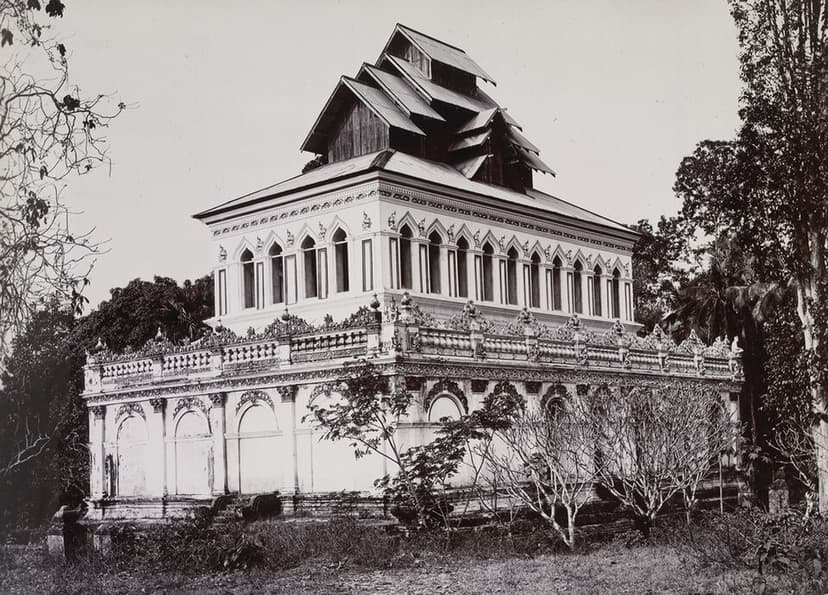
Kalyani Ordination Hall
The Kalyani Ordination Hall is a significant Buddhist site in Bago, Myanmar, renowned for housing the Kalyani Inscriptions. These inscriptions, dating back to 1480, are crucial historical records of Theravada Buddhism. The hall itself, originally built in 1476 by King Dhammazedi to purify the Sangha, has been destroyed and reconstructed multiple times, with its current form dating from 1954.

Le-myet-hna Temple
Le-myet-hna Temple, meaning 'four-sided temple' in Burmese, is a significant Buddhist structure located in Mrauk U. Built by King Min Saw Mon in 1430 AD, it is distinguished by its unique architecture featuring four cardinal entrances and eight seated Buddhas surrounding a central column.
Wat Zom Khum
Wat Zom Khum is a significant 15th-century Buddhist temple located in Kengtung, Shan State, Myanmar. Its prominent pagoda, standing at 38 meters high, is notable for housing six strands of the Buddha's hair, making it a site of religious importance.