
Le-myet-hna Temple
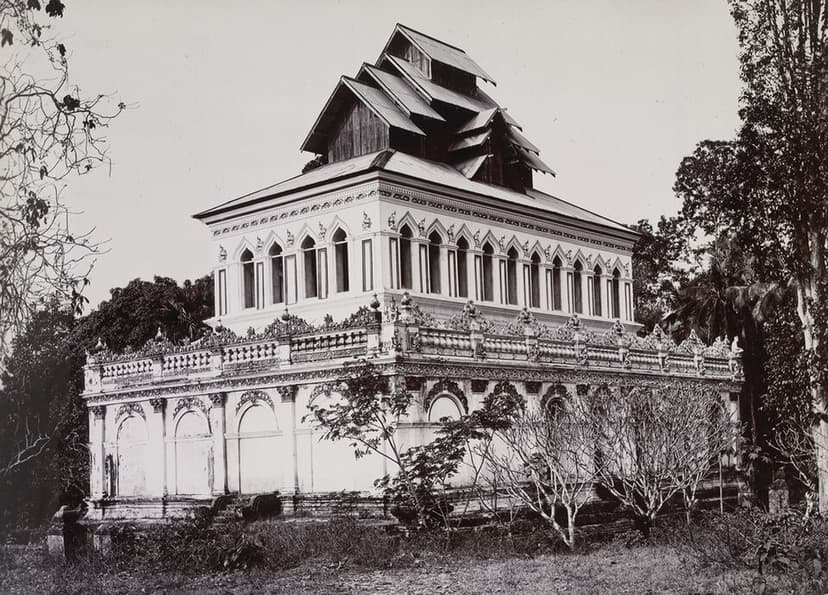
Le-myet-hna Temple, meaning 'four-sided temple' in Burmese, is a significant Buddhist structure located in Mrauk U. Built by King Min Saw Mon in 1430 AD, it is distinguished by its unique architecture featuring four cardinal entrances and eight seated Buddhas surrounding a central column.
Key Facts
- ›Built in 1430 AD by King Min Saw Mon.
- ›Located at the northwest corner of the Shite-thaung Temple in Mrauk U.
- ›Constructed entirely from black sandstone.
- ›Features four entrances, one on each cardinal point.
- ›Houses eight seated Buddhas around a central column.

Important Relationships
- King Min Saw Mon
Four Cardinal Entrances, Eight Seated Buddhas Around A Central Column
About Le-myet-hna Temple
Le-myet-hna Temple, a name that translates to 'four-sided temple' in Burmese, is a significant Buddhist religious site located in Mrauk U, Myanmar. Its construction dates back to 1430 AD, initiated by King Min Saw Mon. The temple is noted for its distinctive architectural design, built entirely from black sandstone.
Architectural Characteristics
A key feature of Le-myet-hna Temple is its symmetrical layout, boasting four entrances, one positioned at each of the cardinal points: north, south, east, and west. Within the temple's interior, a central column serves as the focal point, around which eight seated Buddha images are arranged. This unique arrangement contributes to the temple's spiritual atmosphere and architectural significance.
Historical Context
Founded during the era of King Min Saw Mon, the temple stands as a testament to the architectural and religious practices of its time. Its location in Mrauk U places it within a region rich with historical Buddhist sites, and it is situated near the prominent Shite-thaung Temple, to the northwest of which it lies. The use of black sandstone for its entire construction is a notable material choice that defines its visual character.
Source: Wikipedia ↗
Frequently Asked Questions
When was Le-myet-hna Temple built?
Le-myet-hna Temple was built in 1430 AD. It was constructed during the reign of King Min Saw Mon.
What does the name 'Le-myet-hna' mean?
The name 'Le-myet-hna' translates from Burmese to 'four-sided temple'. This name reflects its distinctive architectural design.
What materials was Le-myet-hna Temple constructed from?
The temple was entirely constructed using black sandstone. This material gives the structure a unique and somber appearance.
What are the notable architectural features of Le-myet-hna Temple?
Le-myet-hna Temple is characterized by its four entrances, positioned at each of the cardinal directions. Internally, it features a central column around which eight seated Buddhas are arranged.
Where is Le-myet-hna Temple located?
Le-myet-hna Temple is situated in Mrauk U, in modern-day Myanmar. It is specifically located at the northwest corner of the Shite-thaung Temple.
Related Buddhist Temples
Htupayon Pagoda
The Htupayon Pagoda is a significant Buddhist stupa located in Sagaing, Myanmar, originally founded in 1444 by King Narapati I. It has a long history of enduring earthquakes and undergoing multiple major reconstructions, with the current structure completed in 2016, making it a testament to resilience and ongoing devotion.
Kalyani Ordination Hall
The Kalyani Ordination Hall is a significant Buddhist site in Bago, Myanmar, renowned for housing the Kalyani Inscriptions. These inscriptions, dating back to 1480, are crucial historical records of Theravada Buddhism. The hall itself, originally built in 1476 by King Dhammazedi to purify the Sangha, has been destroyed and reconstructed multiple times, with its current form dating from 1954.
Wat Zom Khum
Wat Zom Khum is a significant 15th-century Buddhist temple located in Kengtung, Shan State, Myanmar. Its prominent pagoda, standing at 38 meters high, is notable for housing six strands of the Buddha's hair, making it a site of religious importance.