
Dorje Drak
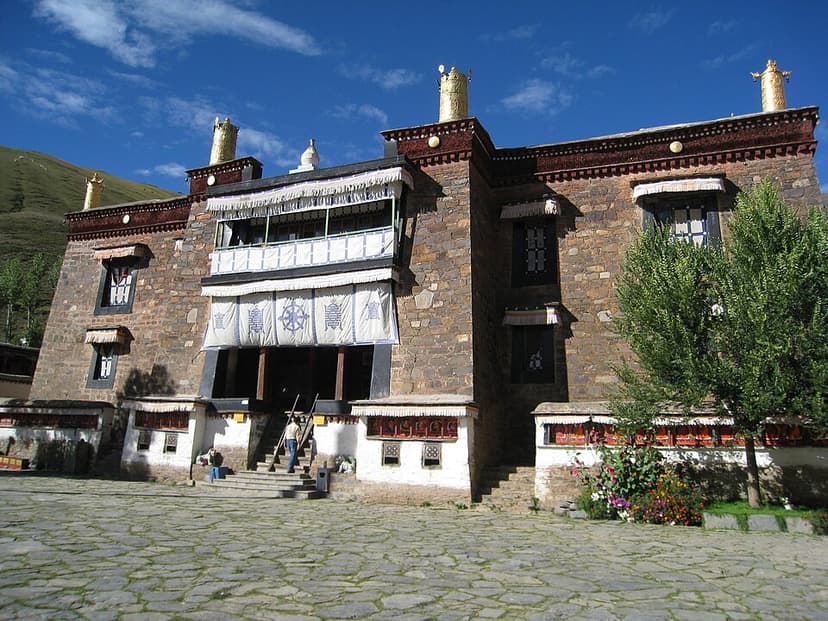
Dorje Drak, meaning "Indestructible Rock Vihara," is a significant Tibetan Buddhist monastery of the Nyingma school, historically one of its "Six Mother Monasteries." Located in the Lhoka Prefecture of Tibet, it was established as Ewam Chogar Gompa and later renamed Dorje Drak due to auspicious natural formations found at its relocation site. The monastery has endured destruction and rebuilding throughout its history, playing a central role in the Nyingma tradition.
Key Facts
- ›Originally named Ewam Chogar Gompa, it was founded by Ngari Panchen Pema Wangyal.
- ›The name Dorje Drak was adopted after the discovery of Padmasambhava's footprint and a naturally formed crossed vajra.
- ›It is considered one of the two most important Nyingma monasteries in the Ü region, alongside Mindrolling Monastery.
- ›The monastery was sacked by Dzungar Mongolians in 1717 and rebuilt under the patronage of the 7th Dalai Lama.
- ›It specialized in the Northern Treasures (Jangter) tradition of Rigdzin Gödem.
- ›A new monastery, Thupten Dorje Drak Ewam Chogar Chökhor Namgyal Ling, was founded in Shimla, India, in 1984 after the original was destroyed.

Important Relationships
- Ngari Panchen Pema Wangyal
- Jangdag Tashi Tobgyal Wangpode
- Rigdzin Ngakgi Wangpo
- Rigdzin Pema Trinle
- 7th Dalai Lama, Kelzang Gyatso
- Rigdzin Gödemchen Ngodrub Gyeltsen
- Taklung Tsetrul Rinpoche
Footprint of Padmasambhava, Naturally Formed Crossed Vajra
- Relocation From Tsang To Its Present Site In 1632
- Sacked By Dzungar Mongolians In 1717
- Rebuilding Began In 1720 Under Patronage of the 7th Dalai Lama
- Destroyed During the 1960s
- Restored From the Mid-1980s
About Dorje Drak
Dorje Drak, meaning "Indestructible Rock Vihara," is a historically significant Tibetan Buddhist monastery belonging to the Nyingma school. It is recognized as one of the "Six Mother Monasteries" of this tradition and is situated in the Lhoka Prefecture of Tibet, in the older southeastern Ü-Tsang region. The monastery's importance extends beyond its original location, with a successor monastery established in Shimla, India, after the original was destroyed.
History and Establishment
The monastery's origins trace back to Ewam Chogar Gompa, built by Ngari Panchen Pema Wangyal (1487-1582). Its name was later changed to Dorje Drak following the discovery of auspicious natural formations at its relocation site: a footprint of Padmasambhava (Guru Rinpoche) and a naturally formed crossed vajra. This relocation occurred in 1632, when the young Third Rigdzin Ngagiwangpo and his guardian were forced to flee the kings of Tsang. The monastery was significantly enlarged by the Fourth Rigdzin Pema Trinle, but it suffered destruction in 1717 at the hands of Dzungar Mongolians.
Reconstruction and Tradition
Rebuilding efforts commenced in 1720 under the patronage of the 7th Dalai Lama. Despite these efforts, the monastery's structures were still largely in ruins when the Fifth Dorje Drak Rigdzin, Kelzang Pema Wangchuk, was enthroned. The Sixth Dorje Drak Rigdzin, Kunzang Gyurme Lhundrub, is remembered for his dedication to the monastery's maintenance, teachings, and the commissioning of religious texts. The monastery specialized in the Northern Treasures (Jangter) tradition, founded by Rigdzin Gödemchen Ngodrub Gyeltsen. It housed approximately 200 monks before the Chinese invasion and around 400 monks prior to the Cultural Revolution.
Destruction and Exile
Dorje Drak was again obliterated in the 1960s. However, it has been gradually restored in recent years through the collaborative efforts of the current incarnation of Dordrak Rigdzin, local communities, and figures like Kelzang Chojor. In response to the destruction of the original monastery, a new monastery named Thupten Dorje Drak Ewam Chogar Chökhor Namgyal Ling was founded in 1984 in Shimla, India, by Taklung Tsetrul Rinpoche. This exile monastery now serves as the seat of the throne-holder of the Dorje Drak tradition and is the current location of the Head of the Nyingma sect.
Source: Wikipedia ↗
Frequently Asked Questions
What does the name Dorje Drak mean?
Dorje Drak translates from Tibetan as "Indestructible Rock Vihara." This name was adopted after auspicious signs, including a footprint of Padmasambhava and a naturally formed crossed vajra, were found at its relocation site.
What is the historical significance of Dorje Drak?
Dorje Drak is recognized as one of the "Six Mother Monasteries" of the Nyingma school of Tibetan Buddhism. It has been a central seat for the Nyingma tradition and has played a key role in preserving and propagating its teachings, particularly the Jangter tradition.
Has Dorje Drak been destroyed and rebuilt?
Yes, the monastery has faced destruction multiple times. It was sacked by Dzungar Mongolians in 1717 and later obliterated during the 1960s. Rebuilding efforts have taken place, with significant restoration occurring from the mid-1980s onwards.
Is there a Dorje Drak monastery outside of Tibet?
Following the destruction of the original monastery, a new Dorje Drak monastery was established in Shimla, India, in 1984. This exile monastery serves as the seat for the throne-holder of the tradition.
What Buddhist tradition is Dorje Drak associated with?
Dorje Drak is a prominent monastery of the Nyingma school, one of the four major schools of Tibetan Buddhism. It is particularly known for its association with the Jangter, or Northern Treasures, tradition.
Related Buddhist Temples

Dzogchen Monastery
Dzogchen Monastery is a significant institution within the Nyingma tradition of Tibetan Buddhism, recognized as one of its "Six Mother Monasteries." Historically located in Kham, Tibet, it was renowned for its extensive community and the Sri Singha Shedra, a renowned monastic college. Following its destruction in the mid-20th century, it was re-established in South India and also continues reconstruction efforts in Tibet.
Kathok
Kathok Monastery, founded in 1159, is a significant "Mother Monastery" of the Nyingma school of Tibetan Buddhism, located in the Kham region of Tibet. It holds historical importance as a center for scholarship and the Anuyoga tradition, and it is renowned for its association with Padmasambhava and the prophecy of 100,000 individuals achieving rainbow body there.
Mindrolling Monastery
Mindrolling Monastery is one of the "Six Mother Monasteries" of the Nyingma school in Tibet, founded in 1676 by Rigzin Terdak Lingpa. Known for its emphasis on scriptural learning, astronomy, and traditional Tibetan medicine, it trained Nyingma scholars and yogis for nearly three centuries. Although damaged by conflict, it has been subject to ongoing reconstruction in Tibet and has also been re-established in India.