
Kathok
Kathok Monastery, founded in 1159, is a significant "Mother Monastery" of the Nyingma school of Tibetan Buddhism, located in the Kham region of Tibet. It holds historical importance as a center for scholarship and the Anuyoga tradition, and it is renowned for its association with Padmasambhava and the prophecy of 100,000 individuals achieving rainbow body there.
Key Facts
- ›Founded in 1159 by Kathok Kadampa Deshek, a prophecy by Guru Rinpoche.
- ›One of the "six Mother Monasteries" of the Nyingma school in Tibet.
- ›Located in Baiyu County, Garzê Tibetan Autonomous Prefecture, Sichuan, at an altitude of 4,000 meters.
- ›Rebuilt in 1656 after falling into disrepair, and again after being destroyed during the Cultural Revolution.
- ›Historically a center for Nyingma Kama lineages and the Anuyoga tradition.
- ›Has influenced the spread of Nyingma monasteries across Tibet, Mongolia, Inner China, Yunnan, and Sikkim.
Important Relationships
- Padmasambhava
- Kathok Kadampa Deshek
- Phagmo Drupa Dorje Gyalpo
- Yeshe Tsogyal
- Düddül Dorjé
- Rigdzin Longsal Nyingpo
- Moktsa Tulku
- Khenpo Ngakchung Tulku
- Katok Rigdzin-tsewang-norbu
- Situ Panchen Chokyi-jungney
- Dzongsar Khyentse Chökyi Lodrö
- Jamyang Gyeltsen
- 4th Kathok Getse Rinpoche Gyurme Tenpa Gyaltsen
- Rock With A Double Vajra and "Kaཿ " Syllable
- Site of Prophecy of 100,000 People Achieving Rainbow Body
- Center For Nyingma Kama Lineages and Anuyoga Tradition
- Founded In 1159.
- Rebuilt In 1656.
- Destroyed After 1966.
- Rebuilt Through Efforts of Moktsa Tulku and Khenpo Ngakchung Tulku.
- Compilation of A 120-Volume Kathok Edition of Oral Lineages In 1999.
About Kathok
Kathok Monastery
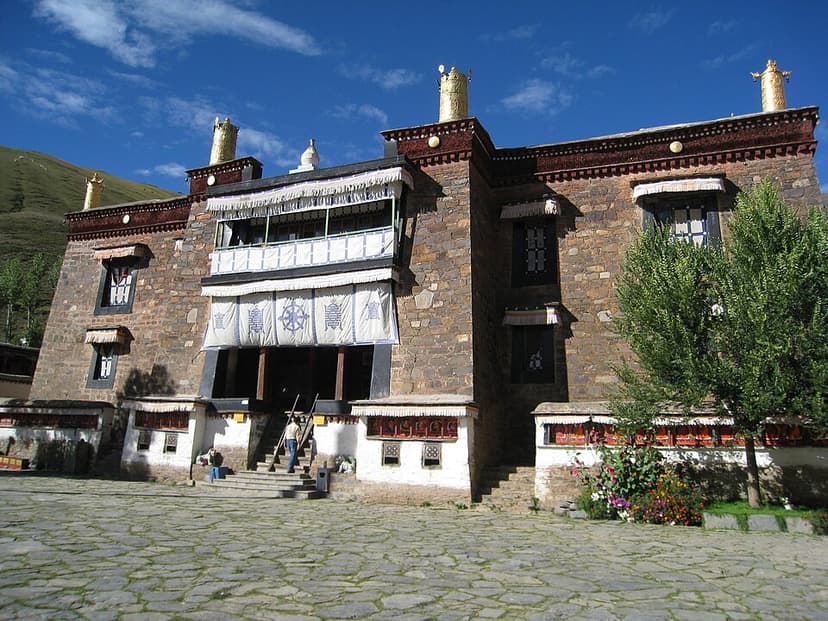
Kathok Monastery, also transliterated as Kathog, Katok, or Katog, is a historically significant Buddhist monastery in Tibet, founded in 1159. It stands as one of the "Six Mother Monasteries" belonging to the Nyingma school of Tibetan Buddhism. Its establishment occurred in the Kingdom of Dege, within the Kham region, an area also known as Do Kham. The monastery's name, meaning "on top of the kaཿ ", originates from its construction upon a sacred rock visited by the revered Buddhist master Padmasambhava, also known as Guru Rinpoche.
History and Significance
The founding of Kathok Monastery is attributed to Kathok Kadampa Deshek, who was a younger brother of Phagmo Drupa Dorje Gyalpo. Guru Rinpoche is said to have prophesied that Deshek would be an emanation of Yeshe Tsogyal and that 100,000 individuals would achieve rainbow body at Kathok. The monastery quickly grew to include numerous branch monasteries across the Do Kham region and beyond, contributing to the spread of Nyingma monasticism.
Kathok has been recognized for its scholarly tradition and its role in preserving the Anuyoga tradition, which had become neglected by other Nyingmapa institutions. The monastery was rebuilt in 1656 after the original structure fell into disrepair. It faced destruction in the period following 1966, during which lamas were imprisoned. However, it was subsequently rebuilt through the dedicated efforts of figures such as Moktsa Tulku and Khenpo Ngakchung Tulku. In 1999, a comprehensive Kathok edition of the oral lineages, twice the size of the Dudjom edition, was compiled, containing rare Nyingma treatises.
Location and Features
Kathok Monastery is situated at an elevation of approximately 4,000 meters (13,000 ft) above sea level on the eastern slopes of a mountain range in Baiyu County, Garzê Tibetan Autonomous Prefecture, Sichuan, China. The monastery complex itself is about 700 meters (2,300 ft) above the valley floor, accessible via a winding dirt road. The nearest town is Horpo, located 17 km to the north. An expansion of the monastery, including a new temple and assembly hall, was completed in 2016, adjacent to the existing complex.
Notable Figures
Over its long history, Kathok Monastery has been associated with many esteemed scholars and practitioners. These include Katog Tsewang Norbu, Getse Mahapandita, Katok Situ Chökyi Gyatso, Khenpo Ngawang Pelzang (Khenpo Ngakchung), and Katok Situ Chökyi Nyima. More recently, figures like Jamyang Gyeltsen, involved in the monastery's rebuilding, and the 4th Kathok Getse Rinpoche Gyurme Tenpa Gyaltsen, known for his mastery of Dzogchen and his role as the 7th head of the Nyingma school, have been prominent.
Source: Wikipedia ↗
Frequently Asked Questions
When was Kathok Monastery founded?
Kathok Monastery was founded in the year 1159. Its establishment was linked to a prophecy by Guru Rinpoche.
What is the significance of Kathok Monastery in Tibetan Buddhism?
Kathok Monastery is one of the "Six Mother Monasteries" of the Nyingma school and is considered a sacred site associated with Guru Rinpoche. It has been a prominent center for scholarship and the preservation of specific Buddhist traditions.
Where is Kathok Monastery located?
Kathok Monastery is situated in Baiyu County, within the Garzê Tibetan Autonomous Prefecture in Sichuan, China. It is located at an altitude of approximately 4,000 meters (13,000 ft).
What is the meaning of Kathok's name?
The name Kathok means "on top of the kaཿ". This refers to the monastery being built on a rock with a "kaཿ " syllable on top, which is a sacred site visited by Guru Rinpoche.
Has Kathok Monastery been destroyed and rebuilt?
Yes, the original monastery fell into disrepair and was rebuilt in 1656. It was later destroyed after 1966 during the Cultural Revolution and subsequently rebuilt through the efforts of lamas like Moktsa Tulku and Khenpo Ngakchung Tulku.
Related Buddhist Temples

Dorje Drak
Dorje Drak, meaning "Indestructible Rock Vihara," is a significant Tibetan Buddhist monastery of the Nyingma school, historically one of its "Six Mother Monasteries." Located in the Lhoka Prefecture of Tibet, it was established as Ewam Chogar Gompa and later renamed Dorje Drak due to auspicious natural formations found at its relocation site. The monastery has endured destruction and rebuilding throughout its history, playing a central role in the Nyingma tradition.

Dzogchen Monastery
Dzogchen Monastery is a significant institution within the Nyingma tradition of Tibetan Buddhism, recognized as one of its "Six Mother Monasteries." Historically located in Kham, Tibet, it was renowned for its extensive community and the Sri Singha Shedra, a renowned monastic college. Following its destruction in the mid-20th century, it was re-established in South India and also continues reconstruction efforts in Tibet.
Mindrolling Monastery
Mindrolling Monastery is one of the "Six Mother Monasteries" of the Nyingma school in Tibet, founded in 1676 by Rigzin Terdak Lingpa. Known for its emphasis on scriptural learning, astronomy, and traditional Tibetan medicine, it trained Nyingma scholars and yogis for nearly three centuries. Although damaged by conflict, it has been subject to ongoing reconstruction in Tibet and has also been re-established in India.