
Bayon
Temple·Cambodia·13th century·Mahayana Buddhism, Theravada Buddhism
The Bayon is a richly decorated Theravada Buddhist temple located in the center of Angkor Thom, Cambodia. Built in the late 12th or early 13th century as the state temple of King Jayavarman VII, it is renowned for its numerous towers adorned with serene, smiling stone faces, widely interpreted as representations of the king and symbolizing compassion and royal authority. Originally conceived as a Mahayana Buddhist monument, it later adapted to the spread of Theravada Buddhism, illustrating the close relationship between Buddhism and royal power in the Khmer Empire.
Key Facts
- ›Constructed in the late 12th or early 13th century by King Jayavarman VII.
- ›Located at the center of Jayavarman VII's capital city, Angkor Thom.
- ›Famous for its towers featuring approximately 200 serene, smiling stone faces.
- ›Originally a Mahayana Buddhist monument, later adapted for Theravada Buddhism.
- ›Features extensive bas-reliefs depicting historical events, religious themes, and daily life.
- ›Considered a striking expression of the baroque style of Khmer architecture.

Important Relationships
- King Jayavarman VII
- Angkor Thom
- Angkor Wat
- Tonle Sap
- Cham forces
- Towers With Serene, Smiling Stone Faces
- Extensive Bas-Reliefs Depicting Historical and Daily Life Scenes
- Central Tower
- Inner and Outer Galleries
- Built As the State Temple of King Jayavarman Vii.
- Adapted To the Spread of Theravada Buddhism.
- Underwent Alterations During the Reign of Hindu Restorationist King Jayavarman Viii.
- Restored In the 20th Century By the éCole FrançAise D'ExtrêMe Orient.
- Conservation Led By the Japanese Government Team For the Safeguarding of Angkor Since 1995.
Baroque Khmer Architecture
About Bayon
Bayon: The Temple of Faces
The Bayon is a highly ornate Buddhist temple located in the heart of Angkor Thom, Cambodia. Constructed in the late 12th or early 13th century by King Jayavarman VII, it served as the state temple of his vast capital city. The Bayon is most celebrated for its striking collection of enigmatic, serene stone faces that adorn its many towers, which are widely believed to represent King Jayavarman VII himself, embodying compassion and royal authority.
History and Religious Significance
Originally conceived as a Mahayana Buddhist monument, the Bayon's religious orientation evolved over time. It later accommodated the growing influence of Theravada Buddhism in Cambodia. This adaptability, along with its rich iconography, highlights the deep connection between Buddhist principles and royal power within the Khmer Empire. The temple's history also includes periods of alteration, notably when the empire temporarily reverted to Hinduism under King Jayavarman VIII, before Theravada Buddhism became dominant. Modern restoration efforts, led by organizations like the École Française d'Extrême Orient and the Japanese Government Team for the Safeguarding of Angkor (JSA), have been crucial in preserving this iconic structure.
Architectural and Artistic Marvel
The Bayon is distinguished by its unique architectural style, described by the JSA as "the most striking expression of the baroque style" of Khmer architecture, in contrast to the classical style of Angkor Wat. Beyond the famous faces, the temple features extensive bas-reliefs that offer vivid depictions of historical events, religious narratives, and scenes of daily life in the Khmer Empire. These detailed carvings provide invaluable insights into the society, warfare, and culture of the Angkorian period. The temple's spatial organization, with its crowded enclosures and prominent upper terrace, contributes to its distinctive atmosphere, where the omnipresent faces of Lokesvara seem to follow the visitor.
Key Features
The temple's most recognizable features are its towers, which originally numbered around 49, though only 37 remain. Each tower supports two to four gigantic, smiling faces, with the total number of faces estimated to be around 200. The outer gallery showcases a continuous series of bas-reliefs depicting significant historical events and vibrant scenes of everyday life, including naval battles and market activities. The inner gallery, in contrast, is largely adorned with scenes from Hindu mythology. At the center of the temple once stood a large statue of the Buddha, which was later removed and destroyed during the Hindu restorationist period but has since been recovered and pieced together.
Source: Wikipedia ↗
Frequently Asked Questions
What is the Bayon temple famous for?
The Bayon is most famous for its numerous towers adorned with serene, smiling stone faces carved on all sides. These faces are commonly interpreted as representations of King Jayavarman VII and symbolize compassion and royal authority.
When was the Bayon built and by whom?
The Bayon was built in the late 12th or early 13th century. It served as the state temple of King Jayavarman VII, who was responsible for its construction as the centerpiece of his capital city, Angkor Thom.
What is the religious affiliation of the Bayon?
Originally, the Bayon was conceived as a Mahayana Buddhist monument. Over time, it adapted to the spread of Theravada Buddhism in Cambodia, and it continues to be used as a Buddhist sanctuary.
What do the carvings on the Bayon represent?
The numerous smiling stone faces on the towers are widely interpreted as representations of King Jayavarman VII, symbolizing compassion and royal authority. Some local beliefs also associate the faces with Brahma due to their four-sided nature, and the three eyes are seen to symbolize Shiva.
What are the bas-reliefs at the Bayon depicting?
The outer gallery of the Bayon features extensive bas-reliefs that depict historical events, religious themes, and scenes of everyday life in the Khmer Empire. These include depictions of battles, processions, market scenes, and domestic life, serving as important visual sources for understanding Angkorian society.
Has the Bayon undergone any changes since its construction?
Yes, the Bayon has undergone numerous additions and alterations since its construction. Subsequent monarchs made changes, including during the reign of Jayavarman VIII when the empire reverted to Hinduism, and later when Theravada Buddhism became dominant. Features like the eastern terrace and libraries are later additions.
Related Buddhist Temples
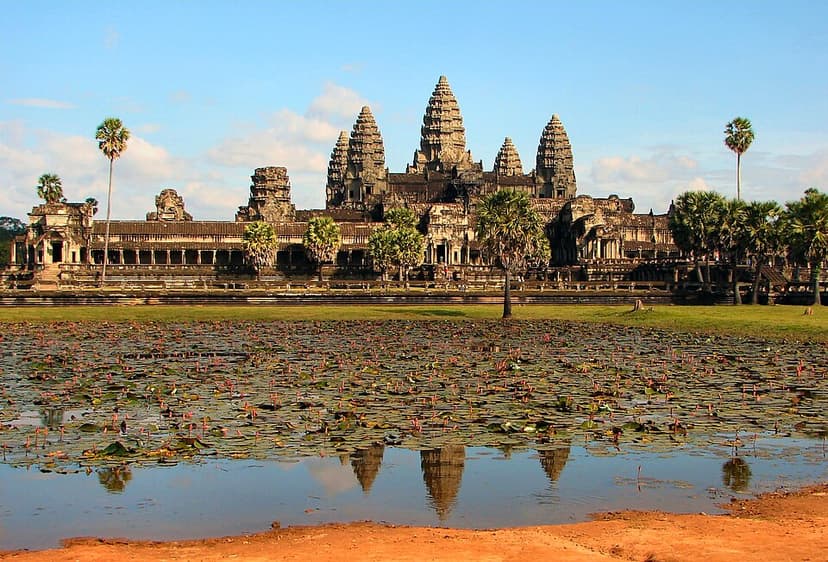
Angkor Wat
Angkor Wat, originally a Hindu temple dedicated to Vishnu and commissioned by King Suryavarman II in the early 12th century, is the largest religious complex in the world and a cornerstone of Khmer architecture. It was gradually transformed into a Theravada Buddhist temple from the late 13th century onwards and has remained an active center of Buddhist worship, serving as a potent symbol of Cambodia and appearing on its national flag.

Banteay Kdei
Banteay Kdei is a Buddhist temple located in Angkor, Cambodia, built in the mid-12th to early 13th centuries during the reign of Jayavarman VII. Characterized by its Bayon architectural style, it served as a Buddhist monastic complex. Although currently dilapidated due to construction issues and poor stone quality, it is undergoing renovation and was occupied by monks until the 1960s.

Baphuon
The Baphuon is a significant Buddhist temple located in Angkor Thom, Cambodia, renowned for its "golden mountain" appearance and its intricate carvings. Originally dedicated to Shiva, it was later converted to Theravada Buddhism, with major restoration efforts transforming it into what has been called the "largest 3D jigsaw puzzle in the world."