
Baphuon
The Baphuon is a significant Buddhist temple located in Angkor Thom, Cambodia, renowned for its "golden mountain" appearance and its intricate carvings. Originally dedicated to Shiva, it was later converted to Theravada Buddhism, with major restoration efforts transforming it into what has been called the "largest 3D jigsaw puzzle in the world."
Key Facts
- ›Built in the MID-11th century, it served as the state temple of Suryavarman I and was originally dedicated to Shiva.
- ›It is an archetype of the Baphuon architectural style, characterized by extensive and intricate carvings.
- ›The temple underwent Theravada Buddhist modifications, including the addition of a large reclining Buddha statue.
- ›Due to its construction on an unstable sandy base, the temple experienced significant structural collapses throughout its history.
- ›A monumental restoration project, known as anastylosis, was undertaken in the late 20th and early 21st centuries, taking 51 years to complete.
- ›The Baphuon is located northwest of the Bayon temple in Angkor Thom.

Important Relationships
- Suryavarman I
- Temür Khan
- Zhou Daguan
- Pascal Royère
- King Norodom Sihamoni
- François Fillon
Artificial Hill Construction, Intricate Carvings, Three-Tiered Temple Mountain Design, Reclining Buddha Statue
- Original Dedication To Shiva
- Conversion To Theravada Buddhism
- Addition of the Reclining Buddha Statue
- Collapse and Subsequent Large-Scale Restoration Projects
Baphuon Style
About Baphuon
The Baphuon is a significant Buddhist temple located within the ancient city of Angkor Thom, in Cambodia. It is distinguished by its construction on an artificial hill, earning it the moniker "golden mountain" (svarnādrī). Originally consecrated to the Hindu deity Shiva in the mid-11th century, the temple was later converted to Theravada Buddhism. Its architecture is considered the archetype of the Baphuon style, characterized by extensive and intricate carvings that adorn nearly every available surface.
History and Construction
Built as the state temple of Suryavarman I (1010–1050 CE), the Baphuon is a three-tiered temple mountain. Recent scientific dating has placed its construction much earlier than previously believed, associating it definitively with Suryavarman I's reign. The temple measures approximately 120 by 100 meters at its base and stands about 34 meters tall, excluding its original tower. The sheer scale and grandeur of the Baphuon impressed foreign visitors, such as Zhou Daguan, an envoy from Temür Khan's court in the late 13th century, who described it as a "Tower of Bronze."
Religious and Structural Transformations
Over time, the Baphuon underwent significant modifications. French scientists have dated Theravada Buddhist alterations to approximately a century before the conventional 16th-century estimation. A notable change was the construction of a large reclining Buddha statue, measuring 9 meters high and 70 meters long, on the west side's second level. This addition likely necessitated the demolition of the 8-meter tower above it to provide building materials. The temple's foundation, built on sand, contributed to its historical instability, with large portions collapsing even before the Buddha was added.
Restoration Efforts
By the 20th century, much of the Baphuon had fallen into disrepair. A massive restoration project, employing the technique of anastylosis (dismantling for structural reinforcement and reassembly), was initiated but abandoned in 1970 due to the outbreak of civil war. This left approximately 300,000 carefully labeled blocks scattered, with their identifying plans lost during the subsequent conflict and Khmer Rouge regime.
A second, monumental restoration effort began in 1996 under the guidance of architect Pascal Royère. This project, widely described as the "largest 3D jigsaw puzzle in the world," took 16 years to complete. The temple was formally reopened on July 3, 2011, with dignitaries including King Norodom Sihamoni of Cambodia and Prime Minister François Fillon of France in attendance, marking the culmination of 51 years of combined restoration work.
Source: Wikipedia ↗
Frequently Asked Questions
When was the Baphuon temple built?
Recent dating suggests the Baphuon was built in the mid-11th century, associated with the reign of Suryavarman I (1010–1050 CE). This is earlier than previously thought.
What was the original dedication of the Baphuon temple?
The Baphuon was originally dedicated to the Hindu god Shiva. It was later converted into a Theravada Buddhist temple.
What is notable about the Baphuon's architectural style?
It is considered the archetype of the Baphuon style, featuring intricate carvings that cover almost every available surface. The temple is built on an artificial hill and is a three-tiered temple mountain.
What major restoration efforts has the Baphuon undergone?
The temple has faced significant collapse, leading to a massive restoration project that involved dismantling and reassembling the structure. This process, known as anastylosis, took 51 years to complete and was likened to the 'largest 3D jigsaw puzzle in the world.'
Is there a reclining Buddha at the Baphuon?
Yes, a 9-meter tall by 70 meter long statue of a reclining Buddha was built on the west side's second level. This addition likely contributed to the demolition of the original tower to provide stones.
Related Buddhist Temples
Angkor Wat
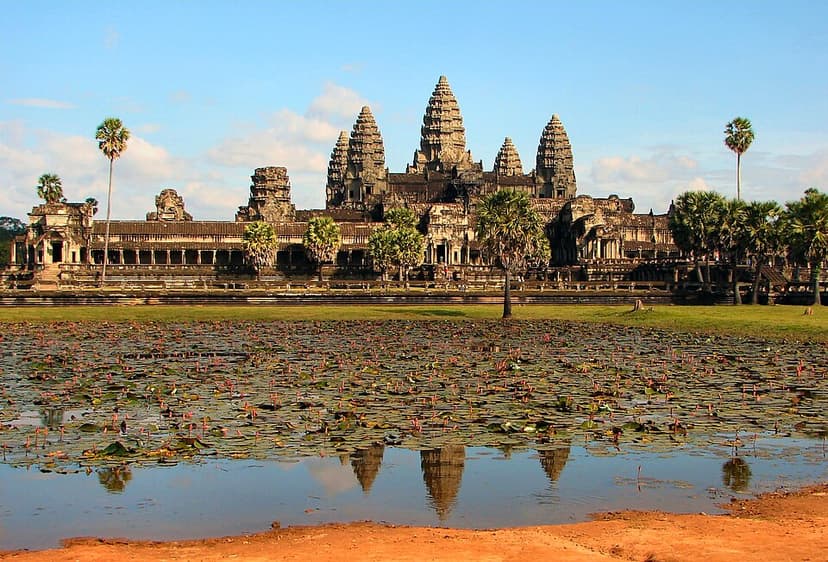
Angkor Wat, originally a Hindu temple dedicated to Vishnu and commissioned by King Suryavarman II in the early 12th century, is the largest religious complex in the world and a cornerstone of Khmer architecture. It was gradually transformed into a Theravada Buddhist temple from the late 13th century onwards and has remained an active center of Buddhist worship, serving as a potent symbol of Cambodia and appearing on its national flag.

Byōdō-in
Byōdō-in is a significant Buddhist temple located in Uji, Kyoto Prefecture, Japan, originally established as a rural villa in 998 and converted into a temple in 1052. It is renowned for its Phoenix Hall, a National Treasure and UNESCO World Heritage site, which exemplifies Heian period architecture and houses a celebrated Amida Buddha statue.
Baisigou Square Pagoda
The Baisigou Square Pagoda was a brick pagoda constructed in the early Western Xia dynasty, circa 1075-1076, in Helan County, Ningxia, China. Although it was illegally destroyed in 1990, archaeological investigations of its ruins revealed a significant number of Tangut artifacts and Buddhist relics, including unique printed texts and manuscripts. The pagoda's location in Baisigou Valley, meaning "Valley of the temple," suggests its association with an important Buddhist temple during the Western Xia period.