
Angkor Wat
Angkor Wat, originally a Hindu temple dedicated to Vishnu and commissioned by King Suryavarman II in the early 12th century, is the largest religious complex in the world and a cornerstone of Khmer architecture. It was gradually transformed into a Theravada Buddhist temple from the late 13th century onwards and has remained an active center of Buddhist worship, serving as a potent symbol of Cambodia and appearing on its national flag.
Key Facts
- ›Constructed between 1113 and 1150 CE during the reign of Khmer King Suryavarman II as a Hindu temple dedicated to Vishnu.
- ›Gradually transformed into a Theravada Buddhist temple from the late 13th century onwards.
- ›The largest religious complex in the world, covering 162.6 hectares.
- ›Features monumental scale, extensive bas-reliefs, and architectural unity characteristic of Khmer architecture.
- ›Uniquely oriented to the west, unlike most Angkorian temples.
- ›A symbol of Cambodia, appearing on the Cambodian national flag.
Important Relationships
- Suryavarman II
- Vishnu
- Jayavarman VII
- Indradevi
- Zhou Daguan
- Zheng He
- António da Madalena
- Henri Mouhot
- Charles-Émile Bouillevaux
- Adolf Bastian
- International Coordinating Committee for the Safeguarding and Development of the Historic Site of Angkor (ICC-Angkor)
- UNESCO
- École française d'Extrême-Orient (EFEO)
- Conservation d'Angkor
- Archaeological Survey of India
- APSARA (Authority for the Protection and Management of Angkor and the Region of Siem Reap)
Monumental Scale, Extensive Bas-Reliefs, Architectural Unity, West-Facing Orientation, Symbol of Cambodia, Temple-Mountain Design, Concentric Galleries, Moat and Outer Wall, Quincunx of Towers, Devatas and Apsaras
- Commissioned By King Suryavarman Ii .
- Construction Commenced In 1122 Ce and Completed In 1150 Ce.
- Gradual Transformation Into A Buddhist Temple From the Late 13th Century Onward.
- Sacked By the Chams In 1178.
- Visited By Chinese Envoy Zhou Daguan and Traveler Zheng He In the 13th–14th Centuries.
- Considered To Have Been Used As Defensive Fortification In Response To the Ayutthaya Empire Threat.
- Continued To Be Inhabited After the Khmer Fall To the Ayutthaya In 1431.
- Japanese Buddhist Pilgrims Established Settlements Alongside Khmer Locals In the 17th Century.
- Rediscovered By Europeans, Notably AntóNio Da Madalena In 1586 and Henri Mouhot In 1860.
- Restoration Efforts Initiated In the 20th Century.
- Designated As A Unesco World Heritage Site In 1992.
Khmer Architecture, Angkor Wat Style
About Angkor Wat
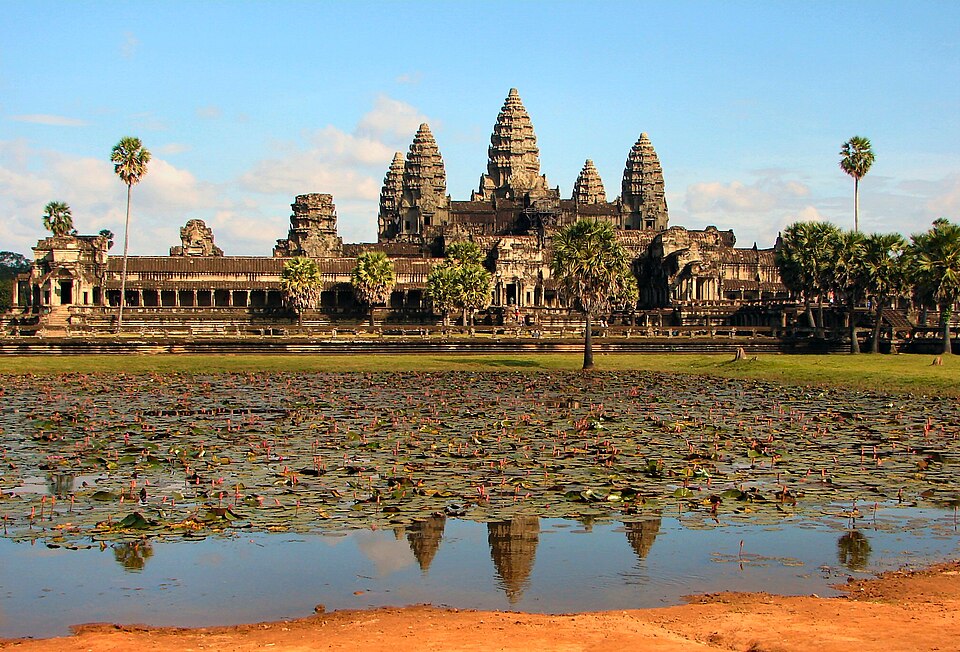
Angkor Wat is a vast temple complex located in Siem Reap, Cambodia, and holds the distinction of being the largest religious complex in the world. Originally constructed between 1113 and 1150 CE as a Hindu temple dedicated to Vishnu during the reign of King Suryavarman II, it was intended as a state temple and his mausoleum. The complex is a prime example of Khmer architecture, renowned for its monumental scale, intricate bas-reliefs, and harmonious design, uniquely oriented towards the west.
History and Transformation
From the late 13th century onwards, Angkor Wat underwent a significant transformation, gradually evolving into a Theravada Buddhist temple. This transition has ensured its continuous use as a center of Buddhist worship for centuries, contributing to its remarkable preservation. The temple's history is marked by periods of construction, adaptation, and even neglect, but it has never been completely abandoned. It experienced European rediscovery in the 16th and 19th centuries, leading to extensive restoration efforts throughout the 20th century, coordinated with international agencies under the umbrella of UNESCO.
Architectural Significance and Symbolism
The architectural design of Angkor Wat is a masterful fusion of the temple-mountain and galleried temple forms. Its layout is widely interpreted as a symbolic representation of Mount Meru, the cosmic mountain central to Hindu and Buddhist cosmology. The complex features progressively elevated galleries leading to a central quincunx of towers, surrounded by a moat and outer wall. Angkor Wat is not only an architectural marvel but also a profound national symbol for Cambodia, prominently featured on its flag. Its enduring religious and cultural significance continues to draw millions of visitors annually.
Source: Wikipedia ↗
Frequently Asked Questions
What is Angkor Wat and why is it significant?
Angkor Wat is the largest religious complex in the world, located in Siem Reap, Cambodia. It is significant for its monumental scale, intricate Khmer architecture, and its historical transition from a Hindu temple dedicated to Vishnu to a Theravada Buddhist center, remaining an active site of worship and a powerful symbol of Cambodian identity.
When was Angkor Wat built and by whom?
Angkor Wat was commissioned by the Khmer King Suryavarman II and its construction commenced in 1122 CE, completing around 1150 CE. It was originally built as a state temple and his mausoleum.
What was the original religious dedication of Angkor Wat?
Angkor Wat was originally constructed as a Hindu temple dedicated to the god Vishnu. Its original name is believed to have been Vrah Viṣṇuloka, meaning 'the sacred dwelling of Vishnu'.
How did Angkor Wat become a Buddhist temple?
From the late 13th century onwards, Angkor Wat began a gradual transformation into a Buddhist temple. This shift was influenced by the growing prominence of Buddhism within the Khmer Empire and has continued to the present day.
What are the key architectural features of Angkor Wat?
Key architectural features include its temple-mountain and galleried temple design, symbolizing Mount Meru. It is characterized by its monumental scale, extensive bas-reliefs depicting Hindu epics and historical events, devatas adorning its walls, and a unique west-facing orientation.
Is Angkor Wat a UNESCO World Heritage Site?
Yes, the Angkor area, which includes Angkor Wat, was designated as a UNESCO World Heritage Site in 1992. This recognition highlights its outstanding universal value.
What does the name 'Angkor Wat' mean?
The modern name Angkor Wat means 'Temple City' or 'City of Temples' in the Khmer language. 'Angkor' derives from 'nokor' (city/capital), and 'Wat' means 'temple grounds'.
Related Buddhist Temples

Baphuon
The Baphuon is a significant Buddhist temple located in Angkor Thom, Cambodia, renowned for its "golden mountain" appearance and its intricate carvings. Originally dedicated to Shiva, it was later converted to Theravada Buddhism, with major restoration efforts transforming it into what has been called the "largest 3D jigsaw puzzle in the world."

Ananda Temple
The Ananda Temple, built in Bagan, Myanmar in 1105 AD, is a significant Buddhist temple renowned for its architectural fusion of Mon and Indian styles. It is celebrated for its four standing Buddha statues, intricate stone sculptures, and glazed terra-cotta plaques depicting Jataka tales, serving as a "veritable museum of stones" and a testament to Theravada Buddhism. The temple, though damaged by an earthquake in 1975, has been fully restored and remains a highly revered site and a cultural icon of Myanmar.
Atamasthana
Atamasthana, meaning "Eight Sacred Places," refers to a collection of eight significant Buddhist sites located in Anuradhapura, Sri Lanka. These locations are believed to be places visited by the Buddha during his legendary trips to the island, making them central to Buddhist pilgrimage and devotion in Sri Lanka. The city of Anuradhapura itself, where these sites are concentrated, was a major political and religious capital for centuries and is now a UNESCO World Heritage Site.