
Vishnupad Temple
The Vishnupad Temple in Gaya, Bihar, is a significant Hindu pilgrimage site dedicated to Vishnu. It is renowned for housing a footprint of the deity, believed to be imprinted on the Dharmasila stone after Vishnu subdued the demon Gayasura. The temple is a central location for Shraddha rites, rituals performed for the departed.
Key Facts
- ›Dedicated to Lord Vishnu, it features a 40-CM footprint of the deity.
- ›Located on the banks of the Phalgu river in Gaya, Bihar.
- ›Believed to be the site where Vishnu pinned the demon Gayasura underground.
- ›The present structure was rebuilt in 1787 by Devi Ahilya Bai Holkar.
- ›It is a central site for Shraddha rites in Hinduism.
- ›The temple is adorned with a 50-kilo gold flag donated by a devotee.

Vishnu
- Religious Pilgrimage Site
- Center For Shraddha Rites
- Site of Vishnu's Legendary Act of Subduing Gayasura
Granite, Basalt
Devi Ahilya Bai Holkar
Footprint of Vishnu On Dharmasila
Phalgu River
About Vishnupad Temple
The Vishnupad Temple, located in the holy city of Gaya in Bihar, India, is a significant Hindu shrine dedicated to Lord Vishnu. Its name, meaning 'temple of Vishnu's feet,' refers to the central artifact housed within: a 40-centimeter footprint of Vishnu, believed to have been imprinted on a basalt slab known as the Dharmasila. This sacred stone marks the spot where Vishnu is said to have subdued the demon Gayasura by pinning him beneath his foot.
Historical and Religious Context
The temple holds immense importance as a primary center for Shraddha rites, crucial rituals performed by Hindus for the peace and salvation of their departed ancestors. The legend states that after Vishnu subdued Gayasura, the demon pleaded for sustenance, and Vishnu granted him a boon that he would be fed daily by prayers offered for the welfare of departed souls. This lore makes the Vishnupad Temple a vital pilgrimage destination for fulfilling ancestral duties.
The current structure of the temple was rebuilt in 1787 by Devi Ahilya Bai Holkar, the ruler of Indore, on the banks of the Phalgu River. The construction involved careful selection of materials, including gray granite blocks, and the skilled craftsmanship of artisans brought from Rajasthan. The temple's architecture is notable, featuring an octagonal shrine, a towering pyramidal roof reaching about 100 feet, and intricately carved pillars.
Architectural Features
Standing approximately 30 meters in height, the Vishnupad Temple is constructed from large granite blocks, skillfully joined with iron clamps. Its octagonal sanctum faces east, and its pyramidal tower is characterized by sloping sides with alternating indented and plain sections that create a series of angled peaks converging at the top. Within the temple complex, an immortal banyan tree, the Akshayavat, is also present, where final rituals for the deceased are performed. The sacred footprint of Vishnu itself is imprinted in solid rock and encircled by a silver-plated basin.
Several prominent Hindu saints, including Madhvacharya, Chaitanya Mahaprabhu, and Vallabhacharya, are recorded to have visited this shrine, underscoring its spiritual legacy. The temple is also adorned with a 50-kilogram gold flag, a donation from a devotee named Gayapal Panda Bal Govind Sen. The Gayawal Brahmins serve as the traditional priests of the temple, known as the Gayawal Tirth Purohit or Pandas of Gaya.
Source: Wikipedia ↗
Frequently Asked Questions
What is the significance of the footprint inside the Vishnupad Temple?
The 40-cm footprint, incised into a block of basalt known as Dharmasila, is believed to be the exact spot where Lord Vishnu placed his foot on the chest of the demon Gayasura. This act is said to have subdued the demon and pinned him underground.
Who rebuilt the current structure of the Vishnupad Temple?
The present-day structure of the Vishnupad Temple was rebuilt in 1787 by Devi Ahilya Bai Holkar, the ruler of Indore. She meticulously oversaw the selection of materials and construction, bringing craftsmen from Rajasthan.
What is the spiritual importance of Vishnupad Temple in Gaya?
The Vishnupad Temple is a paramount center for Shraddha rites, which are crucial rituals performed for the peace and salvation of departed souls. It is a significant pilgrimage destination for Hindus seeking to fulfill these ancestral duties.
What is the legend behind the Vishnupad Temple?
According to legend, the demon Gayasura sought a boon that anyone who saw him would attain salvation, leading to a misuse of this grace. Lord Vishnu subdued him by placing his foot on his chest, leaving the footprint at this site and pinning Gayasura underground.
What are the architectural features of the Vishnupad Temple?
The temple stands 30 meters high with a pyramidal tower that reaches approximately 100 feet. It is constructed from large gray granite blocks joined with iron clamps and features 8 rows of carved pillars supporting the pavilion. The octagonal shrine faces east.
Related Temples (Hindu)

Taraknath Temple
The Taraknath Temple, located in Tarakeswar, West Bengal, India, is a significant Hindu pilgrimage site dedicated to Lord Shiva, worshiped here as Tarakanatha. Constructed in 1729, it features a distinct Bengal architectural style with an 'atchala' structure and an adjacent 'natmandir'. The temple is renowned for its belief that a dip in the nearby Dudhpukur tank fulfills prayers and is considered one of the 64 Jyotirlingas.

Tanot Mata Temple
The Tanot Mata Temple is a significant Hindu shrine located in the Jaisalmer district of Rajasthan, India, near the Pakistan border. Revered as a form of Goddess Hinglaj Mata, the temple is famously associated with the Indian victories in the Indo-Pakistani Wars of 1965 and 1971, with local folklore attributing the successful outcomes to divine intervention. The Border Security Force of India now manages the temple complex, which also includes a victory tower and a war museum.
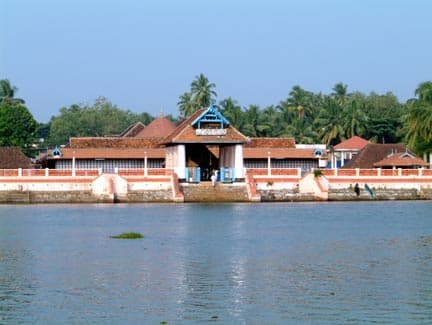
Thriprayar Temple
The Thriprayar Temple, also known as the Shree Ramaswami Temple, is a significant Hindu temple located in Triprayar, Thrissur district, Kerala, India. It is dedicated to Lord Rama, the seventh incarnation of Vishnu, who is depicted with four arms holding a conch, discus, bow, and garland. The temple's origin story involves the idol being worshipped by Krishna in Dwarka, later immersed in the sea, and eventually found by fishermen.