
Vishnudham Mandir
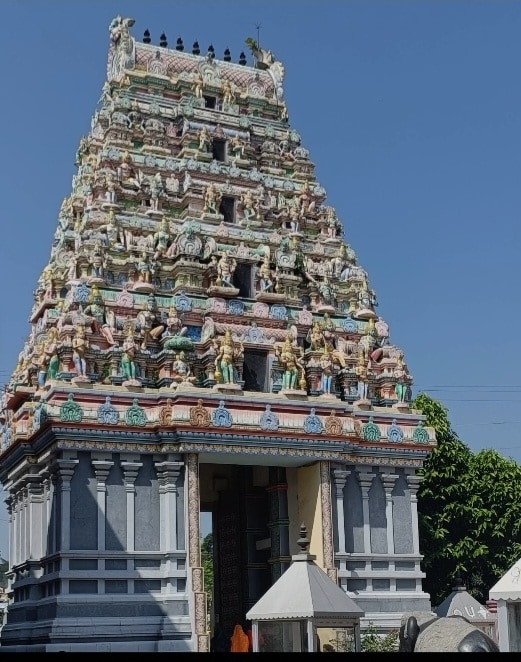
Vishnudham Mandir in Samas, Bihar, is a significant Hindu temple renowned for housing the second largest idol of Lord Vishnu globally. Discovered in 1992, the black granite idol is believed to date back to the Gupta or Pala period and is a focal point for devotees, with worship continuing in a partially constructed temple. The temple's construction was inspired by the Tirupati temple and aims to become a major tourist destination.
Key Facts
- ›Houses the second largest idol of Lord Vishnu in the world.
- ›The black granite idol measures 7.5 feet in height and 3.5 feet in width.
- ›The idol is believed to be from the Gupta or Pala period.
- ›The idol was discovered in a pond in 1992, having been buried for centuries.
- ›The temple is being developed with inspiration from the Tirupati temple.
- ›The idol is the largest representation of Vishnu in the sthanakmudra posture in North India.
Vishnu
- Houses the Second Largest Idol of Lord Vishnu In the World
- Potential Major Tourist Destination
- Unique Historical Idol Discovery
Black Granite
Idol of Lord Vishnu
About Vishnudham Mandir
Vishnudham Mandir, situated in Samas, Bihar, is a prominent Hindu temple distinguished by its possession of the second largest idol of Lord Vishnu in the world. This colossal idol is surpassed in size only by the Lord Venkatesh idol in Tirupati. The temple is located in the Sheikhpura district, specifically within the Barbigha block.
History and Discovery
The significant idol of Lord Vishnu was unearthed on July 5, 1992, during the month of Ashadha, on a Sunday that was Shukla Panchami. Prior to its complete discovery, the idol was known to villagers as 'Silbaba,' with only its aura visible. The unearthing of the idol drew a massive congregation of devotees, which led to the organization of a grand fair that spanned three months. Following this event, the idol was installed with the active participation of local villagers, and formal worship commenced. The construction of the temple began concurrently, with administrative officials conducting site inspections.
Temple Features and Development
The temple was later placed under the purview of the Bihar State Board of Religious Trusts, aligning it with other significant temples in the state. In 2007, the board encouraged the Bihar government to construct a temple mirroring the design of the Tirupati temple. The then Chief Minister, Nitish Kumar, made a pledge in 2009 to develop the Vishnudham Mandir into a tourist attraction. This plan has seen recent realization, with a budget of ₹14.99 crores allocated in February 2025 for its development. Currently, devotees worship the idol within a partially completed temple structure.
The Idol of Lord Vishnu
The idol of Lord Vishnu is crafted from black granite and measures 7.5 feet in height and 3.5 feet in width. It represents the largest idol of Vishnu in the sthanakmudra posture found in North India. Historical and scholarly opinions vary on its age, with some dating it to the Gupta period and others suggesting it may belong to the Pala period. The idol features four arms, each holding a shankha, chakra, gada, and lotus. Beneath the idol's left and right arms are figures, one masculine and one feminine. An inscription on the idol's pedestal, written in ancient Devanagari script, reads 'ऊं उत्कीर्ण सूत्रधारसितदेव:'. The characteristics of this script, particularly the forms of 'अ', 'इ', and 'ई', show evolutionary links to the Brahmi script. Scholars indicate that this script style emerged in North India after the ninth century, noting its use by the Pratihara king Mahendrapala (891-907 AD) in an inscription that also mentions the sculptor Sitadeva.
Alongside the main idol, numerous smaller idols were discovered, which are currently kept outside the garbhagriha in a state of neglect. Many other idols were found in nearby areas and have been placed in the Jagadambaa temple. It is also reported that a Lakshmi idol was found in the vicinity in the 1960s but was subsequently stolen.
Source: Wikipedia ↗
Frequently Asked Questions
Where is Vishnudham Mandir located?
Vishnudham Mandir is located in Samas, within the Barbigha block of the Sheikhpura district in Bihar, India.
When was the idol of Lord Vishnu discovered?
The idol of Lord Vishnu was discovered on July 5, 1992, during Shukla Panchami Sunday in the month of Ashadha. It had been concealed beneath the soil for centuries.
What is the significance of the idol of Lord Vishnu at Vishnudham Mandir?
It is the second largest idol of Lord Vishnu in the world, surpassed only by the idol at Tirupati. It is also the largest representation of Vishnu in the sthanakmudra posture in North India.
What is the architectural style of Vishnudham Mandir?
The temple was constructed in the South Indian architectural style, with plans to develop it further in a manner inspired by the Tirupati temple in Andhra Pradesh.
What is the history behind the idol's discovery?
The idol was revered as the village deity 'Silbaba' before its full unearthing in 1992. Its discovery led to a large gathering of devotees and a three-month-long fair.
What are the estimated origins of the idol?
Scholars suggest the black granite idol may date back to the Gupta period, while some also propose it could belong to the Pala period. An inscription on its pedestal uses an ancient Devanagari script that evolved from Brahmi script, suggesting an origin after the ninth century.
Related Temples (Hindu)

Bhu Varaha Swamy temple
The Bhu Varaha Swamy temple in Srimushnam, Tamil Nadu, is a significant Hindu temple dedicated to Varaha, the boar avatar of Vishnu, and his consort Lakshmi. Constructed in the South Indian architectural style, it is recognized as one of the 108 Abhimana Kshethrams in Vaishnavism and holds historical importance with contributions from the Vijayanagara Empire and Thanjavur Nayak kings.

Ashtalakshmi Temple
The Ashtalakshmi Temple in Hyderabad, India, is a prominent Hindu temple dedicated to the eight forms of Goddess Lakshmi. Built in the South Indian architectural style, it showcases intricate carvings and houses idols of the Ashtalakshmi goddesses, each adorned with gold jewelry.

Taraknath Temple
The Taraknath Temple, located in Tarakeswar, West Bengal, India, is a significant Hindu pilgrimage site dedicated to Lord Shiva, worshiped here as Tarakanatha. Constructed in 1729, it features a distinct Bengal architectural style with an 'atchala' structure and an adjacent 'natmandir'. The temple is renowned for its belief that a dip in the nearby Dudhpukur tank fulfills prayers and is considered one of the 64 Jyotirlingas.