
Vedapureeswarar Temple, Puducherry
The Vedapureeswarar Temple in Puducherry is a Hindu temple dedicated to Lord Shiva and Goddess Parvati. Originally constructed in the Dravidian architectural style, it suffered destruction in 1748 CE during religious riots but was subsequently reconstructed in 1788 CE with public contributions. The temple is an active place of worship and a significant religious site in Puducherry.
Key Facts
- ›Dedicated to Lord Shiva (as Vedapurishvarar) and Goddess Parvati (as Tripurasundari).
- ›Constructed in the Dravidian architectural style.
- ›Destroyed in 1748 CE during religious riots between Hindus and Christians.
- ›Reconstructed in 1788 CE under the patronage of Divan Kandappa Mudaliar.
- ›Features a seven-tiered rajagopuram, 75 feet high.
- ›Maintained and administered by the Sri Vedapurishvarar Tripurasundari Devastanams Trust.

Shiva, Parvati
- Active Place of Worship
- Historical Site of Destruction and Reconstruction
- Example of Dravidian Architecture
Brahmotsavam, Annabhishekam, Maha Shivaratri
Granite
Divan Kandappa Mudaliar
Nandi Statue, Dvarapalas
Rectangular Temple Tank
About Vedapureeswarar Temple, Puducherry
The Vedapureeswarar Temple, also known as Vedapurishvarar Tripurasundari Temple, is a significant Hindu religious site located in Puducherry. Dedicated to Lord Shiva, worshipped as Vedapurishvarar, and Goddess Parvati, worshipped as Tripurasundari, the temple is a prominent example of Dravidian architecture.
History and Reconstruction
The temple's history is marked by destruction and subsequent rebuilding. It was initially constructed in the Dravidian style. However, in 1748 CE, the temple suffered extensive damage and was destroyed during religious riots that occurred between Hindu and Christian communities, involving French troops and local populations. The presiding deities were temporarily housed in the Varadharaja Perundevi Temple during this period. The temple's reconstruction was undertaken in 1788 CE, largely due to the efforts of Divan Kandappa Mudaliar, who raised funds through public contributions. Details of the temple's demolition have been preserved in the diary of Ananda Ranga Pillai, a chronicler of that era. The presiding deities are known to have been relocated to the temple from Samba Ishvaran Ishvari Street in the latter part of the 19th century CE. Currently, the temple is managed and administered by the Sri Vedapurishvarar Tripurasundari Devastanams Trust, operating under the Department of Hindu Religious Institutions of the Government of Puducherry.
Architecture and Features
The Vedapureeswarar Temple exhibits characteristic Dravidian architectural elements. It is distinguished by a seven-tiered rajagopuram, the main gateway tower, which rises to a height of 75 feet (23 meters). Within the temple complex, the presiding deity, Lord Shiva, is enshrined in the sanctum sanctorum in the form of a Lingam. Access to the sanctum is through the flag staff hall, Mahamandapa, and Arthamandapa. A statue of Nandi, the bull vahana of Shiva, faces the shrine within the Mahamandapa. Shrines dedicated to Ganesha and Kartikeya are situated before the Mahamandapa, and the sanctum sanctorum is flanked by two Dvarapalas (guardian figures). The Goddess Tripurasundari is housed in her own sanctum in the form of a Yoni. The temple also features shrines for deities such as Shani, Durga, Chandeshvara, Dakshinamurti, and the Navagrahas, arranged around the two main sanctum sanctorums. A rectangular temple tank, an essential feature of South Indian temples, is located within the complex and features 35 steps leading to its basement.
Worship and Festivals
The temple adheres to the Shaivite and Shaktite traditions of worship, with priests performing daily rituals and pujas. Several significant festivals punctuate the temple's annual calendar. The Brahmotsavam festival, celebrated during the Tamil month of Vaikasi (May-June), the Annabhishekam during Aipassi (October-November), and Maha Shivaratri during Masi (February-March) are among the most prominent. The Hindu saint Ramalinga Svamigal, who lived from 1823 to 1874 CE, is noted for having sung devotional songs about Kartikeya, who is also present in this temple.
Source: Wikipedia ↗
Frequently Asked Questions
When was the Vedapureeswarar Temple destroyed and reconstructed?
The Vedapureeswarar Temple was destroyed in 1748 CE during religious riots involving French troops and local populations. It was subsequently reconstructed in 1788 CE through public contributions, with Divan Kandappa Mudaliar playing a key role.
What architectural style is the Vedapureeswarar Temple built in?
The temple is built in the Dravidian style of architecture. This style is characterized by its towering gopurams (gateway towers) and intricate carvings.
Who are the presiding deities of the Vedapureeswarar Temple?
The presiding deities are Lord Shiva, worshipped as Vedapurishvarar, and Goddess Parvati, worshipped as Tripurasundari. The main deity, Shiva, is present in the form of a Lingam.
What are the prominent festivals celebrated at the Vedapureeswarar Temple?
The temple celebrates several important festivals, including Brahmotsavam in the Tamil month of Vaikasi, Annabhishekam in Aipassi, and Maha Shivaratri in Masi. The temple follows Shaivite and Shaktite traditions.
What is the significance of the rajagopuram at the Vedapureeswarar Temple?
The Vedapureeswarar Temple features a prominent seven-tiered rajagopuram, which is the main gateway tower. It stands at a height of 75 feet (23 meters) and is a significant element of the temple's Dravidian architecture.
Related Temples (Hindu)
Kotappakonda
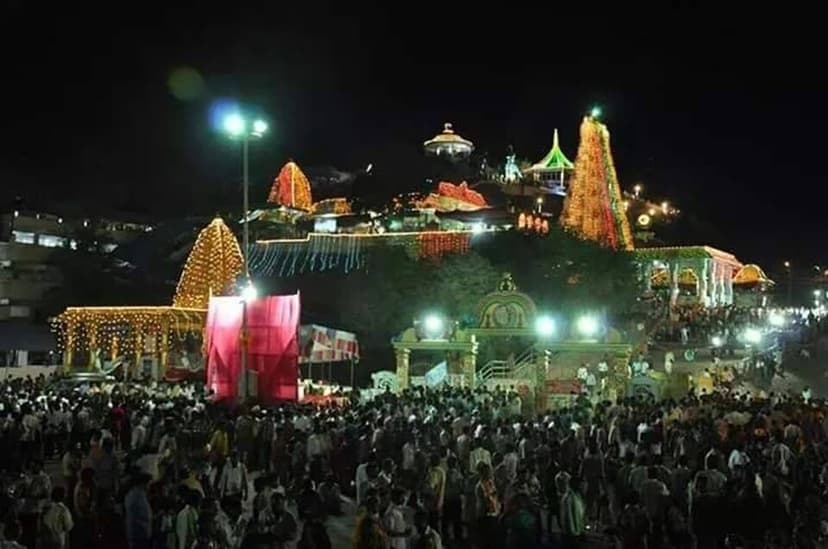
Kotappakonda is a significant Hindu pilgrimage site in Andhra Pradesh, India, centered around the ancient Sri Trikoteswara Swamy Temple, dedicated to Lord Shiva. Renowned for its three distinct peaks, the site is a major Shaivite center, drawing large crowds, especially during the annual Maha Shivaratri festival.

Kumararama
The Kumararama Temple, also known as Bhimarama or Chalukya Kumararama Bhimeswara Temple, is a significant Hindu temple dedicated to Lord Shiva, located in Samalkota, Andhra Pradesh. It is one of the five Pancharama Kshetras and is renowned for its unique limestone Shiva Lingam, which is 16 feet tall and pierces through the roof to the second floor.

Venkateswara Temple, Tirumala
The Venkateswara Temple, also known as Tirumala Temple, is a significant Hindu pilgrimage site located in the Tirumala hills of Andhra Pradesh, India. Dedicated to Venkateswara, a form of Vishnu, the temple is renowned for its Dravidian architecture and is considered one of the wealthiest and most visited religious sites globally. It is administered by the Tirumala Tirupati Devasthanams (TTD), an autonomous body under the Government of Andhra Pradesh.