
Vaikom Mahadevar Temple
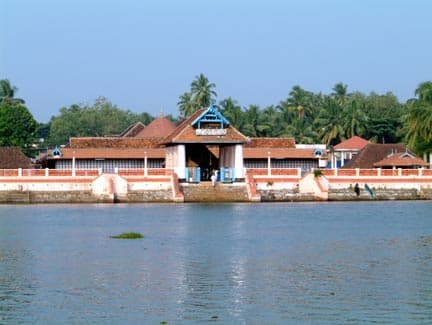
The Vaikom Mahadevar Temple, located in Kerala, India, is an ancient Hindu temple dedicated to Lord Shiva, affectionately known as Vaikkathappan. It is revered as one of the oldest temples in Kerala, with a history stretching back to the Treta Yuga, and is renowned for its Vaikom Ashtami festival.
Key Facts
- ›Dedicated to Lord Shiva, who is locally known as Vaikkathappan.
- ›Believed to house a lingam from the Treta Yuga, making it one of the oldest in Kerala.
- ›Famous for its Vaikom Ashtami festival, celebrated during November-December.
- ›The temple complex spans approximately eight acres and features unique oval-shaped sanctum.
- ›Holds significance for both Shaivites and Vaishnavites.
- ›Features a perpetually closed western door, symbolizing Shiva's wrath against worship disruption.

Shiva
Ancient Place of Shiva Worship, Site of the Vaikom Ashtami Festival, Revered By Both Shaivas and Vaishnavas, Architectural Uniqueness
Vaikom Ashtami
Shaped Stone, Single Piece Woods, Copper Sheets
Khara, Sage Vyaghrapada, Parashurama
About Vaikom Mahadevar Temple
The Vaikom Mahadevar Temple is an ancient and significant Hindu temple dedicated to Lord Shiva, located in Vaikom, Kottayam, Kerala, India. Affectionately known as Vaikkathappan, the deity is revered as one of the most powerful manifestations of Shiva in the region. The temple is considered one of the oldest in Kerala, with its primary lingam believed to date back to the Treta Yuga, one of the historical ages in Hinduism.
Origin and Mythology
According to legend, the lingam was originally obtained by the demon Khara from Lord Shiva himself. After Khara was unable to move the lingams he carried, Shiva promised to remain there, offering liberation to those who sought refuge. The sage Vyaghrapada was entrusted with the custody and worship of the lingams. Later, Parashurama discovered the lingam submerged in water, consecrated it, and built the first temple, establishing the rituals and customs that are believed to be followed to this day.
Architectural Significance
Spanning approximately eight acres, the Vaikom Mahadevar Temple is one of the largest in Kerala. A striking architectural feature is its oval-shaped sanctum sanctorum, a rarity that required exceptional craftsmanship. The temple complex is oriented slightly off the traditional East-West axis and features a unique staircase with six steps leading to the deity, symbolizing the devotee's journey to overcome the six impurities (lust, anger, greed, attachment, ego, and envy) to attain liberation.
The Closed Western Door
A notable and unique aspect of the temple is its western door, which has remained closed for centuries. This closure is attributed to an incident where an individual disrupted the temple's puja rituals. As a consequence, a divine voice decreed that the door should never be opened again, serving as a symbol of Shiva's displeasure with the desecration of his worship.
Vaikom Ashtami Festival
The temple is particularly famous for its annual Vaikom Ashtami festival, also known as Vaikathashtami. This grand celebration typically occurs in November or December, coinciding with Krishna Ashtami in the Malayalam month of Vrischikam. The festival commemorates the divine appearance of Lord Shiva before the sage Vyaghrapada and draws a large number of devotees seeking blessings and fulfillment of their wishes.
Source: Wikipedia ↗
Frequently Asked Questions
What is the significance of the Vaikom Mahadevar Temple?
The Vaikom Mahadevar Temple is considered one of the oldest Shiva temples in Kerala, with its lingam believed to be from the Treta Yuga. It is a powerful place of worship for Shiva and is held in reverence by both Shaivas and Vaishnavas.
When is the Vaikom Ashtami festival celebrated?
The Vaikom Ashtami festival, a major event at the temple, is celebrated on the day of Krishna Ashtami in the Malayalam month of Vrischikam, which typically falls between November and December. The festival commemorates the appearance of Lord Shiva before the sage Vyaghrapada.
What is unique about the architecture of Vaikom Mahadevar Temple?
The temple is noted for its oval-shaped sanctum, which is unusual for Kerala temples and externally appears circular. The sanctum's construction required exceptional architectural skill. Additionally, the temple complex is built on a slight tilt and features a unique staircase leading to the lingam, symbolizing the overcoming of six impurities.
What is the story behind the closed western door of the Vaikom Mahadevar Temple?
The western door of the temple has remained closed since ancient times due to a disruption of worship by a group of owners. According to legend, a man who barged through the door and spat on the offerings was bitten by a poisonous snake and died. A heavenly voice then declared that the door should never be opened again.
Who is believed to have consecrated the lingam at Vaikom Mahadevar Temple?
While the lingam was originally placed by the demon Khara and entrusted to sage Vyaghrapada, it is believed that Parashurama later found it submerged in water. He consecrated the lingam with his prayers and built the first temple, entrusting it to a Brahmin priest.
Related Temples (Hindu)

Taraknath Temple
The Taraknath Temple, located in Tarakeswar, West Bengal, India, is a significant Hindu pilgrimage site dedicated to Lord Shiva, worshiped here as Tarakanatha. Constructed in 1729, it features a distinct Bengal architectural style with an 'atchala' structure and an adjacent 'natmandir'. The temple is renowned for its belief that a dip in the nearby Dudhpukur tank fulfills prayers and is considered one of the 64 Jyotirlingas.

Tanot Mata Temple
The Tanot Mata Temple is a significant Hindu shrine located in the Jaisalmer district of Rajasthan, India, near the Pakistan border. Revered as a form of Goddess Hinglaj Mata, the temple is famously associated with the Indian victories in the Indo-Pakistani Wars of 1965 and 1971, with local folklore attributing the successful outcomes to divine intervention. The Border Security Force of India now manages the temple complex, which also includes a victory tower and a war museum.
Thriprayar Temple
The Thriprayar Temple, also known as the Shree Ramaswami Temple, is a significant Hindu temple located in Triprayar, Thrissur district, Kerala, India. It is dedicated to Lord Rama, the seventh incarnation of Vishnu, who is depicted with four arms holding a conch, discus, bow, and garland. The temple's origin story involves the idol being worshipped by Krishna in Dwarka, later immersed in the sea, and eventually found by fishermen.