
Triyuginarayan Temple
The Triyuginarayan Temple, located in Uttarakhand, India, is an ancient Hindu temple dedicated to Lord Vishnu. It is renowned for the legend of Lord Shiva's marriage to Goddess Parvati, which is said to have been witnessed by Vishnu at this site, making it a significant pilgrimage destination. A unique feature is the perpetual fire, believed to have burned since the divine wedding.
Key Facts
- ›Dedicated to Lord Vishnu, also known as Narayan.
- ›Famous as the site where Lord Shiva married Goddess Parvati.
- ›Features a perpetual fire (Akhand Dhuni) that has burned since ancient times.
- ›The temple courtyard contains sacred bathing ponds (kunds) with legendary healing properties.
- ›Architecturally similar to the Kedarnath Temple.
- ›Believed to have been built by Adi Shankaracharya.

Vishnu, Narayana
Legend of Shiva-Parvati Marriage, Pilgrimage Site, Abhimana Kshethram Temple, Site of Perpetual Sacred Fire
Adi Shankaracharya
- Silver Image of Vishnu Accompanied By Lakshmi and Saraswati
Mandakini River, Sone-Ganga River, Saraswati Ganga, Rudra-Kund, Vishnu-Kund, Brahma-Kund, Saraswati-Kund
About Triyuginarayan Temple
The Triyuginarayan Temple is an ancient Hindu shrine situated in the village of Triyuginarayan in the Rudraprayag district of Uttarakhand, India. Dedicated to Lord Vishnu, the temple is widely revered for its association with the celestial marriage of Lord Shiva and Goddess Parvati, an event believed to have been witnessed by Vishnu himself at this sacred location. This legendary connection makes it a prominent pilgrimage site and an "Abhimana Kshethram" temple.
The Eternal Flame and Sacred Ponds
A unique and defining feature of the Triyuginarayan Temple is the perpetual fire, known as the "Akhand Dhuni," which burns continuously in front of the temple. This flame is believed to have originated from the time of the divine wedding and, while historically self-igniting, is now maintained by the Jamloki Brahmins. The temple is also known as the "Akhand Dhuni temple" due to this eternal flame. The temple courtyard is the source of a stream that feeds four sacred bathing ponds, or "kunds": Rudra Kund, Vishnu Kund, Brahma Kund, and Saraswati Kund. These kunds are considered holy, with waters believed to possess healing properties, particularly for infertility and promoting conjugal bliss.
Legend and Etymology
The name "Triyuginarayan" itself is derived from "tri" (three), "yugi" (a period of time or yuga), and "Narayana" (a name for Vishnu), referencing the belief that pilgrims have offered wood to the eternal fire for three yugas. The legend recounts that Goddess Parvati, the rebirth of Sati, practiced rigorous penance to win Lord Shiva. Their marriage took place in Triyuginarayan village, traditionally considered the capital of Himavat, Parvati's father. Lord Vishnu officiated the ceremony, and Brahma acted as the priest, with all the sages witnessing the event. A stone called the "Brahma Shila" in front of the temple marks the exact spot of this divine union.
Structure and Access
The present shrine is attributed to Adi Shankaracharya and houses a silver image of Lord Vishnu (Narayana) with his consorts, Goddess Lakshmi and Goddess Saraswati. Architecturally, the temple bears resemblance to the Kedarnath Temple. The Triyuginarayan village is accessible via a motorable road from Sonprayag, with options for trekking routes as well, passing through scenic forest areas. The region's geographical setting in the Garhwal Himalayas, at an altitude of 1,980 meters (6,500 ft), is characterized by its mountainous terrain and proximity to high-altitude peaks, contributing to its spiritual and cultural significance.
Source: Wikipedia ↗
Frequently Asked Questions
What is the significance of the perpetual fire at Triyuginarayan Temple?
The perpetual fire, known as Akhand Dhuni, is believed to have been burning since the divine marriage of Lord Shiva and Goddess Parvati. Devotees offer wood to the fire and collect its ashes, which are considered holy and believed to promote conjugal bliss.
What is the legend behind the Triyuginarayan Temple?
The temple is famous because it is believed to be the venue where Lord Shiva married Goddess Parvati. Lord Vishnu is said to have witnessed the ceremony, acting as Parvati's brother, while Brahma served as the priest. The eternal flame and the Brahma Shila stone mark this sacred event.
What are the sacred bathing ponds (kunds) at the temple?
The temple has four sacred bathing ponds: Rudra Kund, Vishnu Kund, Brahma Kund, and Saraswati Kund. According to legend, these ponds originated from Vishnu's navel and the water is believed to cure infertility and is used for bathing, cleansing, sipping, and offering libations.
What is the meaning of the name Triyuginarayan?
The name is derived from 'tri' (three), 'yugi' (a period of time or yuga), and 'Narayana' (another name for Vishnu). It refers to pilgrims offering wood to the fire for three yugas, signifying the ancientness of the site.
What is the architectural style of the Triyuginarayan Temple?
The Triyuginarayan Temple's architectural style is similar to that of the Kedarnath Temple. The present shrine is also known as Akhand Dhuni temple.
Related Temples (Hindu)

Taraknath Temple
The Taraknath Temple, located in Tarakeswar, West Bengal, India, is a significant Hindu pilgrimage site dedicated to Lord Shiva, worshiped here as Tarakanatha. Constructed in 1729, it features a distinct Bengal architectural style with an 'atchala' structure and an adjacent 'natmandir'. The temple is renowned for its belief that a dip in the nearby Dudhpukur tank fulfills prayers and is considered one of the 64 Jyotirlingas.

Tanot Mata Temple
The Tanot Mata Temple is a significant Hindu shrine located in the Jaisalmer district of Rajasthan, India, near the Pakistan border. Revered as a form of Goddess Hinglaj Mata, the temple is famously associated with the Indian victories in the Indo-Pakistani Wars of 1965 and 1971, with local folklore attributing the successful outcomes to divine intervention. The Border Security Force of India now manages the temple complex, which also includes a victory tower and a war museum.
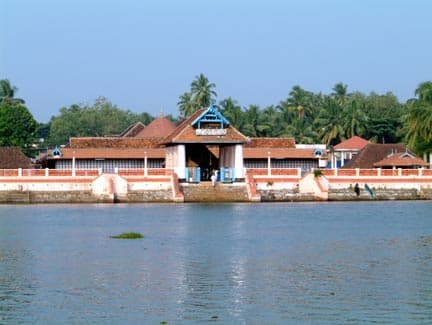
Thriprayar Temple
The Thriprayar Temple, also known as the Shree Ramaswami Temple, is a significant Hindu temple located in Triprayar, Thrissur district, Kerala, India. It is dedicated to Lord Rama, the seventh incarnation of Vishnu, who is depicted with four arms holding a conch, discus, bow, and garland. The temple's origin story involves the idol being worshipped by Krishna in Dwarka, later immersed in the sea, and eventually found by fishermen.