
Thiruthani Murugan Temple
The Thiruthani Murugan Temple, also known as Subramaniya Swamy Temple, is a significant Hindu temple dedicated to Lord Murugan, located on a hillock in Tiruttani, Tamil Nadu, India. It is recognized as one of the six abodes of Murugan and is steeped in mythology, particularly concerning his victory over the asura Surapadman and his marriage to Valli.
Key Facts
- ›Dedicated to Lord Murugan, it is one of the six sacred abodes (Arupadaiveedu) of the deity.
- ›According to mythology, Lord Murugan came to this site to quell his anger after defeating the asura Surapadman.
- ›The temple features unique iconography where Murugan is depicted holding a vajra vel (thunderbolt) and mounted on an elephant instead of his usual peacock.
- ›The temple complex includes 365 steps leading to the shrine, symbolizing the days of the year.
- ›It is mentioned in the Sangam literature and hymns composed by the 14th-century poet Arunagirinathar.
- ›The temple is maintained by the Hindu Religious and Charitable Endowments Department of the Government of Tamil Nadu.

Murugan
One of the Six Abodes of Murugan, Site of Murugan's Marriage To Valli, Mentioned In Sangam Literature, Hymned By Arunagirinathar
Aadi Krittika Festival, Murugan's Wedding With Valli, Murugan's Wedding With Deivanai
Sarvana Pond
About Thiruthani Murugan Temple
The Thiruthani Murugan Temple, also known as Subramaniya Swamy Temple, is a significant Hindu temple dedicated to Lord Murugan, situated on a hillock in Tiruttani, Tiruvallur district, Tamil Nadu, India. This sacred site holds the distinction of being one of the six revered abodes of Murugan, known as Arupadaiveedu. The temple's mythology is deeply intertwined with Murugan's divine exploits, particularly his journey to Tiruttani to appease his anger after vanquishing the demon Surapadman and his subsequent marriage to Valli.
Mythology and Religious Significance
Hindu scriptures recount the epic battles led by Murugan against the asuras to protect the devas. After his decisive victory over Surapadman at Tiruchendur, Murugan is said to have come to Tiruttani to find solace. The town's name, derived from the Tamil words 'seru' (anger) and 'thani' (satiating), reflects this event. Furthermore, the temple is the site where Murugan married Valli, a tribal chief's daughter, whom he courted in the guise of a hunter. The temple's religious importance is further underscored by its mention in ancient Sangam literature, specifically the Tirumurukāṟṟuppaṭai by Nakkeerar, and by the hymns composed by the 14th-century Tamil poet Arunagirinathar, who glorified Murugan and the temple.
Architectural Features and Iconography
The temple complex is perched atop Thanigai hill, accessible via 365 steps, each representing a day of the year. A notable water body, Kalhara Theertham, believed to have been created by Indra, is also located on the hill. The temple boasts a grand nine-tiered main gopuram and four expansive precincts (praharas). The vimana above the sanctum sanctorum is distinct with its six-petaled design. Within the temple, Lord Murugan is depicted in a standing posture, with his left hand resting on his hip. Uniquely, he is shown holding a vajra vel (thunderbolt) in his right hand, a departure from the typical depiction of his weapon. A scar on his chest signifies his battles with the asuras. His mount is an elephant, symbolizing Airavata, gifted by Indra, which faces eastward, away from the main shrine. This specific iconography is maintained at only two locations: Swamimalai and Tiruttani. The temple also houses separate shrines for Deivanai and Valli, as well as for deities like Durga and Bhairava.
Practices and Festivals
Given that Murugan is believed to have come to Tiruttani to quell his anger, the deity is revered for freeing devotees from anger and other evils. While the festival of Surasamharam is celebrated widely in other Murugan temples, it is not observed here; instead, on that day, Murugan is showered with flowers as a gesture to calm his wrath. Common worship practices at the temple include tonsuring, offering panchamirtham (a five-ingredient mixture) and milk, and carrying milk pots and Kavadi. A special sandalwood paste, believed to have medicinal properties, is applied to the deity on specific days and distributed as prasadam.
The temple observes unique festivals, including a three-day celebration commencing on the day the Krittika nakshatra occurs in the month of Aadi. During this festival, Murugan is taken in procession from the Sarvana pond to the hilltop, with devotees carrying elaborately decorated kavadis. In the month of Margazhi, Murugan undergoes a ritualistic bath in hot water before his symbolic wedding to Valli, to ensure his comfort during the winter. On New Year's Eve, the temple steps are washed, adorned with turmeric, and a special puja is performed at midnight. The celestial wedding of Murugan with Deivanai is celebrated in the month of Chithirai, while the annual Brahmotsavam and his wedding with Valli are observed during the month of Masi. The multi-day Brahmotsavam features Murugan being carried on various mounts, including a tiger and an elephant, symbolizing his various divine disguises and appearances.
Source: Wikipedia ↗
Frequently Asked Questions
What is the mythological significance of Thiruthani Murugan Temple?
According to Hindu mythology, Lord Murugan arrived at Tiruttani to calm his anger after defeating the asura Surapadman. The name 'Tiruttani' itself is derived from Tamil words meaning 'anger-sating'. It is also the site where Murugan married Valli.
What are the unique features of the deity's iconography at Thiruthani?
Unlike most Murugan temples, at Thiruthani, the deity is depicted holding a vajra vel (thunderbolt) instead of his traditional 'vel'. Additionally, he is shown with an elephant mount (vahana), symbolizing Airavata gifted by Indra, rather than his usual peacock mount.
What is the architectural significance of the temple?
The temple is situated atop a hillock with 365 steps, representing the days of a year. It features a nine-tiered main gopuram and four precincts. The vimana above the sanctum has a unique six-petaled design.
Which festivals are celebrated at Thiruthani Murugan Temple?
The temple celebrates several unique festivals. A three-day festival begins with the Krittika nakshatra in Aadi, involving a procession and devotees carrying decorated kavadis. The wedding of Murugan with Valli is celebrated during the Masi month as part of the annual Brahmotsavam.
What are the common worship practices at this temple?
Common worship practices include tonsuring, offering panchamirtham and milk. Devotees also carry milk pots and Kavadi. A special sandalwood paste with purported medicinal benefits is applied to the deity on specific days and given as prasadam.
Related Temples (Hindu)

Taraknath Temple
The Taraknath Temple, located in Tarakeswar, West Bengal, India, is a significant Hindu pilgrimage site dedicated to Lord Shiva, worshiped here as Tarakanatha. Constructed in 1729, it features a distinct Bengal architectural style with an 'atchala' structure and an adjacent 'natmandir'. The temple is renowned for its belief that a dip in the nearby Dudhpukur tank fulfills prayers and is considered one of the 64 Jyotirlingas.

Tanot Mata Temple
The Tanot Mata Temple is a significant Hindu shrine located in the Jaisalmer district of Rajasthan, India, near the Pakistan border. Revered as a form of Goddess Hinglaj Mata, the temple is famously associated with the Indian victories in the Indo-Pakistani Wars of 1965 and 1971, with local folklore attributing the successful outcomes to divine intervention. The Border Security Force of India now manages the temple complex, which also includes a victory tower and a war museum.
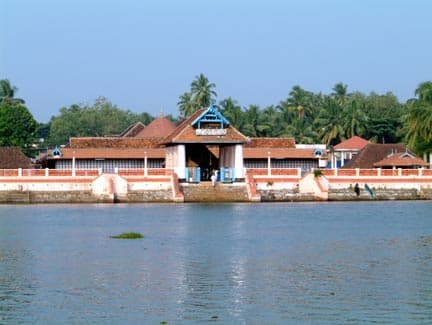
Thriprayar Temple
The Thriprayar Temple, also known as the Shree Ramaswami Temple, is a significant Hindu temple located in Triprayar, Thrissur district, Kerala, India. It is dedicated to Lord Rama, the seventh incarnation of Vishnu, who is depicted with four arms holding a conch, discus, bow, and garland. The temple's origin story involves the idol being worshipped by Krishna in Dwarka, later immersed in the sea, and eventually found by fishermen.