
The Leaning Temple of Huma
The Leaning Temple of Huma is a unique Hindu temple located in Huma village, Odisha, India, on the banks of the Mahanadi River. It is renowned for its significant tilt, with the main temple leaning at an angle of 13.8 degrees, making it one of the few such structures globally.
Key Facts
- ›The temple is dedicated to Lord Bimaleshwar, a form of Shiva.
- ›It is situated on a rocky outcrop beside the Mahanadi River.
- ›The main temple leans at an angle of 13.8 degrees, while smaller temples within the complex tilt in different directions.
- ›The exact reason for the temple's lean is unknown, with theories suggesting geological instability or seismic activity.
- ›An annual fair is held in March on the occasion of Shivratri, attracting many visitors.
- ›A local legend speaks of a milkman who initiated worship here, and a curse associated with catching 'Kudo' fish.

Lord Bimaleshwar
- Architectural curiosity due to its significant lean
- Religious pilgrimage site, particularly during Shivratri
- Unique geological phenomenon
Ganga Vamsi Dynasty, Chauhan Dynasty
Shivratri
Emperor Anangabhima Deva-Iii, King Baliar Singh, King Ajit Singh
Stone Statue of A Woman Cutting Kudo Fish
Mahanadi River
About The Leaning Temple of Huma
The Leaning Temple of Huma is a remarkable Hindu temple situated in the village of Huma, located on the banks of the Mahanadi River, approximately 23 kilometers south of Sambalpur in the Indian state of Odisha. It is distinguished by its significant lean, with the primary temple structure tilting at an angle of 13.8 degrees, making it one of the rare leaning temples found globally. The temple is dedicated to Lord Bimaleshwar, a manifestation of the Hindu deity Shiva.
Architecture and Mystery
The temple's distinctive tilt has fascinated historians, sculptors, and researchers. While the main temple leans in one direction, other smaller temples within the complex are tilted in various directions, and even the boundary walls exhibit a deviation. Despite the lean, the pinnacle of the main temple stands perpendicular to the ground. The precise reason for this inclination remains a subject of speculation. It is unclear whether the lean was an intentional design feature or a result of external factors. Theories propose that geological instability, such as interior displacement of the rocky bed due to river currents or seismic activity, might be responsible, rather than construction flaws or a weak foundation.
Historical Patronage and Legend
Historical records indicate that the temple was initially built by Emperor Anangabhima Deva-III of the Ganga Vamsi dynasty. It underwent rebuilding or renovation by King Baliar Singh, the fifth Chauhan king of Sambalpur, between 1660 and 1690 AD. Subsequent structures within the complex were erected during the rule of King Ajit Singh of Sambalpur from 1766 to 1788 AD. A local legend recounts that the worship of Shiva at this site was initiated by a milkman who offered milk to a rock outcrop on the riverbank, which miraculously absorbed it, leading to the temple's construction. Another legend warns of a curse upon those who catch the local 'Kudo' fish, with a stone statue within the temple complex said to depict a woman afflicted by this curse.
Annual Fair and Tourism
An annual fair is held at the foothills of the temple every March, coinciding with the festival of Shivratri. This event draws large crowds, including international tourists, and the Odisha government has proposed the construction of a hanging bridge to further enhance tourism to the fair. The unique 'Kudo' fish found in the river are often fed by visitors, adding to the local folklore and the temple's mystique.
Source: Wikipedia ↗
Frequently Asked Questions
Where is the Leaning Temple of Huma located?
The Leaning Temple of Huma is situated in Huma village, on the bank of the Mahanadi River, approximately 23 km south of Sambalpur in the Indian state of Odisha.
What deity is worshipped at the Leaning Temple of Huma?
The temple is dedicated to the Hindu god Lord Bimaleshwar, who is a form of Lord Shiva.
Why does the temple lean?
The exact reason for the temple's lean is unknown. Theories suggest it could be due to interior displacement of the rocky bed caused by flood currents or earthquakes, or an uneven underlying rock structure, rather than technical flaws or a weak foundation.
How much does the temple lean?
The main temple leans at an angle of 13.8 degrees. Interestingly, the pinnacle of the temple remains perpendicular to the ground, and other smaller temples within the complex tilt in different directions.
What is the significance of the annual fair at the temple?
An annual fair is held at the foothill of the temple in March, coinciding with Shivratri. This fair attracts large crowds, including foreign visitors, and is a significant event for tourism in the region.
Is there a legend associated with the temple?
According to legend, Shiva worship was initiated by a milkman who offered milk to the rock here, which was miraculously consumed. This led to the construction of the temple. There is also a belief that catching the local 'Kudo' fish results in a curse, with a stone statue depicting a woman supposedly affected by it.
Related Temples (Hindu)

Taraknath Temple
The Taraknath Temple, located in Tarakeswar, West Bengal, India, is a significant Hindu pilgrimage site dedicated to Lord Shiva, worshiped here as Tarakanatha. Constructed in 1729, it features a distinct Bengal architectural style with an 'atchala' structure and an adjacent 'natmandir'. The temple is renowned for its belief that a dip in the nearby Dudhpukur tank fulfills prayers and is considered one of the 64 Jyotirlingas.

Tanot Mata Temple
The Tanot Mata Temple is a significant Hindu shrine located in the Jaisalmer district of Rajasthan, India, near the Pakistan border. Revered as a form of Goddess Hinglaj Mata, the temple is famously associated with the Indian victories in the Indo-Pakistani Wars of 1965 and 1971, with local folklore attributing the successful outcomes to divine intervention. The Border Security Force of India now manages the temple complex, which also includes a victory tower and a war museum.
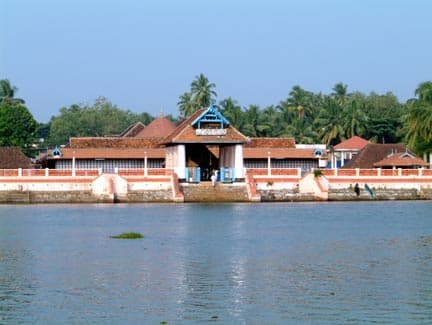
Thriprayar Temple
The Thriprayar Temple, also known as the Shree Ramaswami Temple, is a significant Hindu temple located in Triprayar, Thrissur district, Kerala, India. It is dedicated to Lord Rama, the seventh incarnation of Vishnu, who is depicted with four arms holding a conch, discus, bow, and garland. The temple's origin story involves the idol being worshipped by Krishna in Dwarka, later immersed in the sea, and eventually found by fishermen.