
Thawe Mandir
Thawe Mandir, also known as the Temple of Maa Thawewali, is a significant Hindu temple located in Thawe, Gopalganj District, Bihar, India. It is dedicated to Goddess Durga, worshipped here as Maa Thawewali, and is believed to be a Shakti Peetha. The temple is associated with legends of divine intervention and is a popular pilgrimage site, particularly during festivals.
Key Facts
- ›The temple is dedicated to Goddess Durga, worshipped as Maa Thawewali.
- ›It is considered a Shakti Peetha, one of the prominent seats of the Goddess Shakti.
- ›Thawe Mandir is located in Thawe village, Gopalganj District, Bihar, India.
- ›Legends connect the temple's establishment to the devotee Rahshu Bhagat and a divine intervention from Kamakhya, Assam.
- ›A large fair is held annually in the month of Chaitra (March–April) and during Navratra in Ashvin (October).
- ›The temple is situated near the ruins of an old fort and a decadent palace of the Hathwa King.

Durga, Maa Thawewali, Singhasini Devi, Rahshu Bhawani
Shakti Peetha, Pilgrimage Site, Associated With Divine Legends
Chero Dynasty
Navratra, Chaitra Mela, Ashvin Mela
Shree Rahshu Bhagat Ji, Manan Singh
About Thawe Mandir
Thawe Mandir, also known as the Temple of Maa Thawewali, is a significant Hindu temple located in the village of Thawe, within the Gopalganj District of Bihar, India. Situated approximately 6 km from the district headquarters and near a railway junction, the temple is a prominent religious site dedicated to Goddess Durga, worshipped here in her form as Maa Thawewali.
Religious Significance and Legends
The temple is revered as a Shakti Peetha, one of the most sacred sites dedicated to the Goddess Shakti across India. According to folklore, Maa Thawewali journeyed to Thawe from Kamakhya, Assam, in response to the fervent prayers of her great devotee, Shree Rahshu Bhagat Ji. Legends speak of a local king who, disbelieving Rahshu's devotion, challenged the Goddess, resulting in a dramatic display of divine power that led to the king's demise and the establishment of the Goddess's presence in Thawe. The Goddess is also known by other names such as Singhasini Devi and Rahshu Bhawani.
Worship and Festivals
Devotees worship Maa Thawewali with offerings such as 'Laddo', 'Peda', 'Narial' (coconut), and 'Chunari' (scarf). Mondays and Fridays are considered especially auspicious for worship, drawing larger crowds. The temple hosts significant annual fairs during the Navratra festivals in the months of Chaitra (March–April) and Ashvin (October), attracting numerous pilgrims and visitors.
Historical Context and Surroundings
The site of Thawe Mandir is historically associated with an old fort, though its origins are obscure, and a palace belonging to the Hathwa King, which is now in a dilapidated state. Close to the main temple, there is a peculiar tree whose botanical family remains unidentified, and various legends are associated with both the tree and the idol of the Goddess.
Source: Wikipedia ↗
Frequently Asked Questions
Where is Thawe Mandir located?
Thawe Mandir is situated in the village of Thawe, in Gopalganj District, within the state of Bihar, India. It is approximately 6 km from Gopalganj town, located on the Gopalganj-Siwan National Highway.
To which deity is Thawe Mandir dedicated?
Thawe Mandir is primarily dedicated to Goddess Durga, who is worshipped here by the name Maa Thawewali. She is also known as Singhasini Devi and Rahshu Bhawani.
What is the significance of Thawe Mandir as a Shakti Peetha?
Thawe Mandir is recognized as a Shakti Peetha, which are considered the most sacred abodes of the Goddess Shakti across India. This designation highlights its importance as a pilgrimage site for devotees of the Goddess.
What are the main legends associated with Thawe Mandir?
One prominent legend narrates how Maa Thawewali arrived from Kamakhya, Assam, at the prayer of her devotee Shree Rahshu Bhagat Ji. Another folklore speaks of a king who, disbelieving Rahshu's divine connection, witnessed the goddess's power, leading to the destruction of his kingdom and his death.
When are the important times to visit Thawe Mandir?
Mondays and Fridays are considered particularly important days for worship. Significant fairs are organized twice a year during the Navratra festivals in the months of Chaitra (March–April) and Ashvin (October).
What prasad is offered at Thawe Mandir?
A famous prasad offered at Thawe Mandir is 'Pidkiyaa'. Devotees also commonly offer 'Laddo', 'Peda', 'Narial' (coconut), and 'Chunari' (scarf) to the Goddess.
Related Temples (Hindu)

Taraknath Temple
The Taraknath Temple, located in Tarakeswar, West Bengal, India, is a significant Hindu pilgrimage site dedicated to Lord Shiva, worshiped here as Tarakanatha. Constructed in 1729, it features a distinct Bengal architectural style with an 'atchala' structure and an adjacent 'natmandir'. The temple is renowned for its belief that a dip in the nearby Dudhpukur tank fulfills prayers and is considered one of the 64 Jyotirlingas.

Tanot Mata Temple
The Tanot Mata Temple is a significant Hindu shrine located in the Jaisalmer district of Rajasthan, India, near the Pakistan border. Revered as a form of Goddess Hinglaj Mata, the temple is famously associated with the Indian victories in the Indo-Pakistani Wars of 1965 and 1971, with local folklore attributing the successful outcomes to divine intervention. The Border Security Force of India now manages the temple complex, which also includes a victory tower and a war museum.
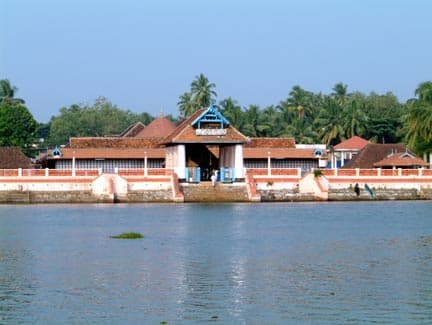
Thriprayar Temple
The Thriprayar Temple, also known as the Shree Ramaswami Temple, is a significant Hindu temple located in Triprayar, Thrissur district, Kerala, India. It is dedicated to Lord Rama, the seventh incarnation of Vishnu, who is depicted with four arms holding a conch, discus, bow, and garland. The temple's origin story involves the idol being worshipped by Krishna in Dwarka, later immersed in the sea, and eventually found by fishermen.