
Thakurdwara Bhagwan Narainji
Thakurdwara Bhagwan Narainji, popularly known as Pandori Dham, is a significant historical Hindu temple in Punjab, India, belonging to the Ramanandi Sampradaya. Founded by Ramanandi saint Shri Bhagwanji and his disciple Shri Narainji, it is recognized as one of the fifty-two Vaishnav dvaras organized by Bairagis and has a history of patronage from Rajput rulers and imperial figures.
Key Facts
- ›Belongs to the Ramanandi Sampradaya and is a Vaishnava gaddi.
- ›Founded by Ramanandi Saint Shri Bhagwanji and his disciple Shri Narainji.
- ›Historically patronized by Rajput rulers of princely states in Jammu and Himachal.
- ›Associated with the Baisakhi fair, a major annual event lasting three days.
- ›Has a network of 39 associated mathas (daughter shrines) across the Indian subcontinent.
- ›The second Mahant, Shri Narainji, is said to have survived an ordeal by Emperor Jahangir.

Vishnu, Rama
Religious Pilgrimage, Historical Importance, Cultural Events, Monastic Tradition, Patronage From Princely States and Emperors
Mughal Empire, Sikh Empire
Baisakhi
Shri Bhagwanji, Shri Narainji, Jahangir, Maharaja Ranjit Singh, Rulers of Nurpur, Rulers of Jammu, Rulers of Mankot, Rulers of Guler, Rulers of Basohli, Rulers of Chamba, Rulers of Bandralta, Rulers of Jasrota, Rulers of Jaswan
About Thakurdwara Bhagwan Narainji
Thakurdwara Bhagwan Narainji, widely recognized as Pandori Dham, is a historically significant Hindu temple situated in the village of Pandori Mahantan within the Gurdaspur district of Punjab, India. It holds a prominent place within the Ramanandi Sampradaya and is designated as a Vaishnava gaddi, functioning as one of the fifty-two Vaishnav dvaras organized by the Bairagi order. The shrine's origins are attributed to the Ramanandi saint Shri Bhagwanji, who, according to tradition, was initiated into the order by Krishnadas Payahari. The temple later took its name from his disciple, Shri Narainji.
History and Tradition
Pandori Dham boasts a rich history, having garnered significant devotion and patronage from various rulers. The Rajput rulers of princely states in the hills of Jammu and Himachal, including those of Nurpur, Jammu, Mankot, Guler, Basohli, Chamba, Bandralta, Jasrota, and Jaswan, were particularly devoted to the shrine. Tradition also recounts that the second Mahant, Shri Narainji, faced an ordeal inflicted by the Mughal Emperor Jahangir, who allegedly poisoned him to test his miraculous powers. Shri Narainji's survival is said to have left Jahangir humbled, leading him to acknowledge the shrine's spiritual authority. Further royal patronage was received during the reign of Maharaja Ranjit Singh, who frequently journeyed to the shrine.
Festivals and Cultural Significance
The temple is particularly renowned for its annual Baisakhi fair, a vibrant three-day event that commences on the first day of Vaisakha. The festivities begin with a grand procession carrying the Mahant in a palanquin, followed by Navgraha Puja and significant charitable donations of money, grains, and cows. Evenings are marked by Sankirtan, religious discourses by the Mahant, and the distribution of prasad. Pilgrims also engage in ritualistic bathing at the sacred tank located within the shrine complex.
Influence and Branches
Over time, Thakurdwara at Pandori Dham extended its spiritual influence far beyond its immediate region. It established numerous daughter shrines, or mathas, spreading across the entire Indian subcontinent. According to genealogical records published by Pandori Dham, there are 39 affiliated mathas located throughout India, with smaller branches in towns across North Punjab, Jammu, and Himachal. Notable historical daughter shrines include those at Damtal in Kangra, Bathu in the erstwhile Guler state, and Lehal in Dhariwal.
Source: Wikipedia ↗
Frequently Asked Questions
Who founded Thakurdwara Bhagwan Narainji?
The temple was founded by the Ramanandi saint Shri Bhagwanji, who was a Dogra Khajuria Brahmin. It was later named after his disciple, Shri Narainji.
What is the significance of Pandori Dham?
Pandori Dham is historically significant as one of the fifty-two Vaishnav dvaras into which Bairagis have been organized. It also received royal patronage from various Hindu princely states and even from Mughal Emperor Jahangir and Maharaja Ranjit Singh.
What is the main festival celebrated at Thakurdwara Bhagwan Narainji?
The most prominent festival celebrated at the temple is the Baisakhi fair, which lasts for three days. The celebrations involve processions, religious discourses, and charitable donations.
How extensive is the influence of Pandori Dham?
Pandori Dham's influence extended across the Indian subcontinent, with 39 associated mathas (daughter shrines) established in various regions, including North Punjab, Jammu, Himachal, South India, Gujarat, Uttar Pradesh, and Maharashtra.
Is there any connection to Emperor Jahangir?
According to tradition, the second Mahant, Shri Narainji, survived an attempt by Emperor Jahangir to test his miraculous powers through poisoning. This event is said to have led Jahangir to acknowledge the supremacy of the shrine.
Related Temples (Hindu)

Taraknath Temple
The Taraknath Temple, located in Tarakeswar, West Bengal, India, is a significant Hindu pilgrimage site dedicated to Lord Shiva, worshiped here as Tarakanatha. Constructed in 1729, it features a distinct Bengal architectural style with an 'atchala' structure and an adjacent 'natmandir'. The temple is renowned for its belief that a dip in the nearby Dudhpukur tank fulfills prayers and is considered one of the 64 Jyotirlingas.

Tanot Mata Temple
The Tanot Mata Temple is a significant Hindu shrine located in the Jaisalmer district of Rajasthan, India, near the Pakistan border. Revered as a form of Goddess Hinglaj Mata, the temple is famously associated with the Indian victories in the Indo-Pakistani Wars of 1965 and 1971, with local folklore attributing the successful outcomes to divine intervention. The Border Security Force of India now manages the temple complex, which also includes a victory tower and a war museum.
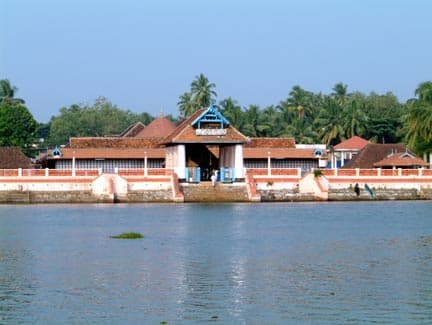
Thriprayar Temple
The Thriprayar Temple, also known as the Shree Ramaswami Temple, is a significant Hindu temple located in Triprayar, Thrissur district, Kerala, India. It is dedicated to Lord Rama, the seventh incarnation of Vishnu, who is depicted with four arms holding a conch, discus, bow, and garland. The temple's origin story involves the idol being worshipped by Krishna in Dwarka, later immersed in the sea, and eventually found by fishermen.