
Tarapith Temple
The Tarapith Temple in West Bengal, India, is a significant Hindu temple dedicated to the goddess Tara, one of the ten Mahavidyas. Recognized as both a Shaktipith and Siddhapith, it is a prominent center for Tantra and Shakti worship, deeply associated with legends of Sati and the sage Vashishta, as well as the mystic saint Bamakhepa.
Key Facts
- ›Dedicated to the Hindu goddess Tara, the second of the ten Mahavidyas.
- ›Recognized as a Shaktipith, believed to be the site where the third eye of Goddess Sati fell.
- ›Associated with the sage Vashishta, who is said to have worshipped the goddess here.
- ›A significant pilgrimage center for Bengali Hindus, attracting millions of devotees annually.
- ›The adjacent cremation ground is a revered site for tantric practices.
- ›Known for its unique rituals, including daily goat sacrifices and non-vegetarian prasad.

Tara
Shaktipith, Siddhapith, Center For Tantra and Shakti Worship, Pilgrimage Site For Bengali Hindus
Kaushiki Amavasya, Phalaharini Amavasya, Ambubachi
Red Brick
Vashistha Muni
- Stone Image of Tara Depicted As A Mother Suckling Shiva
- Four-Armed Metal Image of Tara In Her Fierce Form
Dwaraka River, Jivita Kunda
About Tarapith Temple
Tarapith Temple is a significant Hindu temple located in the village of Tarapith, in the Birbhum district of West Bengal, India. It is primarily dedicated to the worship of the goddess Tara, who is revered as the second of the ten Mahavidyas in Hinduism. The temple holds immense religious importance, being recognized as both a Shaktipith and a Siddhapith, and is considered one of the most prominent and historically significant centers for Tantra and Shakti worship.
Legend and Importance
The mythology surrounding Tarapith Temple is deeply intertwined with the legends of Goddess Sati. According to ancient texts like the Devi Bhagavata Purana and Markandeya Purana, the third eye of Goddess Sati fell at this sacred site after her body was dismembered by Lord Vishnu's Sudarshan Chakra. The sage Vashishta is credited with first discovering this sacred spot and initiating the worship of the goddess, eventually leading to the development of the temple. Tarapith is also closely associated with the mystic saint Bamakhepa, who is said to have experienced profound spiritual insights in this area. The cremation ground adjacent to the temple is particularly revered and is a popular site for tantric practices within Shaktism.
Architecture and Rituals
The Tarapith temple itself is described as a medium-sized structure with thick walls built of red brick. The superstructure features covered passages with numerous arches leading to a spire (shikara). Within the sanctum, two images of Tara are enshrined. The primordial stone image depicts Tara as a mother suckling Shiva, a gentler aspect, which is concealed by a three-foot metal image. This outer image represents Tara in her fierce form, with four arms, a skull garland, and a protruding tongue. The temple's rituals are unique and often involve the daily sacrifice of goats, believed to appease the goddess and secure her blessings. Non-vegetarian food, including mutton and fish, is served as prasad, a practice rooted in its Tantric traditions. Devotees also partake in a holy bath at the adjacent Jivita Kunda, a sacred tank whose waters are believed to possess healing and life-restoring properties.
Spiritual Tourism and Renovation
Tarapith is a major destination for spiritual tourism in Eastern India, drawing an average of 12,000 devotees daily and over 7 million annually, making it a vital economic hub for the region. The town's economy largely thrives around the temple and its associated spiritual attractions. The temple complex also houses several other smaller shrines dedicated to deities like Shiva, Hanuman, and Maa Shashthi, as well as a temple dedicated to Bamakhepa. The temple has undergone significant renovations, including the marbling of the inner floor, painting of walls, and expansion of the 'bhog ghar' to accommodate more pilgrims. New temples have also been constructed within the complex to replace older, fragile structures.
Source: Wikipedia ↗
Frequently Asked Questions
What is the religious significance of Tarapith Temple?
Tarapith Temple is considered a highly significant religious site as it is recognized as both a Shaktipith and a Siddhapith. It is a prominent center for Tantra and Shakti worship, and legends associate it with the goddess Sati and the sage Vashishta.
What is the origin legend of Tarapith Temple?
According to legend, the third eye of Goddess Sati fell at this site after her body was dismembered by Vishnu's Sudarshan Chakra. The sage Vashishta is credited with worshipping here and developing the site into a temple.
Who is the primary deity worshipped at Tarapith Temple?
The primary deity worshipped at Tarapith Temple is the Hindu goddess Tara, who is the second of the ten Mahavidyas. She is worshipped in various forms, including a mother suckling Shiva and a fierce form with four arms.
What is the significance of the cremation ground at Tarapith?
The cremation ground, known as the Maha Smasan, is considered an integral part of the Tarapith Shakti Pith and is highly revered by tantric practitioners. It is believed to be Tara's preferred residence and a place for performing tantric sadhana.
What unique rituals are performed at Tarapith Temple?
Tarapith Temple is known for its unique rituals, including daily goat sacrifices offered by devotees seeking blessings. Non-vegetarian food, such as goat meat and fish, is also served as prasad, which is uncommon in many Hindu temples.
Is Tarapith Temple associated with any famous saints?
Yes, Tarapith Temple is closely associated with the mystic saint Bamakhepa, who is popularly known as the 'mad saint'. He was an ardent devotee of goddess Tara and spent much of his life meditating in the cremation grounds near the temple.
Related Temples (Hindu)

Taraknath Temple
The Taraknath Temple, located in Tarakeswar, West Bengal, India, is a significant Hindu pilgrimage site dedicated to Lord Shiva, worshiped here as Tarakanatha. Constructed in 1729, it features a distinct Bengal architectural style with an 'atchala' structure and an adjacent 'natmandir'. The temple is renowned for its belief that a dip in the nearby Dudhpukur tank fulfills prayers and is considered one of the 64 Jyotirlingas.

Tanot Mata Temple
The Tanot Mata Temple is a significant Hindu shrine located in the Jaisalmer district of Rajasthan, India, near the Pakistan border. Revered as a form of Goddess Hinglaj Mata, the temple is famously associated with the Indian victories in the Indo-Pakistani Wars of 1965 and 1971, with local folklore attributing the successful outcomes to divine intervention. The Border Security Force of India now manages the temple complex, which also includes a victory tower and a war museum.
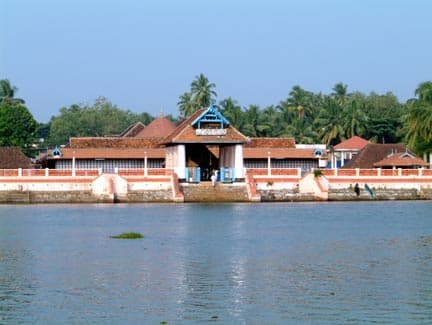
Thriprayar Temple
The Thriprayar Temple, also known as the Shree Ramaswami Temple, is a significant Hindu temple located in Triprayar, Thrissur district, Kerala, India. It is dedicated to Lord Rama, the seventh incarnation of Vishnu, who is depicted with four arms holding a conch, discus, bow, and garland. The temple's origin story involves the idol being worshipped by Krishna in Dwarka, later immersed in the sea, and eventually found by fishermen.