
Swamimalai Murugan Temple
Swamimalai Murugan Temple is a significant Hindu temple dedicated to Lord Murugan, located in Swamimalai, Tamil Nadu, India. It is renowned as one of the Six Abodes of Murugan and is celebrated for its mythological narrative where Murugan taught the Pranava Mantra to his father, Shiva, earning him the name Swaminathaswamy. The temple's unique architecture features a shrine atop a hillock, with sixty steps representing the Tamil calendar years leading to the main deity.
Key Facts
- ›It is one of the six Abodes of Murugan (Arupadaiveedugal), a significant set of temples dedicated to the deity.
- ›The temple commemorates the mythological event where Murugan taught the Pranava Mantra (Om) to Lord Shiva, earning the deity the name Swaminathaswamy.
- ›The temple is situated atop a 60-foot hillock, with sixty steps leading to the main shrine, each named after a year in the Tamil calendar.
- ›The presiding deity, Murugan, is depicted with an elephant mount, a rare iconography gifted by Indra.
- ›The temple is mentioned in Sangam literature, specifically in Tirumurukāṟṟuppaṭai by Nakkeerar, and hymns by the 14th-century poet Arunagirinathar.
- ›It is maintained by the Hindu Religious and Charitable Endowments Department of the Government of Tamil Nadu.

Murugan, Swaminathaswamy, Shiva, Sundareswarar, Meenakshi, Parvati
- One of the Six Abodes of Murugan
- Mythological Importance Related To the Teaching of Pranava Mantra
- Mentioned In Sangam Literature and Hymns of Arunagirinathar
- Unique Iconography of Murugan With An Elephant Mount
Vaikasi Visakam
Kaveri
About Swamimalai Murugan Temple
Swamimalai Murugan Temple, also known as Swaminatha Swamy Temple, is a revered Hindu temple situated on the banks of a tributary of the Kaveri River in Swamimalai, near Kumbakonam in the Thanjavur district of Tamil Nadu, India. It holds significant religious importance as one of the Six Abodes of Lord Murugan, known as Arupadaiveedugal in Tamil.
Mythology and Divine Teachings
The temple's name and significance are deeply rooted in Hindu mythology. It is believed that at this very spot, Lord Murugan, the youthful god of war, expounded the meaning of the sacred Pranava Mantra (Om) to his father, Lord Shiva. This divine teaching elevated Murugan to the status of a guru, and consequently, he is venerated here as Swaminathaswamy, meaning 'Teacher of God.' This narrative is symbolically represented in the temple's architecture, with Murugan's shrine located atop a hillock while Shiva's shrine resides at the foothills.
Architectural Marvels
The temple's structure is distinctive, built atop a 60-foot-high hillock. Sixty steps ascend to the main shrine, with each step bearing the name of one of the sixty Tamil years. This design not only adds to the temple's visual grandeur but also serves as a calendaric representation. The temple complex features three gopurams (gateway towers) and is divided into three precincts. Additionally, shrines dedicated to other deities, including Shiva (Sundareswarar) and Meenakshi (Parvati), are located at the base of the hill.
Unique Iconography and Worship
A notable feature of Swamimalai Murugan Temple is the depiction of the deity with an elephant mount, a rare iconography for Murugan, who is typically associated with a peacock. This elephant mount is said to have been a gift from Indra, the king of the Devas. The temple observes six daily rituals and celebrates three major annual festivals, with Vaikasi Visakam, commemorating Murugan's birthday, being the most prominent. The temple's worship practices include traditional rituals like tonsuring, ablutions with sacred paste, and offerings of milk and panchamirtham.
Historical and Literary Mentions
Swamimalai Murugan Temple is not only a site of religious devotion but also holds historical and literary significance. It is mentioned in ancient Sangam literature, specifically in the work 'Tirumurukāṟṟuppaṭai' by Nakkeerar. The temple's glory was further immortalized by the 14th-century Tamil poet Arunagirinathar, who composed hymns about it in his collection 'Tiruppukal.' The temple is currently maintained and administered by the Hindu Religious and Charitable Endowments Department of the Government of Tamil Nadu.
Source: Wikipedia ↗
Frequently Asked Questions
What is the mythological significance of Swamimalai Murugan Temple?
According to Hindu mythology, Murugan taught the meaning of the Pranava Mantra (Om) to his father, Lord Shiva, at this location. This event led Murugan to be known as Swaminathaswamy, meaning 'Teacher of God,' and signifies Murugan's divine wisdom and his role as a guru.
Why is Murugan depicted with an elephant mount at Swamimalai?
Unlike the usual peacock mount associated with Murugan, the deity is depicted with an elephant mount at Swamimalai. This iconography is believed to be a gift from Indra, the king of the Devas, and is a unique feature of this temple and Tiruttani.
What is the architectural peculiarity of Swamimalai Murugan Temple?
The temple is built atop a 60-foot hillock, with sixty steps leading to the main shrine. Each of these steps is named after one of the sixty years of the Tamil calendar, symbolizing the passage of time and the cyclical nature of life.
What are the main festivals celebrated at Swamimalai Murugan Temple?
The major festival celebrated annually at Swamimalai Murugan Temple is Vaikasi Visakam, which commemorates the birthday of Lord Murugan. The temple also observes three yearly festivals and conducts six daily rituals.
Is Swamimalai Murugan Temple an ancient temple?
Yes, the temple is mentioned in ancient Sangam literature, including Tirumurukāṟṟuppaṭai by Nakkeerar. Additionally, the 14th-century Tamil poet Arunagirinathar composed hymns glorifying Murugan and the temple in his works like Tiruppukal.
Related Temples (Hindu)

Taraknath Temple
The Taraknath Temple, located in Tarakeswar, West Bengal, India, is a significant Hindu pilgrimage site dedicated to Lord Shiva, worshiped here as Tarakanatha. Constructed in 1729, it features a distinct Bengal architectural style with an 'atchala' structure and an adjacent 'natmandir'. The temple is renowned for its belief that a dip in the nearby Dudhpukur tank fulfills prayers and is considered one of the 64 Jyotirlingas.

Tanot Mata Temple
The Tanot Mata Temple is a significant Hindu shrine located in the Jaisalmer district of Rajasthan, India, near the Pakistan border. Revered as a form of Goddess Hinglaj Mata, the temple is famously associated with the Indian victories in the Indo-Pakistani Wars of 1965 and 1971, with local folklore attributing the successful outcomes to divine intervention. The Border Security Force of India now manages the temple complex, which also includes a victory tower and a war museum.
Thriprayar Temple
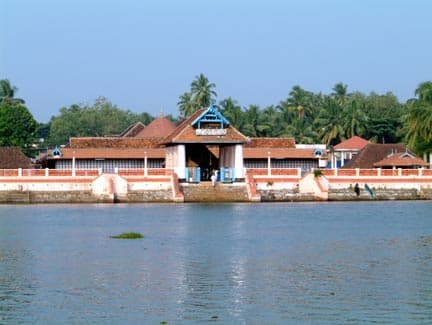
The Thriprayar Temple, also known as the Shree Ramaswami Temple, is a significant Hindu temple located in Triprayar, Thrissur district, Kerala, India. It is dedicated to Lord Rama, the seventh incarnation of Vishnu, who is depicted with four arms holding a conch, discus, bow, and garland. The temple's origin story involves the idol being worshipped by Krishna in Dwarka, later immersed in the sea, and eventually found by fishermen.