
Sri Navaladi Karuppannaswami Temple – Mohanur
The Arulmigu Navaladi Karuppannaswami Temple in Mohanur, Tamil Nadu, is an ancient Hindu temple estimated to be between 500 and 1000 years old. Dedicated to Karuppu Sami, also known by epithets like Navaladian and Judge Durai, the temple is renowned as a 'Swayambu' (self-manifested) site, distinguished by two prominent trees: a Naval tree and a Neem tree.
Key Facts
- ›The temple is located in Mohanur, Namakkal District, Tamil Nadu, India.
- ›It is dedicated to the deity Karuppu Sami, also referred to as Navaladian and Judge Durai.
- ›The temple is considered 'Swayambu', meaning self-manifested.
- ›It is distinguished by the presence of a Naval tree and a Neem tree, with the Naval tree being historically significant.
- ›Devotees seek solutions for debts, family issues, diseases, and success in cattle rearing and marriage alliances.
- ›The temple conducts midnight pujas known as Sathya Puja, considered highly important by worshippers.

Karuppu Sami
Religious Pilgrimage, Historical Site, Swayambu Deity
Mariamman Festival, Kaliamman Festival
King Mohur Pazhayan
About Sri Navaladi Karuppannaswami Temple – Mohanur
Arulmigu Navaladi Karuppannaswami Temple – Mohanur
The Arulmigu Navaladi Karuppannaswami Temple, located in Mohanur, Namakkal District, Tamil Nadu, India, is an ancient Hindu temple with an estimated age ranging from 500 to 1000 years. The temple's presiding deity is Karuppu Sami, who is also known by various epithets such as Navaladian, Judge Durai, and Pattamarathan. It is revered as a 'Swayambu' temple, meaning the deity is self-manifested, and is notable for its proximity to two significant trees: a Naval tree, considered the 'Holy tree', and a Neem tree, referred to as the 'Special tree'.
Legend and History
According to legend, King Mohur Pazhayan, who ruled the region, habitually prayed to Navaladian before making important decisions. He designated the nearby Neem Tree as the region's Watch Tree. Following an invasion by Senguttuvan, the Naval tree began to dry. Because the deity was situated near this tree, he became known as Navaladian, as he was also close to the Naval tree at that time.
Worship and Practices
Devotees visit the Arulmigu Navaladi Karuppannaswami Temple seeking solutions for a wide range of issues, including the alleviation of debt, resolution of family problems, healing from incurable diseases, success in raising cattle, and for children and suitable marriage alliances. A significant practice at the temple involves devotees submitting their prayers in writing, framing their grievances as petitions and tying them to the Pattamaram tree. This act is akin to submitting a formal request to an official. The temple also conducts a midnight puja known as Sathya Puja, which is considered particularly important by worshippers. The pujas performed within the Chellandiamman shrine, a popular sub-shrine, are non-vegetarian.
Festivals and Consecration
Major festivals celebrated at the temple include the Mariamman festival, which takes place over 10 days during the Panguni month (March–April). This is followed by the Kaliamman festival in the Chithirai month (April–May), which lasts for 8 days. The temple underwent a significant consecration ceremony, known as Kumbabisekam, on June 17, 2018, following the completion of a new, tall Raja Gopuram. This event was celebrated over three days, from June 15 to June 17, and was attended by several prominent political figures.
Source: Wikipedia ↗
Frequently Asked Questions
What is the age of the Arulmigu Navaladi Karuppannaswami Temple?
The Arulmigu Navaladi Karuppannaswami Temple is estimated to be between 500 and 1000 years old. This age places it as a significant historical and religious site in the region.
Who is the presiding deity of the temple?
The presiding deity is Karuppu Sami, who is also known by several other names, including Navaladian and Judge Durai. He is also referred to as Pattamarathan.
What is special about the trees at the temple?
The temple is known for two trees: a Naval tree, referred to as the 'Holy tree', and a Neem tree, known as the 'Special tree'. The Naval tree is historically linked to the deity and the legend of King Mohur Pazhayan.
What kinds of prayers are offered at the temple?
Devotees visit the temple seeking divine intervention for various problems, including the burden of debt, family issues, incurable diseases, success in raising cattle, and for finding suitable marriage alliances. They also pray for children.
How do devotees submit their prayers?
Devotees have a unique practice of submitting their prayers in writing. They write their grievances on a petition and tie it to the Pattamaram tree within the temple premises, as if submitting it to an official.
Are there any special pujas performed at the temple?
Yes, the midnight puja, known as Sathya Puja, is considered very important by the devotees. The pujas performed here are also noted to be non-vegetarian.
Related Temples (Hindu)

Taraknath Temple
The Taraknath Temple, located in Tarakeswar, West Bengal, India, is a significant Hindu pilgrimage site dedicated to Lord Shiva, worshiped here as Tarakanatha. Constructed in 1729, it features a distinct Bengal architectural style with an 'atchala' structure and an adjacent 'natmandir'. The temple is renowned for its belief that a dip in the nearby Dudhpukur tank fulfills prayers and is considered one of the 64 Jyotirlingas.

Tanot Mata Temple
The Tanot Mata Temple is a significant Hindu shrine located in the Jaisalmer district of Rajasthan, India, near the Pakistan border. Revered as a form of Goddess Hinglaj Mata, the temple is famously associated with the Indian victories in the Indo-Pakistani Wars of 1965 and 1971, with local folklore attributing the successful outcomes to divine intervention. The Border Security Force of India now manages the temple complex, which also includes a victory tower and a war museum.
Thriprayar Temple
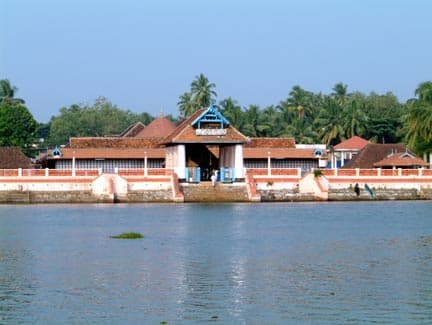
The Thriprayar Temple, also known as the Shree Ramaswami Temple, is a significant Hindu temple located in Triprayar, Thrissur district, Kerala, India. It is dedicated to Lord Rama, the seventh incarnation of Vishnu, who is depicted with four arms holding a conch, discus, bow, and garland. The temple's origin story involves the idol being worshipped by Krishna in Dwarka, later immersed in the sea, and eventually found by fishermen.