
Shankaracharya Temple
The Shankaracharya Temple, also known as Jyeshteshwara Temple, is an ancient Hindu temple situated atop the Zabarwan Range in Srinagar, Kashmir. Dedicated to Lord Shiva, it is historically significant as one of the oldest temples in the region and is believed by Kashmiri Hindus to have been visited by Adi Shankara.
Key Facts
- ›The temple is dedicated to Lord Shiva and is located on a hill overlooking Srinagar.
- ›It is considered the oldest temple in Kashmir, though its exact construction date is debated.
- ›Historically, the hill was known as 'Gopadri' or 'Gopa Hill' and the temple as 'Jyesthesvara'.
- ›Kashmiri Hindus associate the temple with Adi Shankara, believing he composed the Saundarya Lahari there.
- ›The temple is a Monument of National Importance and centrally protected by the Archaeological Survey of India.
- ›It remains an active place of worship, particularly visited by Kashmiri Hindus during festivals like Herath (Maha Shivaratri).

Shiva
Historical, Religious Pilgrimage, Architectural
Herath
Stone
Gopaditya, Mihirakula, Jaloka
Lingam Encircled By A Snake
Dal Lake, Jhelum River
About Shankaracharya Temple
The Shankaracharya Temple, also known as the Jyeshteshwara Temple, is a significant Hindu place of worship located atop the Zabarwan Range in Srinagar, Kashmir. Perched at an elevation of 1,000 feet above the valley floor, it offers panoramic views of Srinagar city, the Dal Lake, and the Jhelum River.
History and Tradition
Considered the oldest temple in Kashmir, its exact construction date remains a subject of debate among historians. Ancient texts mention the hill as 'Gopadri' or 'Gopa Hill.' According to the chronicler Kalhana in the Rajatarangini, King Gopaditya is said to have built the temple as a shrine to Jyesthesvara (Shiva Jyestharuda) around 371 BCE. The Alchon Hun king Mihirakula is also credited with its founding. Historical accounts also associate figures like Jaloka, son of Ashoka, with the monument.
Kashmiri Hindus hold a strong tradition that the temple was visited by the philosopher Adi Shankara, leading to its current name. It is believed that Adi Shankara composed the literary work Saundarya Lahari here, particularly after embracing the regional faith centered on Shakti and the union of Shiva and Shakti.
Architecture and Current Status
The temple's architecture features a solid rock foundation with a 20-foot tall octagonal base supporting a square building. The interior consists of a small, circular chamber containing a Lingam. The temple has undergone various renovations and patronage over centuries, including steps constructed by Dogra King Gulab Singh and later additions and electrical installations by the Maharaja of Mysore. The Dharmarth Trust has managed the temple since the 19th century.
Today, the Shankaracharya Temple is a Monument of National Importance, centrally protected by the Archaeological Survey of India. It remains an active place of worship, drawing pilgrims, especially during festivals like Herath (Maha Shivaratri) and the Amarnath Yatra. A road constructed in 1969 provides access, though a portion is reserved for communication towers. The temple complex is a destination for religious tourism, with limited human activity otherwise on the hill.
Source: Wikipedia ↗
Frequently Asked Questions
Where is the Shankaracharya Temple located?
The Shankaracharya Temple is situated on top of the Zabarwan Range in Srinagar, in the Kashmir Valley of Jammu and Kashmir, India. It overlooks the city from a height of approximately 1,000 feet above the valley floor.
Who is the Shankaracharya Temple dedicated to?
The temple is primarily dedicated to Lord Shiva. It is also known as Jyeshteshwara Temple, referencing Shiva Jyestharuda.
What is the historical significance of the Shankaracharya Temple?
It is considered the oldest temple in Kashmir, both historically and traditionally. Kashmiri Hindus strongly believe it was visited by Adi Shankara, after whom the temple and hill are named, and that the literary work Saundarya Lahari was composed there.
What is the architectural style of the Shankaracharya Temple?
The temple rests on a solid rock with a 20 ft tall octagonal base supporting a square building. The interior is a small, dark, circular chamber with a ceiling supported by four octagonal columns surrounding a basin containing a Lingam.
When is the best time to visit the Shankaracharya Temple?
The temple is visited by Kashmiri Hindus on festivals such as Herath, which is Maha Shivaratri in the region. It is also part of government tourist circuits and is lit up on occasions like Maha Shivaratri.
Who manages the Shankaracharya Temple?
The Dharmarth Trust has managed the temple since the 19th century, along with other temples in the region. Karan Singh is the sole chairperson trustee.
Related Temples (Hindu)

Taraknath Temple
The Taraknath Temple, located in Tarakeswar, West Bengal, India, is a significant Hindu pilgrimage site dedicated to Lord Shiva, worshiped here as Tarakanatha. Constructed in 1729, it features a distinct Bengal architectural style with an 'atchala' structure and an adjacent 'natmandir'. The temple is renowned for its belief that a dip in the nearby Dudhpukur tank fulfills prayers and is considered one of the 64 Jyotirlingas.

Tanot Mata Temple
The Tanot Mata Temple is a significant Hindu shrine located in the Jaisalmer district of Rajasthan, India, near the Pakistan border. Revered as a form of Goddess Hinglaj Mata, the temple is famously associated with the Indian victories in the Indo-Pakistani Wars of 1965 and 1971, with local folklore attributing the successful outcomes to divine intervention. The Border Security Force of India now manages the temple complex, which also includes a victory tower and a war museum.
Thriprayar Temple
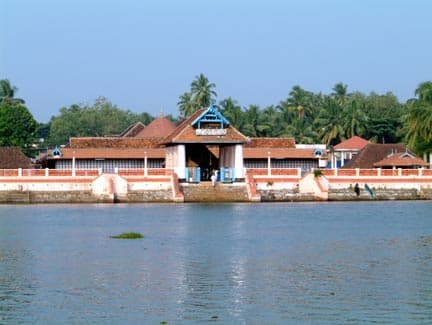
The Thriprayar Temple, also known as the Shree Ramaswami Temple, is a significant Hindu temple located in Triprayar, Thrissur district, Kerala, India. It is dedicated to Lord Rama, the seventh incarnation of Vishnu, who is depicted with four arms holding a conch, discus, bow, and garland. The temple's origin story involves the idol being worshipped by Krishna in Dwarka, later immersed in the sea, and eventually found by fishermen.