
Shani Shingnapur
Shani Shingnapur is a village in Maharashtra, India, renowned for its temple dedicated to Shani, the Hindu deity associated with the planet Saturn. The village is famous for its unique practice of not having doors on any of its houses, shops, or even the temple, a tradition rooted in the belief that the deity protects the community from theft. This belief stems from the presence of a self-emerged idol of Shani, considered a 'jagrut devasthan' or 'alive temple'.
Key Facts
- ›The village is known for its unique tradition of having no doors on houses, shops, or the temple.
- ›Residents believe the deity Shani protects the village from theft, with no reported incidents for a significant period.
- ›The central idol is a self-emerged black stone statue of Shani, considered a 'Swayambhu' deity.
- ›The deity is worshipped in an open-air platform, as per divine instruction, with no roof over the idol.
- ›Thousands of devotees visit daily, with crowds increasing significantly on Saturdays and Amavasya days.
- ›Historically, the village has seen no incidents of riot, murder, or rape, and no complaints filed at police stations.

Shani
Religious Pilgrimage, Unique Social Tradition, Belief In Divine Protection
Shani Jayanti, Shani Thrayodashi, Amavasya
Stone
Shepherds
Swayambhu Shanaishwara Statue
About Shani Shingnapur
Shani Shingnapur, also known as Shani Shinganapur, is a significant religious site located in the Indian state of Maharashtra. The village is famed for its temple dedicated to Shani, the Hindu deity associated with the planet Saturn. This temple is not just a place of worship but also the center of a unique cultural phenomenon: the absence of doors on houses, shops, and the temple itself within a mile radius of the shrine.
Beliefs and Traditions
The bedrock of Shani Shingnapur's fame lies in the deeply held belief that the deity Shani actively protects the village from any form of theft or burglary. This conviction stems from the presence of a "Swayambhu" (self-emerged) idol of Lord Shani, a black, imposing stone believed to have emerged from the earth. According to local lore passed down through generations, the idol was discovered by shepherds, and Lord Shani himself appeared in a dream, stating that he preferred to remain under the open sky and would ensure the safety of the hamlet.
This divine assurance has led to a remarkable tradition where doors and locks are considered unnecessary. Despite the absence of physical security measures on dwellings, the village historically reported virtually no thefts. While isolated incidents of theft were reported in 2010 and 2011, the general perception of safety and divine protection remains a strong draw for devotees.
The Shrine and Worship
The central shrine features a five-and-a-half-foot-high black rock statue on an open-air platform, symbolizing Lord Shani. Accompanying the main idol are a Trishula (trident) and a Nandi (bull) image. The temple attracts tens of thousands of visitors daily, with numbers swelling to several lakhs on auspicious days like Amavasya (New Moon) and Saturdays, which are considered most favorable for appeasing Lord Shani. Devotees perform rituals such as bathing the idol with water and oil, offering flowers, and performing 'tēla' (oil) abhisheka.
Historical Context and Social Significance
The historical importance of Shani Shingnapur is intertwined with its unique social fabric. The tradition of open homes and the absence of crime have made it a subject of study and admiration. The village also boasts educational institutions and essential services like a post office. A notable development was the opening of a "lockless" bank branch by UCO Bank in 2011, acknowledging the village's near-zero crime rate.
In recent times, the temple has also been in the news regarding the entry of women into the inner sanctum. Following a tradition that restricted female devotees, a landmark Bombay High Court judgment in 2016 led to the temple trust officially allowing women entry into the sanctum, reflecting evolving societal norms within a deeply traditional setting.
Source: Wikipedia ↗
Frequently Asked Questions
What is Shani Shingnapur famous for?
Shani Shingnapur is most famous for its temple dedicated to Lord Shani and the village's unique tradition of having no doors on any buildings. Residents believe the deity protects them from theft, and this belief is deeply integrated into the village's way of life.
What is the significance of the idol at Shani Shingnapur?
The idol of Lord Shani at Shingnapur is considered 'Swayambhu,' meaning it self-emerged from the earth in the form of a black stone. It is believed to be a 'jagrut devasthan,' an alive temple where the deity still resides and actively protects devotees.
Why do houses and the temple in Shani Shingnapur have no doors?
According to local tradition and belief, Lord Shani himself instructed that no roof was needed for his shrine, as the sky is his roof. He also promised to protect the hamlet from thieves. Consequently, for centuries, houses, shops, and the temple have been built without doors or locks, relying on the deity's protection.
When is the best time to visit Shani Shingnapur?
Saturdays are considered the busiest and most auspicious days for visiting Shani Shingnapur, as it is believed to be Lord Shani's favorite day. Devotees also throng the temple in large numbers on Saturdays that fall on Amavasya (New Moon day), which is considered particularly auspicious.
Are there any restrictions for women at the Shani Shingnapur temple?
Historically, women were restricted from entering the inner sanctum of the temple. However, following a Bombay High Court judgment in 2016, the temple trust officially allowed women devotees to enter the sanctum.
Related Temples (Hindu)

Taraknath Temple
The Taraknath Temple, located in Tarakeswar, West Bengal, India, is a significant Hindu pilgrimage site dedicated to Lord Shiva, worshiped here as Tarakanatha. Constructed in 1729, it features a distinct Bengal architectural style with an 'atchala' structure and an adjacent 'natmandir'. The temple is renowned for its belief that a dip in the nearby Dudhpukur tank fulfills prayers and is considered one of the 64 Jyotirlingas.

Tanot Mata Temple
The Tanot Mata Temple is a significant Hindu shrine located in the Jaisalmer district of Rajasthan, India, near the Pakistan border. Revered as a form of Goddess Hinglaj Mata, the temple is famously associated with the Indian victories in the Indo-Pakistani Wars of 1965 and 1971, with local folklore attributing the successful outcomes to divine intervention. The Border Security Force of India now manages the temple complex, which also includes a victory tower and a war museum.
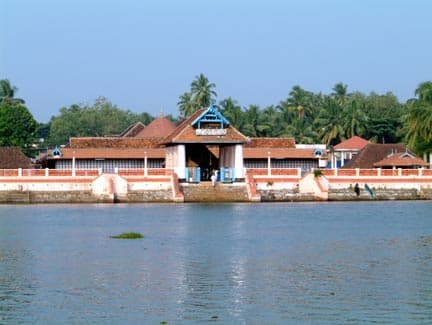
Thriprayar Temple
The Thriprayar Temple, also known as the Shree Ramaswami Temple, is a significant Hindu temple located in Triprayar, Thrissur district, Kerala, India. It is dedicated to Lord Rama, the seventh incarnation of Vishnu, who is depicted with four arms holding a conch, discus, bow, and garland. The temple's origin story involves the idol being worshipped by Krishna in Dwarka, later immersed in the sea, and eventually found by fishermen.