
Sangameswarar Temple
The Sangameswarar Temple, also known as Thirunana and Thirukooduthurai, is a significant Hindu temple located in Bhavani, Tamil Nadu, India. Dedicated to Lord Shiva, it is renowned for its location at the confluence of the Kaveri, Bhavani, and the mystic Amutha rivers, and is praised in ancient Tamil literature.
Key Facts
- ›The temple is situated at the confluence of three rivers: Kaveri, Bhavani, and the Amutha.
- ›It is considered a holy site where devotees perform last rites for their ancestors.
- ›Legend states that Kubera, along with sages Vishvamitra and Parasara, worshipped the presiding deity.
- ›The temple is one of the 275 Paadal Petra Sthalams, praised in ancient Tamil devotional literature.
- ›A British Collector, William Karo, attributed his life being saved to the goddess Bhavani Vedanaayaki Amman and left a gold plate as an offering.
- ›The temple complex is spread across a 4-acre plot.

Shiva, Parvati, Kartikeya, Vishnu
- Religious pilgrimage site
- Site for performing ancestral rites
- Mentioned in ancient Tamil devotional literature
- Architectural beauty with stone carvings and unique sculptures
Chera, Chola, Pandya
Brahmotsavam
Stone
Kubera, Vishvamitra, Parasara, William Karo
Smiling and Weeping Stone Statues, Gold Plate Offering By William Karo
Kaveri River, Bhavani River, Amutha River
About Sangameswarar Temple
The Sangameswarar Temple, also known by its ancient Tamil literary names Thirunana and Thirukooduthurai, is a significant Hindu temple located in the town of Bhavani, within the Erode district of Tamil Nadu, India. It is dedicated to Lord Shiva, who is worshipped here as Sangameswarar. The temple's unique geographical placement is at the confluence of three rivers: the Kaveri, the Bhavani, and the mystical Amutha (also referred to as Agaya Gangai).
Confluence and Sacred Rites
The confluence of these three rivers is known as Dakshina Triveni Sangamam or Kooduthurai, signifying its great spiritual importance. The riverbanks are a revered site where devotees perform the last rites for their ancestors, seeking spiritual merit and peace for the departed souls. This practice underscores the temple's role not only as a place of worship but also as a crucial site for ancestral rituals.
Legends and Divine Encounters
Ancient legends imbue the Sangameswarar Temple with divine significance. It is said that Kubera, the celestial treasurer, was guided to worship a Shiva Lingam beneath an Ilandhai tree (Zizyphus mauritiana) at this very spot, recognizing it as a place of immense spiritual power. The tree, which is the stala vriksham, continues to bear fruit year-round and is integral to the temple's daily rituals. The temple's lore also suggests that sages Vishvamitra and Parasara worshipped the presiding deity here. Furthermore, a legend recounts how the goddess Bhavani Vedanaayaki Amman intervened to save the life of William Karo, a British Collector, in 1804. In gratitude, he presented a gold plate inscribed with his signature and the date, which is still preserved within the temple.
Historical and Literary Connections
The temple holds a prominent place in Tamil devotional literature, being recognized as one of the 275 Paadal Petra Sthalams. These are shrines praised in the hymns of the Nayanmars, particularly by Sambandar, who composed ten poems dedicated to Lord Shiva at this temple, recorded in the 2nd Thirumurai. Saint Arunagirinathar also visited Thirunanaa and composed numerous songs, including Thirupugazh, in praise of Lord Subramanya.
Architectural Features
The Sangameswarar Temple is constructed on a 4-acre plot and features a five-tiered RajaGopuram on its northern side. The architecture showcases the craftsmanship of the region, with notable stone carvings. Among its unique artistic features are two identical stone statues located in front of the Ambal shrine; one appears to smile, while the other seems to shed tears. The temple also houses a precious Ambal statue donated by the British period collector. The presiding deity Shiva is accompanied by his consort Pannaar Mozhiyaal (Vedanayagi), and separate shrines are dedicated to Kartikeya, Vishnu, and his consort Soundaravalli Thaayar. The temple complex also contains a mobile Amirthalingeswarar Sivalinga, which is central to rituals for those seeking boons for children.
Source: Wikipedia ↗
Frequently Asked Questions
Where is the Sangameswarar Temple located?
The Sangameswarar Temple is located in Bhavani, a town in the Erode district of the Indian state of Tamil Nadu. It is situated near the confluence of the Kaveri and Bhavani rivers.
What is the significance of the confluence of rivers at this temple?
The temple is built at the meeting point of the Kaveri, Bhavani, and the mystic Amutha rivers, a confluence known as Dakshina Triveni Sangamam or Kooduthurai. This sacred spot is where devotees perform last rites for their ancestors.
Who are the primary deities worshipped at Sangameswarar Temple?
The primary deity worshipped is Lord Shiva, known as Sangameswarar. His consort Pannaar Mozhiyaal, also known as Vedanayagi, has a shrine, as do Kartikeya, Vishnu, and his consort Soundaravalli Thaayar.
Is there any legend associated with the temple's founding or construction?
According to legend, Kubera, son of Vishrava, was advised to worship the Shiva Lingam under an Ilandhai tree at this site due to its divine nature, having been visited by Vedas and inhabited by Gandharvas. The Ilandhai tree, the stala vriksham, still bears fruit and is used for daily puja.
What historical events are associated with the Sangameswarar Temple?
During the Chera, Chola, and Pandya periods, a secret cave passage was believed to connect this temple with the Chidambaram temple, with pujas performed simultaneously. In 1804, a British Collector named William Karo was saved from a collapsing bungalow by a divine intervention, leading him to offer a gold plate to the goddess Vedanaayaki Amman.
What is architecturally notable about the Sangameswarar Temple?
The temple features a five-tiered RajaGopuram on its north side. It is known for its stone carvings, including two identical stone statues in front of the Ambal shrine, where one appears to smile and the other to shed tears. The temple also houses a mobile Amirthalingeswarar Sivalinga.
Is the Sangameswarar Temple mentioned in ancient Tamil literature?
Yes, the temple is praised in old Tamil literature as Thirunana and is recognized as one of the 275 Paadal Petra Sthalams. The Nayanmar Sambandar composed poems in its praise, and Saint Arunagirinathar also composed songs on Lord Subramanya after visiting the site.
Related Temples (Hindu)

Taraknath Temple
The Taraknath Temple, located in Tarakeswar, West Bengal, India, is a significant Hindu pilgrimage site dedicated to Lord Shiva, worshiped here as Tarakanatha. Constructed in 1729, it features a distinct Bengal architectural style with an 'atchala' structure and an adjacent 'natmandir'. The temple is renowned for its belief that a dip in the nearby Dudhpukur tank fulfills prayers and is considered one of the 64 Jyotirlingas.

Tanot Mata Temple
The Tanot Mata Temple is a significant Hindu shrine located in the Jaisalmer district of Rajasthan, India, near the Pakistan border. Revered as a form of Goddess Hinglaj Mata, the temple is famously associated with the Indian victories in the Indo-Pakistani Wars of 1965 and 1971, with local folklore attributing the successful outcomes to divine intervention. The Border Security Force of India now manages the temple complex, which also includes a victory tower and a war museum.
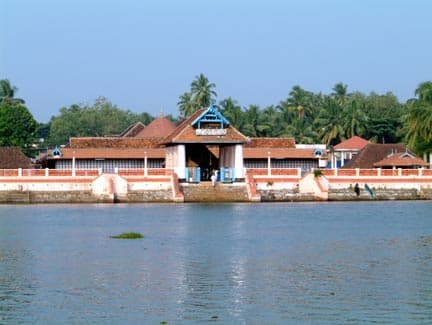
Thriprayar Temple
The Thriprayar Temple, also known as the Shree Ramaswami Temple, is a significant Hindu temple located in Triprayar, Thrissur district, Kerala, India. It is dedicated to Lord Rama, the seventh incarnation of Vishnu, who is depicted with four arms holding a conch, discus, bow, and garland. The temple's origin story involves the idol being worshipped by Krishna in Dwarka, later immersed in the sea, and eventually found by fishermen.