
Samaleswari Temple
The Samaleswari Temple, located in Sambalpur, Odisha, India, is a significant Hindu temple dedicated to Goddess Samaleswari, also known as Samalei Maa. Revered as 'Mother of the Universe,' she is a prominent deity in western Odisha and parts of Chhattisgarh, second only to Lord Jagannath in regional importance. The temple, built in the Sandhara architectural order, features a square sanctum and a circumambulatory gallery supported by stone pillars, housing a unique idol carved from a single granite rock.
Key Facts
- ›Dedicated to Goddess Samaleswari (Samalei Maa), revered as 'Mother of the Universe'.
- ›Located on the banks of the Mahanadi River in Sambalpur, Odisha, India.
- ›Holds significant religious importance across western Odisha and parts of Chhattisgarh and Jharkhand.
- ›Built in the Sandhara architectural order, featuring a square sanctum and a circumambulatory path.
- ›The deity's idol is a large granite rock with a yoni symbol and a mouth represented by a shallow cut.
- ›Prominent festivals include Navaratri pujas and the chief festival of Nuakhai, where the first agricultural produce is offered.

Samaleswari, Samalei Maa
- Regional Presiding Deity Second Only To Lord Jagannath In Odisha
- Important Pilgrimage Site For Western Odisha and Parts of Chhattisgarh and Jharkhand
- Unique Granite Rock Idol Symbolizing Motherhood and Yoni Worship
Navaratri, Nuakhai
Granite, Stone, Lime Mortar
- Idol of Goddess Samaleswari Carved From Granite Rock
- Eleven Parswa Devis Embedded On the Outer Wall of the Sanctum
Mahanadi River
About Samaleswari Temple
The Samaleswari Temple, situated in Sambalpur, Odisha, India, is a prominent Hindu temple dedicated to Goddess Samaleswari, affectionately known as Samalei Maa. This revered deity is considered the presiding goddess of Sambalpur and holds immense religious significance across western Odisha and extends her influence into parts of Chhattisgarh and Jharkhand. Goddess Samaleswari has been worshipped since ancient times, embodying aspects of Jagat Janani (Mother of the Universe), Durga, Mahalaxmi, Mahasaraswati, and Adishakti. Her regional importance is second only to that of Lord Jagannath within Odisha, making the temple a crucial spiritual center.
The temple itself is constructed in the Sandhara architectural order, characterized by a square sanctum that is enclosed by a gallery of pillars designed for pradakshina, or circumambulation. The sanctum is located four steps below the 10-foot-wide covered circumambulation path, which is supported by twelve stone pillars. A notable feature of the temple's exterior is the presence of eleven parswa devis (side Goddesses) embedded on the outer wall of the sanctum, allowing devotees to worship them during their circumambulation.
The idol of Shree Shree Samalei Devi is particularly distinctive. It is formed from a large block of granite rock, featuring an inverted, trunk-like projection at the bottom that symbolizes a yoni. A shallow cut on its 'Baraha' like face represents the mouth, and a traditional Sambalpuri nose ornament of pure gold hangs from her nose. Beaten gold leaves serve as substitute eyes, giving the deity a unique and awe-inspiring appearance that evokes sentiments of reverence, devotion, and maternal love.
Several important festivals are celebrated at the Samaleswari Temple throughout the year. The two Navaratri pujas, observed in March-April and September-October, are significant periods where the goddess is adorned differently each day to represent the Navadurgas. The Ashwin Navaratri is celebrated with particular splendor. The chief festival for the entire western Odisha region is Nuakhai, during which farmers offer the first harvest from their lands to the goddess before its consumption, highlighting the temple's connection to agricultural prosperity and community life.
Source: Wikipedia ↗
Frequently Asked Questions
Who is Goddess Samaleswari?
Goddess Samaleswari, also known as Samalei Maa, is the presiding deity of Sambalpur and is worshipped as Jagat Janani (Mother of the Universe), Durga, Mahalaxmi, Mahasaraswati, and Adishakti. She holds profound religious significance across western Odisha and parts of neighboring states.
What is the architectural style of the Samaleswari Temple?
The Samaleswari Temple is built in the Sandhara order. This style features a square sanctum enclosed by a gallery of pillars intended for pradakshina (circumambulation). The temple's circumambulatory path is supported by twelve stone pillars.
What is unique about the idol of Goddess Samaleswari?
The idol of Goddess Samaleswari is carved from a single large block of granite rock. It has an inverted, trunk-like projection at the bottom symbolizing a yoni, and her mouth is represented by a shallow cut on a 'Baraha' like face. Golden leaves form her eyes, and a gold nose ornament adorns her.
What are the main festivals celebrated at Samaleswari Temple?
Three festivals are observed prominently: Navaratri pujas in March-April and September-October, where the goddess is dressed to represent the Navadurgas. The chief festival for the region is Nuakhai, during which farmers offer the first produce from their lands to the goddess.
Where is Samaleswari Temple located?
Samaleswari Temple is situated in Sambalpur, Odisha, India, on the banks of the sacred Mahanadi River.
Related Temples (Hindu)

Taraknath Temple
The Taraknath Temple, located in Tarakeswar, West Bengal, India, is a significant Hindu pilgrimage site dedicated to Lord Shiva, worshiped here as Tarakanatha. Constructed in 1729, it features a distinct Bengal architectural style with an 'atchala' structure and an adjacent 'natmandir'. The temple is renowned for its belief that a dip in the nearby Dudhpukur tank fulfills prayers and is considered one of the 64 Jyotirlingas.

Tanot Mata Temple
The Tanot Mata Temple is a significant Hindu shrine located in the Jaisalmer district of Rajasthan, India, near the Pakistan border. Revered as a form of Goddess Hinglaj Mata, the temple is famously associated with the Indian victories in the Indo-Pakistani Wars of 1965 and 1971, with local folklore attributing the successful outcomes to divine intervention. The Border Security Force of India now manages the temple complex, which also includes a victory tower and a war museum.
Thriprayar Temple
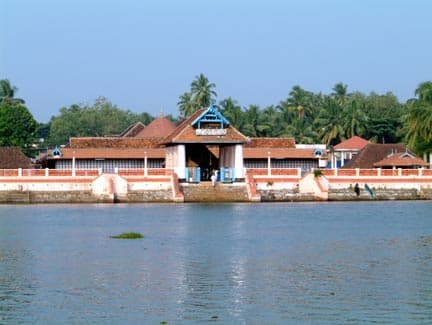
The Thriprayar Temple, also known as the Shree Ramaswami Temple, is a significant Hindu temple located in Triprayar, Thrissur district, Kerala, India. It is dedicated to Lord Rama, the seventh incarnation of Vishnu, who is depicted with four arms holding a conch, discus, bow, and garland. The temple's origin story involves the idol being worshipped by Krishna in Dwarka, later immersed in the sea, and eventually found by fishermen.