
Rani Sati Temple Jhunjhunu
The Rani Sati Temple in Jhunjhunu, Rajasthan, India, is dedicated to Rani Sati, a 13th- to 17th-century Rajasthani woman who committed sati (self-immolation) upon her husband's death. The temple is notable for its white marble construction, colorful wall paintings, and the worship of a trishul instead of deities, though a portrait of Rani Sati is present. It is a significant pilgrimage site, attracting hundreds of devotees daily for elaborate aarti ceremonies.
Key Facts
- ›Dedicated to Rani Sati, a 13th- to 17th-century Rajasthani woman who performed sati.
- ›Located in Jhunjhunu, Rajasthan, India.
- ›The temple's central object of worship is a trishul, symbolizing power and force.
- ›Features white marble construction and colorful wall paintings.
- ›The complex includes temples dedicated to Hanuman, Sita, Thakur Ji, Ganesha, and Shiva.
- ›A special observance is held on Bhadra Amavasya.

Rani Sati
Pilgrimage Site, Commemorates the Act of Sati
Bhadra Amavasya
White Marble
- Colorful Wall Paintings
- Murals and Glass Mosaics Depicting the History of the Place
About Rani Sati Temple Jhunjhunu
The Rani Sati Temple, located in Jhunjhunu, Rajasthan, India, is a significant Hindu temple primarily dedicated to Rani Sati. Rani Sati, also known as Narayani Devi or Dadiji, was a Rajasthani woman believed to have lived between the 13th and 17th centuries, who famously committed sati, or self-immolation, upon her husband's death. The temple serves as a major center for her worship and to commemorate her act of devotion.
History and Legend
The temple's narrative is deeply intertwined with legends that trace back to the Mahabharata era. One prominent legend recounts the story of Uttara, wife of Abhimanyu, who wished to perform sati but was prevented due to her pregnancy. She was granted a boon by Lord Krishna to be reunited with Abhimanyu in every future lifetime and to achieve the status of sati. In a subsequent life, as Narayani, she married Tandhan Jalan. When Tandhan was killed by a king's son over a horse, Narayani not only fought and killed the king but then chose to perform sati with her husband. Her loyal caretaker, Ranaji, was blessed that his name would be honored alongside hers, leading to her veneration as Rani Sati.
Accounts of Rani Sati's life and the circumstances of her death vary, with dates ranging from 1295 to the 17th century. Some legends describe her husband's death at the hands of invaders or dacoits, with her subsequent sati to protect her honor or as the first of thirteen widows in her family to do so.
Temple Architecture and Worship
The Rani Sati Temple is architecturally notable for its construction primarily from white marble, adorned with colorful wall paintings and exquisite murals and glass mosaics depicting the temple's history. Uniquely, the temple does not contain paintings or statues of deities. Instead, the central object of worship for devotees is a trishul, symbolizing power and force. A portrait of Rani Sati Dadiji is prominently displayed in the main hall.
The temple complex is expansive and includes smaller shrines dedicated to other deities such as Lord Hanuman, Sita, Thakur Ji, Lord Ganesha, and Lord Shiva. A large statue of Lord Shiva is a prominent feature in the center of the complex, surrounded by green gardens.
Observances and Festivals
The temple attracts hundreds of devotees daily, who participate in elaborate aarti ceremonies held twice a day: the Mangala Aarti in the early morning and the Sandhya Aarti in the evening. A particularly significant event is the special Poojan utsav that takes place on Bhadra Amavasya, the 15th day of the dark half of the Bhadra month in the Hindu calendar, which holds special significance for the temple and its followers.
Source: Wikipedia ↗
Frequently Asked Questions
Who is Rani Sati and why is she worshipped?
Rani Sati, also known as Narayani Devi or Dadiji, was a Rajasthani lady who lived between the 13th and 17th centuries. She is worshipped for her act of sati (self-immolation) on her husband's death, an act commemorated in various temples across Rajasthan and beyond.
What is unique about the worship at Rani Sati Temple Jhunjhunu?
The temple is notable for not holding paintings or statues of male or female gods. Instead, a trishul, which depicts power and force, is religiously worshipped by followers. A portrait of Rani Sati is displayed in the main hall.
When is the most significant festival at the Rani Sati Temple?
The most significant observance at the temple is a special Poojan utsav held on Bhadra Amavasya. This falls on the 15th day of the dark half of the Bhadra month in the Hindu calendar.
What are the timings for the Aarti ceremonies at the temple?
Elaborate aarti ceremonies are performed twice daily at the temple. The Mangala Aarti is performed in the early morning when the temple opens, and the Sandhya Aarti is performed in the evening at sunset.
What other deities are worshipped within the Rani Sati Temple complex?
Besides the main temple dedicated to Rani Sati, the complex also houses temples for Lord Hanuman, Sita, Thakur Ji, Lord Ganesha, and Lord Shiva. A large statue of Lord Shiva is situated in the center of the complex, surrounded by gardens.
Related Temples (Hindu)

Taraknath Temple
The Taraknath Temple, located in Tarakeswar, West Bengal, India, is a significant Hindu pilgrimage site dedicated to Lord Shiva, worshiped here as Tarakanatha. Constructed in 1729, it features a distinct Bengal architectural style with an 'atchala' structure and an adjacent 'natmandir'. The temple is renowned for its belief that a dip in the nearby Dudhpukur tank fulfills prayers and is considered one of the 64 Jyotirlingas.

Tanot Mata Temple
The Tanot Mata Temple is a significant Hindu shrine located in the Jaisalmer district of Rajasthan, India, near the Pakistan border. Revered as a form of Goddess Hinglaj Mata, the temple is famously associated with the Indian victories in the Indo-Pakistani Wars of 1965 and 1971, with local folklore attributing the successful outcomes to divine intervention. The Border Security Force of India now manages the temple complex, which also includes a victory tower and a war museum.
Thriprayar Temple
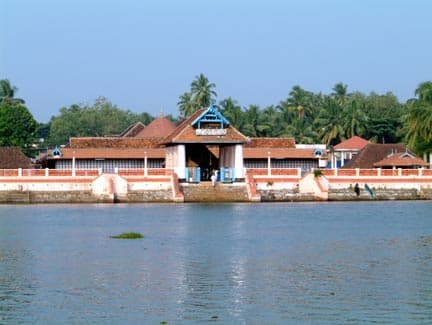
The Thriprayar Temple, also known as the Shree Ramaswami Temple, is a significant Hindu temple located in Triprayar, Thrissur district, Kerala, India. It is dedicated to Lord Rama, the seventh incarnation of Vishnu, who is depicted with four arms holding a conch, discus, bow, and garland. The temple's origin story involves the idol being worshipped by Krishna in Dwarka, later immersed in the sea, and eventually found by fishermen.