
Parshuram Kund
Parshuram Kund is a significant Hindu pilgrimage site located in the Lohit district of Arunachal Pradesh, India. Situated on the Brahmaputra plateau along the Lohit River, it is dedicated to the sage Parashurama, the sixth avatar of Lord Vishnu. The sacred kund is believed to cleanse pilgrims of their sins, drawing devotees from across India and Nepal, particularly during the Makar Sankranti festival.
Key Facts
- ›Parshuram Kund is a Hindu pilgrimage site in Arunachal Pradesh, India.
- ›It is dedicated to sage Parashurama, the sixth avatar of Lord Vishnu.
- ›Pilgrims take a holy dip in the kund, believing it washes away sins.
- ›Tens of thousands of devotees visit annually, especially on Makar Sankranti.
- ›The kund was re-established after the 1950 Assam earthquake.
- ›A dashavatar temple dedicated to Lord Vishnu is also present.

Parashurama, Vishnu, Renuka
Hindu Pilgrimage Site, Believed To Cleanse Sins, Associated With Sage Parashurama's Mythology
Makar Sankranti
Pilgrims From Assam
Lohit River
About Parshuram Kund
Parshuram Kund is a deeply revered Hindu pilgrimage site situated in the Lohit district of Arunachal Pradesh, India. Nestled on the Brahmaputra plateau in the lower reaches of the Lohit River, it is approximately 48 kilometers from the town of Tezu. The kund is primarily dedicated to the sage Parashurama, who is considered the sixth avatar of Lord Vishnu.
Religious Importance and Mythology
The site holds immense religious significance as it is believed to be the spot where Parashurama washed his axe after committing the sin of beheading his mother, Renuka, on his father's orders. According to legend, the axe became embedded in his hand, and it was only after washing it in the waters of the Lohit River that it detached, symbolizing his absolution. Devotees visit Parshuram Kund to take a holy dip in its sacred waters, which are believed to cleanse them of their sins. The kund attracts pilgrims not only from various parts of India, including neighboring states like Manipur and Assam, but also from Nepal.
Historical Context and Reconstruction
The kund was originally established by pilgrims from Assam in the 1970s. However, the original site was obliterated by the devastating Assam earthquake in 1950. Following this natural disaster, massive boulders mysteriously formed a new kund in the riverbed, creating the present-day site of worship. In addition to the main kund, there is a shrine dedicated to Devi Renuka and a dashavatar temple that features representations of all ten distinct avatars of Sri Maha Vishnu.
Annual Observances and Tourism
Each year, Parshuram Kund becomes a focal point for a significant religious gathering, particularly on the occasion of Makar Sankranti in January. During this festival, the site witnesses the arrival of over 70,000 devotees and sadhus who partake in the holy ritual. The area also presents opportunities for tourism, with activities such as trekking, hiking, and river rafting available on the Lohit River, offering visitors a blend of spiritual and adventurous experiences.
Source: Wikipedia ↗
Frequently Asked Questions
What is Parshuram Kund and where is it located?
Parshuram Kund is a prominent Hindu pilgrimage site situated in the Lohit district of Arunachal Pradesh, India. It is located on the Brahmaputra plateau in the lower reaches of the Lohit River, approximately 48 km from Tezu.
What is the religious significance of Parshuram Kund?
The site is dedicated to sage Parashurama and is believed to be where he washed his axe after beheading his mother, thus cleansing himself of sin. Pilgrims take a holy dip in the sacred kund, which is thought to wash away one's sins.
When do pilgrims visit Parshuram Kund?
The kund attracts a large number of pilgrims annually, especially on the occasion of Makar Sankranti, which falls in January. Over 70,000 devotees and sadhus often take a holy dip during this festival.
What is the mythological story behind Parshuram Kund?
According to local mythology, Parashurama, the sixth avatar of Vishnu, beheaded his mother Renuka on his father's orders. His axe became stuck to his hand as a consequence of this grave sin. He came to the Lohit River to wash his hands, and upon dipping them in the water, the axe detached, forming the sacred kund.
Has the kund always existed in its current form?
The original site of the kund was established by pilgrims in the 1970s and was covered by the 1950 Assam earthquake. Massive boulders mysteriously formed a new kund in the riverbed after the earthquake.
What other deities are worshipped at Parshuram Kund?
Besides being dedicated to Lord Parshuram, there is also a shrine dedicated to Devi Renuka. Additionally, a dashavatar temple honors Sri Maha Vishnu with all ten of his distinct avatars.
Related Temples (Hindu)

Taraknath Temple
The Taraknath Temple, located in Tarakeswar, West Bengal, India, is a significant Hindu pilgrimage site dedicated to Lord Shiva, worshiped here as Tarakanatha. Constructed in 1729, it features a distinct Bengal architectural style with an 'atchala' structure and an adjacent 'natmandir'. The temple is renowned for its belief that a dip in the nearby Dudhpukur tank fulfills prayers and is considered one of the 64 Jyotirlingas.

Tanot Mata Temple
The Tanot Mata Temple is a significant Hindu shrine located in the Jaisalmer district of Rajasthan, India, near the Pakistan border. Revered as a form of Goddess Hinglaj Mata, the temple is famously associated with the Indian victories in the Indo-Pakistani Wars of 1965 and 1971, with local folklore attributing the successful outcomes to divine intervention. The Border Security Force of India now manages the temple complex, which also includes a victory tower and a war museum.
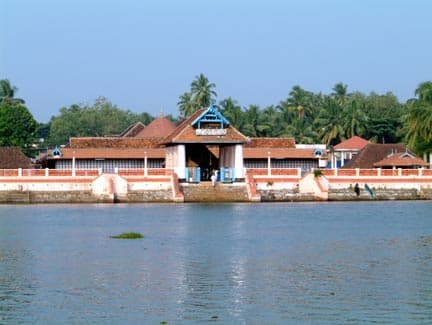
Thriprayar Temple
The Thriprayar Temple, also known as the Shree Ramaswami Temple, is a significant Hindu temple located in Triprayar, Thrissur district, Kerala, India. It is dedicated to Lord Rama, the seventh incarnation of Vishnu, who is depicted with four arms holding a conch, discus, bow, and garland. The temple's origin story involves the idol being worshipped by Krishna in Dwarka, later immersed in the sea, and eventually found by fishermen.