
Padmavati Temple
Vijayanagara and Dravidian·India
The Padmavati Temple in Tiruchanur, Andhra Pradesh, India, is a significant Hindu temple dedicated to Goddess Padmavati, an incarnation of Lakshmi and the consort of Lord Venkateswara. Administered by the Tirumala Tirupati Devasthanams, it is a vital pilgrimage site, often visited before or after the main Tirumala temple, and is renowned for its Vijayanagara and Dravidian architectural influences.
Key Facts
- ›The temple is dedicated to Goddess Padmavati, an incarnation of Lakshmi.
- ›It is located in Tiruchanur, near Tirupati city in Andhra Pradesh, India.
- ›The temple follows Pancharatra Agama and Vadakalai traditions.
- ›Its architecture is primarily inspired by Vijayanagara and Dravidian styles.
- ›The Rajagopuram is approximately 40 feet tall and features intricate carvings.
- ›The temple complex includes sub-temples dedicated to Krishna Swamy and Sundararaja Swamy.

Padmavati, Alamelu Mangamma, Alarmel Mangai
- Important Pilgrimage Site
- Dedicated To Goddess Padmavati, Consort of Venkateswara
- Architectural Blend of Vijayanagara and Dravidian Styles
Annual Karthika Bramhotsavams, Vasanthotsavam, Teppotsavam, Varalakshmi Vratam, Navaratri, Panchami Teertham
Stone, Marble
King Akasharaja, Queen Dharani Devi
Padmasarovaram
About Padmavati Temple
The Padmavati Temple, located in Tiruchanur, a part of Tirupati city in Andhra Pradesh, India, is a prominent Hindu temple dedicated to Goddess Padmavati. She is revered as an incarnation of Goddess Lakshmi and is the divine consort of Lord Venkateswara. The temple is managed by the Tirumala Tirupati Devasthanams (TTD) and holds significant importance for pilgrims, often considered an essential visit as part of a pilgrimage to Tirupati.
Legend and Deity
Temple legends recount the story of Goddess Lakshmi leaving Vaikunta due to an insult to Lord Vishnu and eventually manifesting on Earth as Princess Padmavati. She emerged from a golden lotus discovered by King Akasharaja and Queen Dharani Devi. Lord Srinivasa (a form of Vishnu) encountered Padmavati, and their celestial wedding is celebrated as a sacred union in Vaishnavite tradition. Goddess Padmavati is the main deity, facing east within the sanctum, seated in a Padmasana posture, holding lotuses. She is worshipped for prosperity and is believed to intercede with Lord Venkateswara on behalf of devotees.
Architecture and Complex
The temple's architecture is a striking amalgamation of Vijayanagara and Dravidian styles, sharing many features with the renowned Tirumala Venkateswara Temple. The structures are predominantly built from stone and marble. A notable feature is the Rajagopuram, approximately 40 feet tall, adorned with intricate carvings and five tiers topped with golden kalashas. The temple complex also houses sub-temples dedicated to Krishna Swamy and Sundararaja Swamy, with the Krishna Swamy Temple dating back to 1221 CE, making it the oldest within the complex. The Padmasarovaram, or Lotus Tank, is considered the sacred birthplace of Goddess Padmavati and is an integral part of the temple's sacred geography.
Worship and Festivals
Worship at the Padmavati Temple adheres strictly to the Pancharatra Agama traditions. The daily schedule includes rituals like the Suprabhatam, Kumkumarchanas, Kalyanotsavam, and Ekanta Seva. Special weekly sevas, such as Ashtadala Pada Padmaradhana on Mondays and Thiruppavada Seva on Thursdays, are observed. Fridays are particularly auspicious for Goddess Lakshmi, with Abhishekam and Sahasra Deepalankarana performed. The temple celebrates grand annual festivals, including the Annual Karthika Bramhotsavams, Vasanthotsavam, Teppotsavam, Varalakshmi Vratam, and Navaratri. The Chakra Snanam ritual at Padmasarovaram marks the culmination of the Brahmotsavams, drawing large crowds of devotees.
Source: Wikipedia ↗
Frequently Asked Questions
Who is Goddess Padmavati?
Goddess Padmavati is considered an earthly manifestation of Goddess Lakshmi and is the consort of Lord Venkateswara. According to legend, she emerged from a golden lotus found while King Akasharaja was ploughing a field. She is worshipped for prosperity and is believed to convey devotees' wishes to Lord Venkateswara.
What is the legend behind Goddess Padmavati and Lord Venkateswara?
The legend describes Sage Bhrigu's insult to Lord Vishnu, leading Goddess Lakshmi to leave Vaikunta and reach earth. Vishnu followed her, and while he performed penance, Lakshmi was discovered as an infant princess named Padmavati. Lord Srinivasa (Vishnu) encountered Padmavati, fell in love, and after his foster mother acted as a messenger, a celestial wedding was arranged. Later, Padmavati and Lakshmi took their forms as stone idols to remain with Vishnu on the hills.
What are the architectural highlights of the Padmavati Temple?
The temple's architecture is a blend of Vijayanagara and Dravidian styles, with features similar to the Tirumala Venkateswara Temple. Key elements include the five-tiered, white-painted Rajagopuram with gilded gates, numerous mandapams for various rituals, and the Shanti Nilayam above the sanctum, mirroring Tirumala's Ananda Nilayam.
What is the significance of the Padmasarovaram tank?
The Padmasarovaram, also known as the Lotus Tank, is considered the birthplace of Goddess Padmavati. It is a sacred spot where devotees often take a dip before proceeding for darshan. The important Chakra Snanam ritual is conducted here during the annual Brahmotsavams.
What are some of the important daily rituals and weekly sevas performed at the temple?
Daily rituals include the Suprabhatam (waking the Goddess), Kumkumarchanas, Kalyanotsavam, Unjala Seva, and Ekanta Seva. Notable weekly sevas include Ashtadala Pada Padmaradhana on Mondays, Thiruppavada Seva on Thursdays, Abhishekam on Fridays, and Sahasra Deepalankarana on Friday evenings. The Ashtottara Sata Kalasabhishekam is performed on the first Wednesday of each month.
What are the major annual festivals celebrated at the Padmavati Temple?
The temple hosts magnificent annual festivities such as the Annual Karthika Bramhotsavams, which begins with Dhwajarohanam and concludes with Pushpayagam. Other prominent festivals include Vasanthotsavam (Spring Festival), Teppotsavam (Float Festival), Varalakshmi Vratam, and Navaratri. The culmination of the Annual Padmavati Brahmotsavams includes the Chakra Snanam at Padmasarovaram.
Related Temples (Hindu)

Taraknath Temple
The Taraknath Temple, located in Tarakeswar, West Bengal, India, is a significant Hindu pilgrimage site dedicated to Lord Shiva, worshiped here as Tarakanatha. Constructed in 1729, it features a distinct Bengal architectural style with an 'atchala' structure and an adjacent 'natmandir'. The temple is renowned for its belief that a dip in the nearby Dudhpukur tank fulfills prayers and is considered one of the 64 Jyotirlingas.

Tanot Mata Temple
The Tanot Mata Temple is a significant Hindu shrine located in the Jaisalmer district of Rajasthan, India, near the Pakistan border. Revered as a form of Goddess Hinglaj Mata, the temple is famously associated with the Indian victories in the Indo-Pakistani Wars of 1965 and 1971, with local folklore attributing the successful outcomes to divine intervention. The Border Security Force of India now manages the temple complex, which also includes a victory tower and a war museum.
Thriprayar Temple
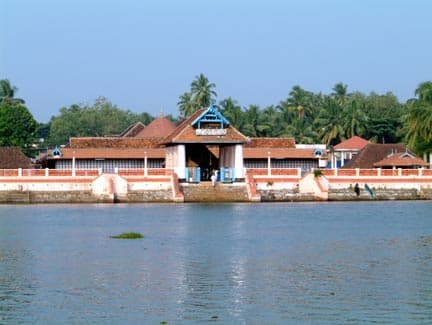
The Thriprayar Temple, also known as the Shree Ramaswami Temple, is a significant Hindu temple located in Triprayar, Thrissur district, Kerala, India. It is dedicated to Lord Rama, the seventh incarnation of Vishnu, who is depicted with four arms holding a conch, discus, bow, and garland. The temple's origin story involves the idol being worshipped by Krishna in Dwarka, later immersed in the sea, and eventually found by fishermen.