
Oachira Temple
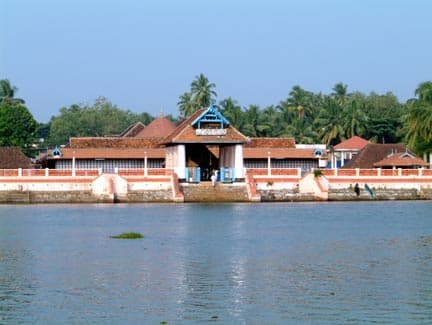
Oachira Temple is an ancient Hindu pilgrimage center located in Kollam district, Kerala, India, dedicated to Para Brahman, the Universal Consciousness. It is unique for its open-air worship, with devotees offering prayers under trees rather than in traditional temple structures. The temple is renowned for its significant festivals, including the Oachira Vrischikam Festival and the ritualistic Oachirakali.
Key Facts
- ›The temple is dedicated to Para Brahman (Universal Consciousness), also referred to as Ohmkaram.
- ›It is situated on thirty-six acres of land and is known as 'Dakshina Kashi' (South Kashi).
- ›Oachira Temple is characterized by its open-air worship, with no conventional covered structures for deities.
- ›Key festivals include the Oachira Vrischikam Festival and Irupathattam onam, which features large 'Eduppu kala' (bull idols).
- ›Oachirakali is a significant ritualistic mock-fighting event performed in muddy water by martial art experts.
- ›Historical surveys from the early 19th century by British officials Ward and Conner noted the presence of an old temple and a reservoir at the site.

Para Brahman, Universal Consciousness, Ohmkaram
- Ancient Pilgrimage Center
- Unique Open-Air Worship Practice
- Cultural Significance of Oachirakali and Related Festivals
Kayamkulam Raja
Oachira Vrischikam Festival, Irupathattam Onam, Oachirakali
Eduppu Kala
Kallukettuchira
About Oachira Temple
Oachira Temple, situated in Oachira, Kollam district, in the South Indian state of Kerala, is an ancient and revered pilgrimage center. According to local Puranas, it holds significant sacred status within Kerala and India. The temple is notable for its dedication to Para Brahman, representing the Universal Consciousness or Ohmkaram, and is acclaimed as 'Dakshina Kashi' (South Kashi).
Unique Worship and Complex
Spanning thirty-six acres, Oachira Temple distinguishes itself by its unconventional approach to worship. Unlike traditional Hindu temples, it lacks covered structures for deities. Devotees perform their prayers and rituals directly under the shade of carefully maintained trees, embracing a more direct connection with the divine formless power.
Festivals and Rituals
The temple is a focal point for significant annual celebrations. The Oachira Vrischikam Festival, held between December and January, is a major event. Another prominent festival is 'Irupathattam onam,' celebrated 28 days after Onam, which is dedicated to cattle and features the creation of enormous 'Eduppu kala'—bull idols constructed from cloth and hay, which are then pulled to the temple on wheels. The Oachirakali, a vibrant ritual occurring in June, involves martial art experts engaging in mock-fighting within muddy water, historically stemming from ancient war exercises of the Kayamkulam Raja's soldiers.
Historical Context
Early 19th-century observations by British officials Ward and Conner documented the site, noting an ancient, damaged temple on the eastern side of the Padanilam and a large reservoir at the ground's center. The origins of the name 'Oachira' are subject to various beliefs, with one plausible theory suggesting it evolved from 'Onattuchira,' a reservoir historically linked to the Kayamkulam Raja and his soldiers. This historical reservoir, situated in the vast ground known as Padanilam, may have lent its name to the surrounding area, which subsequently transformed into Oachira.
Source: Wikipedia ↗
Frequently Asked Questions
What is the primary deity worshipped at Oachira Temple?
Oachira Temple is primarily dedicated to Para Brahman, understood as the Universal Consciousness or Ohmkaram. The temple signifies the original formless power, sometimes associated with Lord Shiva.
What makes Oachira Temple unique in its architecture or worship practices?
The temple is unique because it lacks traditional covered structures for deities. Worship is conducted in the open, with devotees praying under neatly preserved trees.
What are the major festivals celebrated at Oachira Temple?
The main festivals include the Oachira Vrischikam Festival, celebrated in December and January, and Irupathattam onam, a festival of cattle featuring large bull idols made of cloth and hay. Oachirakali, a ritualistic mock-fight, is also a significant annual event.
What is the historical significance of Oachira Temple?
It is an ancient pilgrimage center mentioned in the Puranas as a sacred place. Early 19th-century surveys by British officials Ward and Conner documented its existence and noted a reservoir at the site, contributing to understanding its historical context.
What is the origin of the name 'Oachira'?
While several myths exist, a plausible explanation suggests the name derives from 'Onattuchira,' a reservoir used by soldiers of the Kayamkulam Raja (also known as Onattu Rajah). The name likely evolved and corrupted over time to become Oachira.
What is Oachirakali and its historical context?
Oachirakali is a ritual performed annually in June, involving mock-fighting in muddy water. Historically, it originated as a war exercise performed by soldiers of the Kayamkulam Raja, gathering from various local divisions (karas) to practice martial skills.
Related Temples (Hindu)

Taraknath Temple
The Taraknath Temple, located in Tarakeswar, West Bengal, India, is a significant Hindu pilgrimage site dedicated to Lord Shiva, worshiped here as Tarakanatha. Constructed in 1729, it features a distinct Bengal architectural style with an 'atchala' structure and an adjacent 'natmandir'. The temple is renowned for its belief that a dip in the nearby Dudhpukur tank fulfills prayers and is considered one of the 64 Jyotirlingas.

Tanot Mata Temple
The Tanot Mata Temple is a significant Hindu shrine located in the Jaisalmer district of Rajasthan, India, near the Pakistan border. Revered as a form of Goddess Hinglaj Mata, the temple is famously associated with the Indian victories in the Indo-Pakistani Wars of 1965 and 1971, with local folklore attributing the successful outcomes to divine intervention. The Border Security Force of India now manages the temple complex, which also includes a victory tower and a war museum.
Thriprayar Temple
The Thriprayar Temple, also known as the Shree Ramaswami Temple, is a significant Hindu temple located in Triprayar, Thrissur district, Kerala, India. It is dedicated to Lord Rama, the seventh incarnation of Vishnu, who is depicted with four arms holding a conch, discus, bow, and garland. The temple's origin story involves the idol being worshipped by Krishna in Dwarka, later immersed in the sea, and eventually found by fishermen.