
Nrisingha Temple
The Nrisingha Temple, located in Nadia, West Bengal, is an ancient temple dedicated to Lord Narasimha. Legend states the temple dates back to the Satya Yuga, with Lord Narasimha having visited the site. It holds significance for its historical connections to Chaitanya Mahaprabhu and its patronage by the kings of Krishnanagar.
Key Facts
- ›The temple is dedicated to Lord Narasimha, an avatar of Vishnu.
- ›Legend attributes its origin to the Satya Yuga, when Lord Narasimha visited the site.
- ›It is located in Nadia district, West Bengal, India.
- ›Chaitanya Mahaprabhu and Jeev Goswami were known to frequent the temple.
- ›The temple was reconstructed in 1896 by Raja Khistish Chandra Roy of Krishnagar.

Narasimha
Historical, Religious Pilgrimage
Roy Dynasty of Krishnanagar
Krishnachandra Roy, Raja Khistish Chandra Roy
Mandakini River
About Nrisingha Temple
The Nrisingha Temple, situated at Thakurtala, Nrisinghapally, near the Nabadwip-Krishnagar road in the Nadia district of West Bengal, India, is an ancient place of worship dedicated to Lord Narasimha, an avatar of the Hindu deity Vishnu.
Historical and Legendary Origins
According to local history and legend, the temple's origins are traced back to the Satya Yuga, the first and most virtuous of the four Hindu cosmic ages. It is believed that Lord Narasimha himself visited this site to wash the blood from his claws after vanquishing the demon king Hiranyakasipu. Adjacent to the temple is a pond, which is historically said to have been part of the celestial Mandakini River. This mythical event established the site's sanctity, leading to its recognition as Narasimha Kshetra or Nrisinghapally.
Association with Vaishnavism and Royal Patronage
The temple holds particular significance for its connections to the Vaishnava tradition. Sri Chaitanya Mahaprabhu, a prominent figure in the Bhakti movement, and his associate Jeev Goswami were known to frequent this temple. Later, Krishnachandra Roy, the King of Krishnanagar, actively contributed to establishing the shrine of Narasimha. The temple underwent a significant reconstruction in 1896, undertaken by Raja Khistish Chandra Roy, also of Krishnagar, preserving its continuity for devotees.
Source: Wikipedia ↗
Frequently Asked Questions
What is the historical significance of the Nrisingha Temple?
According to legend, the Nrisingha Temple dates back to the Satya Yuga, a mythical golden age. It is believed that Lord Narasimha visited this site to cleanse his claws after defeating the demon Hiranyakasipu. The area later became known as Narasimha Kshetra or Nrisinghapally due to this association.
Who are the prominent historical figures associated with the Nrisingha Temple?
The temple has a historical connection to Chaitanya Mahaprabhu and his associate Jeev Goswami, who are said to have visited it frequently. Krishnachandra Roy, the King of Krishnanagar, also played a role in establishing the shrine of Narasimha.
When was the Nrisingha Temple reconstructed?
The temple underwent reconstruction in the year 1896. This reconstruction was carried out by Raja Khistish Chandra Roy, who was the ruler of Krishnagar at that time.
What is the geographical location of the Nrisingha Temple?
The Nrisingha Temple is situated at Thakurtala, Nrisinghapally, within the Nadia district of the Indian state of West Bengal. It is located beside the Nabadwip-Krishnagar road.
Related Temples (Hindu)

Taraknath Temple
The Taraknath Temple, located in Tarakeswar, West Bengal, India, is a significant Hindu pilgrimage site dedicated to Lord Shiva, worshiped here as Tarakanatha. Constructed in 1729, it features a distinct Bengal architectural style with an 'atchala' structure and an adjacent 'natmandir'. The temple is renowned for its belief that a dip in the nearby Dudhpukur tank fulfills prayers and is considered one of the 64 Jyotirlingas.

Tanot Mata Temple
The Tanot Mata Temple is a significant Hindu shrine located in the Jaisalmer district of Rajasthan, India, near the Pakistan border. Revered as a form of Goddess Hinglaj Mata, the temple is famously associated with the Indian victories in the Indo-Pakistani Wars of 1965 and 1971, with local folklore attributing the successful outcomes to divine intervention. The Border Security Force of India now manages the temple complex, which also includes a victory tower and a war museum.
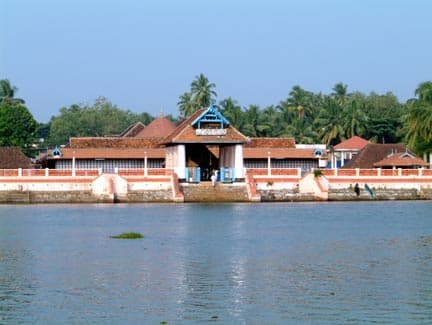
Thriprayar Temple
The Thriprayar Temple, also known as the Shree Ramaswami Temple, is a significant Hindu temple located in Triprayar, Thrissur district, Kerala, India. It is dedicated to Lord Rama, the seventh incarnation of Vishnu, who is depicted with four arms holding a conch, discus, bow, and garland. The temple's origin story involves the idol being worshipped by Krishna in Dwarka, later immersed in the sea, and eventually found by fishermen.