
Mookambika temple
The Mookambika temple is a significant Hindu shrine dedicated to the goddess Mookambika, an aspect of Adi Parashakti. Located in Kollur, coastal Karnataka, it is considered her most important abode and is venerated as Saraswati in the morning, Lakshmi at noon, and Parvati in the evening.
Key Facts
- ›The temple is dedicated to the Hindu goddess Mookambika, an aspect of Adi Parashakti.
- ›Mookambika is regarded as the form of Shakti representing creativity and ingenuity.
- ›The goddess is worshipped as Saraswati in the morning, Lakshmi at noon, and Parvati in the evening.
- ›The primary idol is believed to have been established by Adi Shankara.
- ›A popular legend links the goddess's presence to Adi Shankara's penance and a broken promise.
- ›The temple is located in Kollur village, Udupi district, in coastal Karnataka.

Mookambika, Adi Parashakti, Saraswati, Lakshmi, Parvati
Most Important Abode of Goddess Mookambika, Center For Veneration of Shakti, Pilgrimage Site
Adi Shankara
About Mookambika temple
The Mookambika temple is a prominent Hindu shrine dedicated to the goddess Mookambika, who is considered an aspect of Adi Parashakti, the supreme goddess in Hinduism. This temple is regarded as her most significant abode and is located in the village of Kollur, in the Udupi district of coastal Karnataka, India.
Mookambika is venerated as the embodiment of Shakti, the divine feminine energy, symbolizing creativity and ingenuity. The goddess is worshipped in different forms throughout the day: as Saraswati in the morning, representing knowledge and arts; as Lakshmi at noon, symbolizing wealth and prosperity; and as Parvati in the evening, embodying divine power and motherhood.
Legend states that the goddess acquired her name after defeating the asura Mookasura, who had been rendered speechless and thus unable to claim a boon from Shiva. The combined energies of the Trimurti (Brahma, Vishnu, and Shiva) and Tridevi (Saraswati, Lakshmi, and Parvati) culminated in the creation of Mookambika to restore cosmic balance.
The temple's sanctum sanctorum is believed to contain a linga with a golden line splitting it, representing the Trimurti and Tridevi. Adi Shankara is credited with establishing a vigraham (idol) of Mookambika behind this linga. Another popular legend connects Adi Shankara to the temple, suggesting that the goddess stayed at Kollur after he inadvertently broke a condition during his penance to establish her in Kerala.
Due to its religious importance and the legends associated with it, the Mookambika temple is a significant pilgrimage site, attracting devotees from Karnataka, Kerala, and Tamil Nadu.
Source: Wikipedia ↗
Frequently Asked Questions
Who is the primary deity worshipped at the Mookambika temple?
The primary deity worshipped at the Mookambika temple is the Hindu goddess Mookambika. She is considered an aspect of Adi Parashakti and is venerated as Saraswati in the morning, Lakshmi at noon, and Parvati in the evening.
What is the legend behind the goddess Mookambika?
According to legend, the goddess Mookambika acquired her name after slaying the asura Mookasura, who was rendered speechless by Goddess Saraswati. The Trimurti and Tridevi then combined their energies to create Mookambika to defeat him and restore cosmic balance.
What is the significance of Adi Shankara in relation to the Mookambika temple?
Adi Shankara is regarded to have found and established a vigraham (idol) of Mookambika behind the linga at the temple in Kollur. Another legend states that he established the goddess's presence there after a failed attempt to lead her to Kerala without looking back.
Where is the Mookambika temple located?
The Mookambika temple is located in Kollur village, in the Udupi district of Kundapura, within the Tulunadu region of coastal Karnataka, India.
How is the goddess Mookambika venerated throughout the day?
The goddess Mookambika is venerated in different forms throughout the day. She is worshipped as Saraswati in the morning, signifies knowledge and arts; as Lakshmi at noon, representing wealth and prosperity; and as Parvati in the evening, embodying divine energy and motherhood.
Related Temples (Hindu)

Taraknath Temple
The Taraknath Temple, located in Tarakeswar, West Bengal, India, is a significant Hindu pilgrimage site dedicated to Lord Shiva, worshiped here as Tarakanatha. Constructed in 1729, it features a distinct Bengal architectural style with an 'atchala' structure and an adjacent 'natmandir'. The temple is renowned for its belief that a dip in the nearby Dudhpukur tank fulfills prayers and is considered one of the 64 Jyotirlingas.

Tanot Mata Temple
The Tanot Mata Temple is a significant Hindu shrine located in the Jaisalmer district of Rajasthan, India, near the Pakistan border. Revered as a form of Goddess Hinglaj Mata, the temple is famously associated with the Indian victories in the Indo-Pakistani Wars of 1965 and 1971, with local folklore attributing the successful outcomes to divine intervention. The Border Security Force of India now manages the temple complex, which also includes a victory tower and a war museum.
Thriprayar Temple
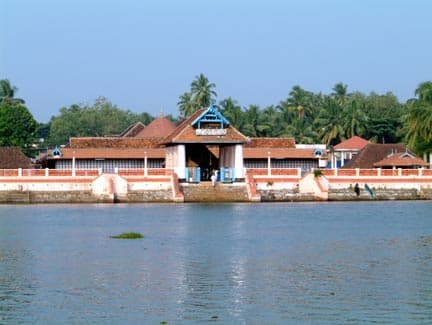
The Thriprayar Temple, also known as the Shree Ramaswami Temple, is a significant Hindu temple located in Triprayar, Thrissur district, Kerala, India. It is dedicated to Lord Rama, the seventh incarnation of Vishnu, who is depicted with four arms holding a conch, discus, bow, and garland. The temple's origin story involves the idol being worshipped by Krishna in Dwarka, later immersed in the sea, and eventually found by fishermen.