
Marudhamalai Subramanya Swami Temple, Coimbatore
12th-century·India
The Marudhamalai Subramanya Swami Temple, located in Coimbatore, Tamil Nadu, is a historic hill temple dedicated to Lord Murugan, considered the seventh in the list of the Six Abodes of Murugan. Situated atop a 600-foot granite hill and built by Tamil kings during the Sangam period, the temple is named after the native marudham tree found there. It is a significant pilgrimage site, known for its sacred springs and its association with the sage Pambatti Siddhar.
Key Facts
- ›The temple is dedicated to Lord Murugan, a form of Kartikeya.
- ›It is traditionally considered the seventh of the six Abodes of Murugan.
- ›The temple is situated on a 600-foot granite hill in the Western Ghats, west of Coimbatore.
- ›Its construction is attributed to Tamil kings during the Sangam period.
- ›Sacred springs, Maruda Theertham and Skanda Theertham, are believed to have medicinal properties.
- ›The temple is associated with Pambatti Siddhar, one of the 18 Tamil Siddhars.

Murugan
Pilgrimage Site, Historical Temple, Association With Pambatti Siddhar, One of the Six Abodes of Murugan
Thaipusam
Granite
Tamil Kings
Maruda Theertham, Skanda Theertham
About Marudhamalai Subramanya Swami Temple, Coimbatore
The Marudhamalai Subramanya Swami Temple, also known as Maruthamalai Marudhachalamurthy Temple, is a significant hill temple located in Coimbatore, Tamil Nadu, India. It is traditionally regarded as the seventh in the revered list of the Six Abodes of Murugan.
Historical Context and Construction
The temple's origins are traced back to the 12th century, with its construction attributed to Tamil kings during the Sangam period, as suggested by references in the Purananuru. It is dedicated to Lord Murugan, a prominent deity in Hinduism also known as Kartikeya. The temple is situated on a 600-foot tall granite hill, which forms part of the Western Ghats, approximately 12 kilometers west of Coimbatore's city center.
Etymology and Site Features
The name 'Marudhamalai' is derived from the native 'marudham' tree (Terminalia arjuna) that grows abundantly on the hill, combined with 'malai,' the Tamil word for hill or mountain. Unlike many other Murugan temples situated on hills, this temple is uniquely positioned on the eastern face of the mountain. The presiding deity is known by several epithets, including Marudhamalai Andavar, Marudachalapathi, and Dhandayuthanpani.
Sacred Waters and Spiritual Significance
Several sacred springs, known as theerthams, are found around the temple complex. Prominent among these are Maruda Theertham and Skanda Theertham, which are steeped in local belief and are said to possess medicinal properties. The temple is also closely associated with Pambatti Siddhar, one of the 18 Siddhars, a group of Tamil sages. Legend states that Pambatti Siddhar performed penance on this hill in the 12th century and received blessings from Lord Murugan. A tunnel is said to connect the main sanctum to the Siddhar's cave, which he is believed to have used for worship.
Practices and Administration
Festivals dedicated to Lord Murugan, such as Thaipusam, are celebrated with great fervor at the temple. Many evenings witness devotees participating in a chariot procession (ratha yatra) of Murugan around the temple premises. The Marudhamalai Subramanya Swami Temple is currently maintained and administered by the Hindu Religious and Charitable Endowments Department of the Government of Tamil Nadu, ensuring its continued role as an active place of worship and a vital pilgrimage destination.
Source: Wikipedia ↗
Frequently Asked Questions
What is the Marudhamalai Subramanya Swami Temple?
The Marudhamalai Subramanya Swami Temple is a significant hill temple dedicated to Lord Murugan, located in Coimbatore, Tamil Nadu. It is traditionally recognized as the seventh of the Six Abodes of Murugan and has a history dating back to the Sangam period.
What is the etymology of the name Marudhamalai?
The name Marudhamalai is derived from the native marudham tree (Terminalia arjuna) that grows on the hill, and 'malai,' which means hill or mountain in Tamil. The temple stands on a 600-foot granite hill also called Marudhamalai.
Who is the presiding deity at Marudhamalai?
The presiding deity is Lord Murugan, who is worshipped here under various names including Marudhamalai Andavar, Marudachalapathi, and Dhandayuthanpani. He is a form of Kartikeya.
What is the historical significance of the Marudhamalai Temple?
The temple is believed to have been built by Tamil kings during the Sangam period, with its origins indicated in the Purananuru. It is a historic site of worship for Lord Murugan.
Are there any sacred water bodies associated with the temple?
Yes, there are sacred springs or pools of water around the temple known as Maruda Theertham and Skanda Theertham. These are traditionally believed to possess medicinal properties.
What is the connection between the temple and Pambatti Siddhar?
The temple is associated with Pambatti Siddhar, a 12th-century Tamil sage who performed penance on Marudhamalai hill. Legend states that Lord Murugan appeared to him here, blessed him, and a connecting tunnel exists between the sanctum and Siddhar's cave.
Related Temples (Hindu)

Taraknath Temple
The Taraknath Temple, located in Tarakeswar, West Bengal, India, is a significant Hindu pilgrimage site dedicated to Lord Shiva, worshiped here as Tarakanatha. Constructed in 1729, it features a distinct Bengal architectural style with an 'atchala' structure and an adjacent 'natmandir'. The temple is renowned for its belief that a dip in the nearby Dudhpukur tank fulfills prayers and is considered one of the 64 Jyotirlingas.

Tanot Mata Temple
The Tanot Mata Temple is a significant Hindu shrine located in the Jaisalmer district of Rajasthan, India, near the Pakistan border. Revered as a form of Goddess Hinglaj Mata, the temple is famously associated with the Indian victories in the Indo-Pakistani Wars of 1965 and 1971, with local folklore attributing the successful outcomes to divine intervention. The Border Security Force of India now manages the temple complex, which also includes a victory tower and a war museum.
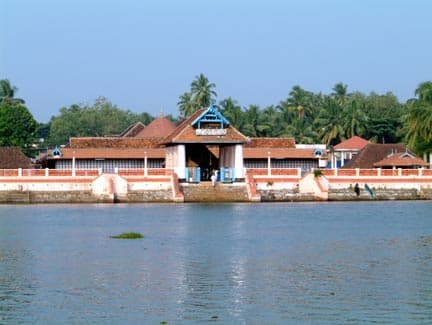
Thriprayar Temple
The Thriprayar Temple, also known as the Shree Ramaswami Temple, is a significant Hindu temple located in Triprayar, Thrissur district, Kerala, India. It is dedicated to Lord Rama, the seventh incarnation of Vishnu, who is depicted with four arms holding a conch, discus, bow, and garland. The temple's origin story involves the idol being worshipped by Krishna in Dwarka, later immersed in the sea, and eventually found by fishermen.